Month: March 2026

  • An Exchange Between Two Ways of Looking

    An Exchange Between Two Ways of Looking


    There are collectors who acquire.

    And there are those who live with objects for a long time before letting them go.


    Not long ago, an anthropologist came to see a Dogon figure.

    He didn’t come alone.

    He came with his wife, and they spent time with the piece — quietly, without deciding.

    Nothing happened that day.

    Which, in hindsight, was already meaningful.


    Two weeks later, he returned.

    This time, not to negotiate.

    But with a different kind of proposal.

    He was ready to let go of pieces he had lived with for years, in order to take one with him.


    An anthropologist looks differently.

    Not in terms of categories or completeness.

    But in terms of use.

    How an object has been handled.
    Returned to.
    Integrated into a life.

    And over time, that changes what is kept.


    The group that came from this exchange was not assembled.

    It had already taken shape, slowly, over years.

    African, but not only African.

    Objects that lived alongside Oceanic works, Pre-Columbian pieces, and traces of archaeology.

    Not separated, but understood in relation.


    That kind of collecting leaves marks.

    Not always visible at first.

    But present in the surface.
    In the choices.
    In what was not discarded.


    Some pieces reveal themselves immediately.

    Others take longer.

    Those are often the ones that remain.


    Looking back, the exchange was simple.

    Not a transaction.

    But a moment where two ways of seeing aligned — just long enough for objects to change hands.


    Below are some of the pieces that came from that moment. (click on the images to enlarge)


    If one of these speaks to you, feel free to get in touch.

    I’ll be happy to share more images, provenance, or details.


    Happy and curious,
    David Norden

    Antique Dan Mask with Original Textile Remains

    Share and Enjoy !

    Shares
  • How to Train Your Eye in African Art: 3 Practical Tips for Collectors

    How to Train Your Eye in African Art: 3 Practical Tips for Collectors

    Chibinda Ilunga figure, Chokwe, Angola — Museum RietbergThis article is based on a recent newsletter I sent to collectors. 


    Over the years, I’ve noticed that most collectors are not lacking interest — they are lacking orientation.

    Where do you look?
    What do you trust?
    And how do you train your eye?

    In this guide, I share three practical directions that I personally use — and that can quietly transform the way you see African art.


    1. Train Your Eye: Use Museum Collections

    Figure of the culture hero Chibinda Ilunga, Workshop of the Chokwe region, Angola, around 1850 Wood, Museum Rietberg, 2007.1, Gift acquired through Novartis 5 2007.1

    If there is one habit I would recommend to any collector, it is this: spend time with museum collections.

    Not only in person — but also online.

    Today, many major institutions offer access to thousands of documented objects. You can study proportions, surfaces, patina, and even small details that rarely appear in books.

    In the guide below, you’ll find direct and active links to museum databases, along with a selection of objects that I personally find particularly interesting.

    Over time, something shifts — you begin to recognise what feels right… and what doesn’t.

    → Explore museum collections

    Collector insight:
    The more time you spend with strong, documented objects, the more confident your decisions become when a good piece appears.


    2. Understand What You Are Really Looking At

    One of the most common mistakes I see is confusion between authentic objects and decorative pieces.

    The difference is not always obvious — especially at the beginning.

    But authentic objects tend to have a certain internal coherence:
    the proportions make sense, the wear follows use, the surface has depth, and the object carries a presence that is difficult to imitate.

    In the article below, I explain how I approach this distinction in practice:

    → Read the article on authenticity

    Collector insight:
    Once you have seen enough authentic pieces, decorative ones start to feel strangely empty — even when they look convincing at first glance.


    Ibibio chanel mask

    Ibibio “Chanel” mask — Nigeria

    A Piece That Caught My Eye

    While writing this, I was reminded of a mask I have kept in the collection for some time — an Ibibio “Chanel” mask.

    At first glance, it may seem unusual or even playful. But if you take a closer look, you begin to see the coherence in the carving, the balance in the proportions, and the way the surface has evolved through handling and use.

    It is also a good example of how African artists could absorb and reinterpret external influences, while remaining rooted in their own visual language.

    This is exactly the kind of object where experience matters — not because it is obvious, but because it reveals itself over time.

    → View the Ibibio mask


    3. Be Careful with Labels

    African art is often simplified — sometimes too much.

    Certain names are used so loosely that they can become misleading.

    Take the Kuba, for example.

    Behind this single label lies a complex network of workshops, styles, and neighbouring cultures. Not everything labelled “Kuba” is what you might expect — and understanding that can completely change how you evaluate an object.

    In the article, I also touch on the figure traditionally associated with the founding of the Kuba Kingdom, and why that history still matters when looking at objects today.

    If you want to look beyond the label and discover the story behind it:

    → Read the Kuba article

    Collector insight:
    Collectors who rely too much on names often miss good objects — or overpay for average ones.


    A Final Thought

    Collecting is not about owning many objects.

    It is about learning to recognise the right ones — and having the confidence to act when you see them.

    Even after 30 years, I still return to museum collections, compare objects, and refine my eye.

    If you would like to explore pieces selected through that same process:


    Happy and curious,
    David Norden

    African Antiques From Antwerp — One Eye, 30 Years of Selection
    Personally chosen with curiosity and experience — so you can collect with confidence.

    Share and Enjoy !

    Shares
  • Museums Databases with Important African Art Collections

    Museums Databases with Important African Art Collections

    This guide for collectors and enthusiasts reflects how I personally use museum collections as a collector and dealer to evaluate and understand African art.

    It is illustrated with a selection of objects that have particularly caught my eye.

    Over the years, many collectors have asked me how to distinguish genuine African art from purely decorative pieces.

    In essence, it comes down to recognition — building a visual memory by studying important collections, well-curated auctions, and fairs where you can see, touch, and even smell the objects.

    But above all, it comes from visiting museums.

    Below is a selection of museums with significant African holdings. Some are well known, others less so, but all are worth exploring. Whenever possible, I include direct links to the online collections, which are extremely valuable for research and comparison, as well as interesting references to historical photographs taken in situ.


    Major International Museums

    Metropolitan Museum of Art — New York

    Nsiba (whistle) for a hunter or diviner
    Nsiba (whistle) from Kongo for a hunter or diviner. On view at The Met Fifth Avenue in Gallery 344

    Main website
    https://www.metmuseum.org

    details on the collections:

    https://www.metmuseum.org/art/collection

    Online african art collection

    https://www.metmuseum.org/art/collection/search?q=african+art

    The Metropolitan Museum houses one of the most important African art collections in the world. The recently reinstalled Michael C. Rockefeller Wing presents masterpieces from West and Central Africa including Fang reliquary figures, Yoruba sculpture and Kongo power figures. The Met’s digital collection is one of the most powerful research tools available to collectors.


    Musée du Quai Branly – Jacques Chirac — Paris

    Main website
    https://www.quaibranly.fr

    Collection database
    https://collections.quaibranly.fr

    The Quai Branly holds one of the largest collections of African art in Europe, with tens of thousands of objects. Its digital catalogue allows detailed searches across cultures, regions and materials.


    British Museum — London

    Main website
    https://www.britishmuseum.org

    Collection database
    https://www.britishmuseum.org/collection

    You can do a virtual visit of the African Art alleries, and much more (like listening to podcasts):

    https://www.britishmuseum.org/collection/galleries/africa

    The British Museum’s African collections include archaeological objects, sculpture, textiles and royal regalia. Particularly famous are the Benin bronzes, which continue to play an important role in discussions about cultural heritage and restitution.


    National Museum of African Art — Washington D.C.

    Main website
    https://africa.si.edu

    https://africa.si.edu/africa

    Collection database
    https://africa.si.edu/collection

    Discover also the most interesting Eliot Elisofon Photographic Archives

    https://africa.si.edu/archives

    Collection GORLIA Emile, 1909
    In the Chokwe country-side A village [graphic] :Photo: Gorlia around 1910

    Part of the Smithsonian Institution, this museum is entirely dedicated to African art. Its collection includes both traditional sculpture and modern works.


    Baltimore Art Museum BMA

    Male Mask Kifwebe Nooter BMA 1984.84

    A spectacular early male Kifwebe mask 1984 gift of Robert and Nancy Nooter, Washington, D.C.

    One of the most important collections of African art in the United States, the BMA’s African art collection features works from more than 200 African cultures in a full range of media.

    https://artbma.org/collection/african-art

    African Art database:

    https://collection.artbma.org/collections/3197/african/objects

    10 Art Museum Drive, Baltimore, MD 21218


    Important European Collections

    Royal Museum for Central Africa — Tervuren

    Main website
    https://www.africamuseum.be

    Spotlight on the collections
    https://www.africamuseum.be/en/discover/focus_collections

    Photographer Henri Goldstein1956 Bambulu Maniema HP1956 32
    Photographer Henri Goldstein1956 Bambulu Maniema HP1956 32

    Located near Brussels, this museum holds one of the most extensive collections of Central African objects anywhere in the world, including masks, sculptures, textiles and ritual objects from the Congo basin. It is also used by everyone having an interest in the old colony of Congo resources, and is today also actively working with the diaspora


    Pitt Rivers Museum — Oxford

    Main website
    https://www.prm.ox.ac.uk

    Online collections
    https://www.prm.ox.ac.uk/collections-online#/search

    Collections & many research projects

    https://www.prm.ox.ac.uk/collections-research-sites

    Online database:

    https://www.prm.ox.ac.uk/collections-online#/search

    Screenshot 2026 03 19 at 09 45 06 Collections online Pitt Rivers Museum
    Luba stool Collections online. Given in 1911 to the Pitt Rivers Museum.

    The Pitt Rivers Museum is famous for its unique display style and its enormous ethnographic holdings. The online database provides access to a wide range of African objects collected over the last century.


    Sainsbury Collection at Norwich UK

    on line database

    https://sainsburycentre.ac.uk/?s=&aos=1&production_place=Africa

    A XVIth century sceptre : https://sainsburycentre.ac.uk/art-and-objects/231-royal-sceptre/

    more 3D objects from Sainsbury

    https://sketchfab.com/sainsbury-centre/collections/african-art-5da6531a347c4ed594c1ac43ec44fc23

    The University of East Anglia also have a good Centre for African Art and Archaeology

    https://www.uea.ac.uk/groups-and-centres/centre-for-african-art-and-archaeology


    Wereldmuseum — Leiden

    J.A. (José Augusto) da Cunha Moraes (Fotograaf)
    J.A. (José Augusto) da Cunha Moraes (Fotograaf) around 1880

    Main website
    https://www.wereldmuseum.nl

    African continent Collection database

    https://collectie.wereldmuseum.nl/#/query/3793eb72-4dca-4d2e-a139-8803b7e23e4d

    Formerly known as the National Museum of Ethnology, the Wereldmuseum holds extensive ethnographic collections from Africa gathered during the nineteenth and early twentieth centuries.


    Museum Rietberg — Zurich

    Main website
    https://rietberg.ch/en

    Collections
    https://rietberg.ch/en/collections

    Africa Art Archive (Himmelheber archive)
    https://africa-art-archive.ch

    The Museum Rietberg in Zurich is one of the most important museums in Europe devoted to non-European art. Its African collection contains around 2,400 objects, mainly from West and Central Africa, covering more than six centuries of artistic traditions.

    Figure of the culture hero Chibinda Ilunga, Workshop of the Chokwe region, Angola, around 1850 Wood, Museum Rietberg, 2007.1, Gift acquired through Novartis 5 2007.1
    Figure of the culture hero Chibinda Ilunga, Workshop of the Chokwe region, Angola, around 1850 Wood, Museum Rietberg, 2007.1, Gift acquired through Novartis

    What makes this museum especially valuable, from a collector’s point of view, is its archive related to African art scholarship. One of the most notable is the Hans Himmelheber archive, which contains thousands of field photographs, films and documents related to African artists and workshops.

    https://africa-art-archive.ch/en/


    Screenshot 2026 03 19 at 10 00 08 Ein ungehobener Schatz Einblicke ins Fotoarchiv – Africa Art Archive
    Ein ungehobener Schatz: Einblicke ins Fotoarchiv. Museum Rietberg

    For collectors and researchers, the Rietberg museum provides an important perspective on African art history and collecting traditions in Europe.


    Musée d’Ethnographie de Genève (MEG)

    https://www.meg.ch/en

    Collections Research

    https://www.meg.ch/en/research-collections

    African Art database

    https://collections.geneve.ch/meg/catalogue/en/musinfo00.php?dpt=ETHAF

    The MEG in Geneva houses important ethnographic collections including masks, ritual objects and ceremonial sculptures from across Africa.


    Museums in Africa

    Nigerian National Museum — Lagos

    https://lagosmuseum.ng/home

    Nigeria’s national museum preserves important archaeological and cultural treasures including Nok terracottas and Yoruba sculptures. It plays a key role in preserving and studying Nigerian cultural heritage.

    Objects in wood database:

    https://lagosmuseum.ng/collections/3696c6d7-b8b0-44a7-be6a-e6d28b6d1dfd


    The Théodore Monod African Art Museum (Musée Théodore Monod d’Art africain)

    in Dakar, Senegal is one of the oldest art museums in West Africa. It was promoted by Léopold Senghor, the country’s first President.

    The museum has more than 10,000 items, traditional and contemprary. It also host scientific events, and works with international institutions .

    The Théodore Monod Museum of African Art, Dakar


    J. RANDLE CENTRE Yorùbá Heritage

    A museum about Yoruba art, traditions and masquerades.
    https://www.jrandlecentre.com
    Lagos Island, Lagos 102273, Lagos. +234 807 891 8190. museum@jrandlecentre.com

    See a little video about the Yoruba museum

    https://www.dw.com/en/lagos-museum-highlights-yoruba-cultural-heritage/video-71392477 

    and if you have time read my little Yoruba Horseman Legend

    The Yoruba Horseman: A Legend of the Rider


    National Museum of Lubumbashi

    AI Overview
    The
    National Museum of Lubumbashi (Musée national de Lubumbashi) is located at 750 Avenue du Musée, Lubumbashi, Democratic Republic of the Congo. It is known for its extensive collection of ethnographic, archaeological, and contemporary art, housed in a distinctive building designed by Claude Strebelle

    National Museum of Lubumbashi


    Ethnographic Museum of Rwanda

    Rwanda Ethnographic Museum

    Make a virtual visit of the museum

    https://ethnographic.rwandaheritage.gov.rw/

    Africa itself holds many more important museums and collections — far more than can be listed here.


    Lesser-Known Museums with Valuable African Collections

    Many collectors are familiar with the large institutions in Paris, London or New York, but a number of other museums also hold remarkable African objects and sometimes provide excellent online access.

    For collectors and researchers, smaller museum databases often contain fascinating objects that rarely appear in publications. They can help identify regional styles, compare carving traditions, and sometimes reveal historical provenance information.

    These institutions are often overlooked but can be extremely useful for research and comparison. Exploring these lesser-known collections can lead to surprising discoveries and a deeper appreciation of African artistic traditions.


    Museum aan de Stroom (MAS) — Antwerp

    Being based in Antwerp myself, I enjoy browsing the MAS collection regularly. It sometimes reveals objects connected to Belgium’s early collecting history and the long relationship between Antwerp and Central Africa.

    Screenshot 2026 03 19 at 10 55 05 (PNG afbeelding 360 × 720 pixels) Geschaald (99%)
    This Luba bowl entered the Mas collection of African Art in 1958. The bowl was filled with white clay and other objects of power.

    Online collection database
    https://search.mas.be/search/simple

    The MAS museum in Antwerp has made its entire collection accessible online. More than 600,000 objects can be searched through the database, including African masks, sculptures and ethnographic material.

    One particularly interesting aspect of the MAS database is that it includes not only objects currently on display but also those kept in storage.

    Ofika Mbole Mas Museum Henry Pareyn
    Ofika Mbole Mas Museum Henry Pareyn

    You can search in the database for the objects from Henry (Henri) Pareyn wo started collecting and dealing in African art (mostly from the Belgian Congo) in the 1890s.

    Based in Antwerp, he amassed huge collections. Two major sales took place during his lifetime: in around 1910 and notably, in 1920 when the City of Antwerp purchased 1600 ‘Congo objects of all kinds’ which formed the basis of the Antwerp Ethnography Museum’s Central African collections. After his death in 1928, his widow offered his entire collection to the City of Antwerp for 350,000 Belgian Francs. This offer was declined and the collection was put up for auction at the Grand Hotel, Antwerp in 10-15 December 1928.

    This 5 day auction with almost 2,000 lots raised 2,000,000 Belgian Francs. Many of the lots were sold to external buyers, among them Sir Henry Wellcome (from whom much came to the BM). See Waterfield & King p.71 for a rumour that an English dealer had bought half the sale for Sir Henry Wellcome. The lot numbers of items in the Pareyn sale were written in ink on a white paper disc that was pasted to the front of the object; this enables many of Wellcome’s purc hases from the Pareyn sale to be recognised, like also Henry Pareyn in the Fowler museum.


    Museu Nacional de Etnologia — Lisbon

    Museu Nacional de Etnologia Lisboa Portugal
    Museu Nacional de Etnologia Lisboa Portugal

    Museum website
    https://museudeetnologia.pt/in-english/

    Portugal’s National Museum of Ethnology holds important collections from Africa, especially from former Portuguese territories such as Angola, Mozambique and Guinea-Bissau. The museum preserves valuable documentation of traditional cultures and colonial collecting history.


    Museum of the Lisbon Geographical Society — Lisbon

    This museum is rarely mentioned in discussions of African art but and can only be visited by appointment, but it contains remarkable historical collections gathered during Portuguese exploration and colonial expeditions. Among the highlights are impressive Congo and Chokwe materpieces objects . The museum of the Lisbon Geographical Society is one of the best-kept secrets in Lisbon. It inherited its collection from what was once the “Colonial Museum” and assumed an ethnographic focus from early on. It grew through a campaign of acquisitions and the donations of collectors and travellers who accompanied the Portuguese outposts in the former empire. Discover ceramics, sculptures, furniture, paintings, fabrics, glass, tiles and even scientific instruments from the most disparate of sources: Angola, Guinea, Mozambique, São Tomé and Príncipe, Cape Verde, Timor and Macau. A unique exhibition, which brings together art and scientific/everyday objects and which shows the habits and depictions of distant lands. Be a 21st-century explorer and travel in time at this 19th-century society.

    Rua das Portas de Santo Antão, 100, 1150-269, Lisboa


    Minneapolis Institute of Art — Minneapolis

    Artsmia Congo power figure 4002302
    Arts mia Congo power figure 4002302

    Department of African Art
    https://new.artsmia.org/art-artists/curatorial-departments/department-of-the-arts-of-global-africa

    Online database:

    https://collections.artsmia.org/search/_exists_:%22list:african-art-highlights%22

    The Minneapolis Institute of Art has developed one of the strongest African art collections in the United States. The museum is known for carefully selected masterpieces and scholarly exhibitions devoted to African sculpture.


    Fowler Museum at UCLA — Los Angeles

    Online collections database
    https://argus.fowler.ucla.edu/final/Portal/Default.aspx?lang=en-US

    The Fowler Museum is highly respected among scholars of African and Oceanic art. Its digital database includes many objects from Africa some also from Henry Pareyn and often provides good photographic documentation.

    Lega art congo jay last collection fowler museum

    I remember that I got a wonderfull  and instructive private viewing from the  curator during an exhibition they did in Paris in collaboratin with the Quai Branly Museum about the Lega objects from the  Jay Last collection.


    Fine Arts Museums of San Francisco (de Young Museum)

    Luba artist, Figure, 19th century, Democratic Republic of Congo. Wood, metal, and fiber, 10 1/4 x 2 x 1 7/8 in. (26 x 5.1 x 4.8 cm). Fine Arts Museums of San Francisco, Gift of Richard Scheller, 2019.1
    Luba artist, Figure, 19th century, Democratic Republic of Congo. Wood, metal, and fiber, 10 1/4 x 2 x 1 7/8 in. (26 x 5.1 x 4.8 cm). Fine Arts Museums of San Francisco, Gift of Richard Scheller, 2019.1  A Luba Figure: An Expression of Ideals of Beauty and a Locus for Memory

    Collection search
    https://www.famsf.org/art/collections

    The de Young Museum holds a significant African art collection, particularly strong in West African sculpture. Its digital catalogue allows visitors to explore objects from many regions of the continent.


    Horniman Museum — London

    Tanzania figure-Horniman Museum
    Tanzania figure-Horniman Museum

    Anthropology collection
    https://www.horniman.ac.uk/explore-the-collections/anthropology-collection/

    The Horniman Museum has an important ethnographic collection that includes African masks, musical instruments and ritual objects collected during the late nineteenth and early twentieth centuries.


    Need to discover more African Art museums around the World ?

    https://en.wikipedia.org/wiki/Category:African_art_museums


    Specialized Research Archives Used by Scholars and Professionals

    Beyond museum collections, several digital archives are extremely valuable for serious research on African art.


    Yale University Art Gallery — African Art Digital Archives

    https://artgallery.yale.edu/research-and-learning/curatorial-areas/african-art/african-art-digital-archives

    The Yale archives include the Van Rijn Archive up to 2012 for free and the Ross Archive, which contain historical photographs before 1920’s, field documentation and research material related to African art collecting and scholarship. These archives are widely used by researchers.

    8.990 items images from before 1921 from the Ross Archives

    https://www.jstor.org/site/yaleuniversitylibrary/rossarchiveofafricanimages-yuag/


    AHDRC — African Heritage Documentation & Research Centre

    https://ahdrc.org/

    The AHDRC is one of the most important digital research platforms dedicated to African art. The archive contains thousands of historical photographs, field documentation and publications, and allows also to get access to the price history and exhibitions and publications the objects where in and has a good search engine.

    Access is subscription-based (approximately €250 per year) and the platform is widely used by professional researchers, dealers and scholars.

    To get a taste, on Jstor you can access for free the database updated till 2012, and search among 111.580 items

    https://www.jstor.org/site/yaleuniversitylibrary/yuag-van-rijn-archive-african-art/


    Artkhade

    https://artkhade.com

    Artkhade provides a digital platform for cataloguing artworks at auctions and collections and is used by museums, galleries and collectors to manage documentation and provenance information. It is increasingly used within the professional art world for price setting.


    Why Museum Databases Matter for Collectors

    Museum collections remain one of the most valuable resources for anyone interested in African art. They allow collectors to:

    • compare objects with documented museum examples

    • study regional styles and carving traditions

    • explore historical provenance information

    • examine high-quality photographs of important works

    Many museums now provide high-definition images, and some allow images to be used for scholarly or educational purposes. These digital collections have become an essential tool for collectors, researchers and enthusiasts who wish to deepen their understanding of African sculpture.

    Even after many years working with African art, I still find museum collections — both in person and online — an endless source of discovery. If you know other museum databases with strong African art collections, feel free to let me know. I am always interested in discovering new resources.

    And if this article has made you curious to go further, you can explore a selection of African masks and figures — each chosen through the same eye I’ve developed over 30 years of looking:

    African masks and figures in the shop.


    Additional Museums Suggested by Collectors

    Following the publication of this guide, several collectors kindly shared additional museums worth exploring. Many of these are less frequently discussed but can offer valuable insights for collectors and researchers.


    🇬🇧 United Kingdom

    Sainsbury Centre for Visual Arts — Norwich

    Main website: https://www.sainsburycentre.ac.uk

    Collection: https://www.sainsburycentre.ac.uk/art-and-objects/

    Located at the University of East Anglia, this museum combines African, Oceanic and modern art in a very refined setting designed by Norman Foster.

    👉 Particularly interesting for collectors because of its clarity of display and emphasis on form, allowing objects to be studied almost as sculpture.


    Royal Albert Memorial Museum — Exeter

    Main website: https://rammuseum.org.uk

    Collections: https://rammuseum.org.uk/collections/

    A regional museum with well-curated world cultures galleries.

    👉 A reminder that important objects are not only in major capitals, and often easier to study in quieter environments.


    World Museum — Liverpool

    Main website: https://www.liverpoolmuseums.org.uk/world-museum

    Collections: https://www.liverpoolmuseums.org.uk/collections

    Liverpool’s history as a major trading port is reflected in its collections, including African material gathered through maritime networks.

    👉 Particularly useful for understanding historical collecting contexts and trade routes.


    Horniman Museum — London

    Main website: https://www.horniman.ac.uk

    Collections: https://www.horniman.ac.uk/explore-the-collections/

    Although much has changed in recent years, the Horniman still holds important African material.

    👉 Worth exploring for early ethnographic collections and historical depth.


    National Museum of Scotland — Edinburgh

    Main website: https://www.nms.ac.uk

    Collections: https://www.nms.ac.uk/explore-our-collections/

    The museum holds a wide range of ethnographic objects, including African works, though they are dispersed across different galleries.

    👉 Valuable for unexpected discoveries rather than focused study.


    Brighton Museum & Art Gallery — Brighton

    Main website: https://brightonmuseums.org.uk/brighton-museum/

    Collections: https://brightonmuseums.org.uk/discover/collections/

    Known for its World Art collection, although much remains in storage.

    👉 A useful reminder that museum databases often reveal far more than what is displayed.


    Powell-Cotton Museum — Kent

    Main website: https://powell-cottonmuseum.org

    Collections: https://powell-cottonmuseum.org/the-collection/

    A smaller museum with strong holdings from East Africa, collected by Percy Powell-Cotton.

    👉 Particularly interesting for field-collected material and early colonial-era documentation.


    🇺🇸 United States

    American Museum of Natural History — New York

    Main website: https://www.amnh.org

    African collections overview: https://www.amnh.org/research/anthropology/collections/collections-history/african-ethnography

    The AMNH holds one of the most important ethnographic collections in the world, including a celebrated Mangbetu collection and extensive photographic archives.

    👉 Particularly valuable for historical field documentation and early collecting context.


    🇩🇪 Germany

    Germany holds some of the most important ethnographic collections in Europe.


    Ethnologisches Museum — Humboldt Forum, Berlin

    Main website: https://www.humboldtforum.org

    Online collections: https://sammlungenonline.humboldtforum.org/en

    One of the largest ethnographic collections in the world, with around 500,000 objects, including approximately 75,000 from Africa

    👉 The online database allows access to a large number of objects and is an essential research tool.


    Rautenstrauch-Joest Museum — Cologne

    Main website: https://www.rjm-koeln.de

    Collections: https://www.rjm-koeln.de/en/collection/

    A highly regarded ethnographic museum with strong African holdings and well-researched exhibitions.

    👉 Particularly valuable for contextual interpretation and contemporary perspectives.


    Linden-Museum — Stuttgart

    Main website: https://lindenmuseum.de

    Collections: https://www.lindenmuseum.de/en/collection/

    One of Germany’s major ethnological museums, with extensive African collections.

    👉 Worth visiting for depth and historical breadth.


    Weltkulturen Museum — Frankfurt

    Main website: https://weltkulturenmuseum.de

    Collections: https://weltkulturenmuseum.de/en/collections/

    Combines historical collections with contemporary research and artistic dialogue.

    👉 Interesting for bridging traditional and contemporary perspectives.


    MARKK Museum am Rothenbaum — Hamburg

    Main website: https://markk-hamburg.de

    Collections: https://markk-hamburg.de/en/collections/

    Formerly the Museum für Völkerkunde, historically one of the major ethnographic museums in Europe.

    👉 Important for historical collections, though its presentation has evolved significantly.


    🇪🇺 Other European Museums

    Museum of Ethnography — Budapest

    Main website: https://neprajz.hu/en

    Collections: https://collections.neprajz.hu

    Associated with the work of Emil Torday, an important early collector of African material.

    👉 Particularly relevant for Central African collections and early fieldwork history.


    Bernisches Historisches Museum — Bern

    Main website: https://www.bhm.ch

    Collections: https://www.bhm.ch/en/collections/

    Holds diverse ethnographic material including African and Oceanic objects.

    👉 Also notable for historical links to exploration and collecting.


    Museo delle Civiltà (formerly Pigorini) — Rome

    Main website: https://museodellecivilta.cultura.gov.it

    Collections: https://museodellecivilta.cultura.gov.it/en/collections/

    One of Italy’s most important ethnographic museums, with significant African collections.

    👉 Particularly relevant for colonial-era collecting and documentation.


    Final Note

    These additional museums confirm something I have learned over the years: good objects are not only found in the major institutions.

    Often, it is in lesser-known collections that you begin to recognise subtleties — variations in style, unusual forms, or objects that have not yet been widely published. For a collector, this is where the eye sharpens.

    If you have the opportunity, I would encourage you to visit some of these museums, explore beyond the obvious, and, whenever possible, meet local collectors along the way.

    And if your travels lead you to interesting discoveries — whether in museums or private collections — I would be very interested to hear from you. Exchanges between collectors are often where the most meaningful pieces change hands.

    I am always open to discussing objects, helping to place important pieces, or simply sharing thoughts about what you have seen.

    Share and Enjoy !

    Shares
  • Authentic African Art: Masks, Figures and Ritual Objects for Collectors

    Authentic African Art: Masks, Figures and Ritual Objects for Collectors

    Traditional African art is one of the most powerful artistic traditions in the world. Across hundreds of cultures and thousands of communities, artists created masks, sculptures, and ritual objects that served social, spiritual, and political purposes.

    Unlike modern decorative art, authentic African art was created to function inside living traditions. Masks danced in ceremonies, figures protected villages, and ritual objects mediated between the living and the ancestors.

    For collectors today, these objects offer something rare:
    a chance to hold a piece of cultural history shaped by belief, ritual, and time.

    For more than 30 years, I have helped collectors discover authentic traditional African art through my gallery in Antwerp and through my website:

    Browse the collection →
    https://buyafricanantiques.com/shop/


    African Masks: The Living Faces of Ritual

    Among the most recognizable forms of African tribal art are masks.

    But masks were never simply sculptures.
    They were part of performances involving costume, dance, music, and community participation.

    When worn during ceremonies, a mask allowed the dancer to embody:

    • ancestral spirits

    • mythological beings

    • protective forces

    • social characters within the community

    Many of the most striking African masks combine stylized abstraction with deep symbolic meaning.

    Example from the collection

    Bena Biombo Chameleon Helmet Mask

    https://buyafricanantiques.com/product/bena-biombo-mask/

    This rare helmet mask from the Bena Biombo people of the Congo features distinctive chameleon-like eyes symbolizing transformation and adaptability. Masks like this were used during royal funerary ceremonies and masquerades that connected the living community with ancestral spirits. ‘read also the article about the Kuba tribe since they are not what you think. 

    Other masks currently available include:

    Each mask reflects the unique artistic language of its culture.


    African Sculptures and Figures

    Across many African traditions, carved figures were used as spiritual intermediaries.

    These sculptures could represent:

    • ancestors

    • protective spirits

    • fertility forces

    • ritual guardians

    Rather than decorative statues, these figures were often kept in shrines, consulted by diviners, or used to protect families and villages.

    Example: Lobi Ritual Sculpture

    Double Head Dayir Lobi Figure – Burkina Faso

    https://buyafricanantiques.com/product/double-head-dayir-lobi-figure-burkina-faso/

    This impressive sculpture represents the ancestral couple of the Lobi clan and was traditionally placed in shrine spaces where it protected the community and embodied ancestral authority.

    Another fascinating example of Lobi artistic tradition is this iron sculpture:

    Lobi Iron Bird

    https://buyafricanantiques.com/product/a-lobi-iron-bird/

    Hand-hammered by a Lobi blacksmith, the bird represents the remarkable metalworking skills of West African artisans and reflects the symbolic role animals play in African cosmology.

    Other sculptural objects currently available include:

    Each object carries its own cultural narrative and history of use.


    The Materials of African Tribal Art

    African artists worked with a wide range of materials depending on regional traditions and available resources.

    Art form Typical materials Cultural role
    Masks Wood, pigments, raffia Ritual dances and masquerades
    Figures Wood, iron, terracotta Ancestors, protective spirits
    Metal objects Iron, bronze, brass Prestige objects and ritual implements
    Dolls and figures Wood and beads Fertility and spiritual symbolism

    These materials were rarely chosen for decoration alone.
    They were selected for their symbolic meaning and ritual function.


    How African Art Influenced Modern Art

    When European artists encountered African masks and sculptures in the early twentieth century, the impact was profound.

    Artists such as Picasso and Modigliani were inspired by the bold geometry, stylized faces, and expressive power of African sculpture. These encounters helped shape movements such as Cubism and modernism.

    But what fascinated these artists was not merely style.

    It was the realization that in African cultures art was inseparable from life, ritual, and belief.


    Collecting Authentic African Art Today

    Today, the biggest challenge for collectors is distinguishing authentic traditional objects from decorative reproductions.

    Many pieces offered online were made for the tourist market and were never used in African communities.

    Recognizing genuine objects requires experience:

    • knowledge of carving traditions

    • understanding of surface and patina

    • familiarity with ritual use and cultural context

    After more than three decades working with African art, I still find that the most reliable guide is simply this:

    having seen thousands of objects over many years.

    That experience shapes the selection you see on my website.


    Explore Authentic African Masks and Sculptures

    If you would like to explore authentic African art currently available, you can browse the collection here:

    View the shop →
    https://buyafricanantiques.com/shop/

    You will find:

    • traditional African masks

    • ancestral figures

    • ritual sculptures

    • rare tribal objects from across the continent

    Each piece is carefully selected and described with its cultural context.


    A Personal Invitation to Collectors

    If you are looking for a particular type of African mask or figure, feel free to contact me.

    After more than 30 years in this field, I may know where it is hiding.

    Many collectors who visit the site are not simply buying an object —
    they are building a relationship with a tradition.

    And sometimes the right piece appears only when someone is looking with the right eye.

    Happy collecting,

    David Norden
    BuyAfricanAntiques.com
    Antwerp

    Share and Enjoy !

    Shares
  • The Kuba Are Not What You Think

    The Kuba Are Not What You Think

    Most people think they understand what “Kuba” means.

    A tribe. A style. A familiar category.

    But that’s usually where the misunderstanding begins.

    What we call the Kuba is not a single people in the usual sense. It is a kingdom — or more precisely, the result of one. Nearly twenty different groups, brought together and held within a structure that did not exist before. (https://en.wikipedia.org/wiki/Kuba_Kingdom)

    And that structure still shows in the objects.

    If you spend enough time with Kuba work, you begin to notice something subtle. Even when a surface feels playful, even when a pattern seems to wander, there is always a sense that it could not have been otherwise.

    That feeling has a beginning.

    In the early 17th century, this was not yet a kingdom. It was a region of separate groups, without a real center. Then a man appeared — or returned, depending on the version of the story.

    His name was Shyaam a-Mbul a Ngoong. He ruled circa 1625-1640) and  is remembered as the founder of Kuba civilisation, but not because he simply took power. What he did was more interesting than that. He reorganized what existed. He introduced titles, created a court, and brought different groups into a single system. (https://encyclopaediaafricana.com/shyaam-ambul-angoong/)

    Some accounts describe him as an outsider, even someone who had to disguise himself and move carefully before taking control. Others emphasize that he travelled, learned from other kingdoms, and returned with knowledge that allowed him to reshape the region. (Encyclopaedia Africana)

    Either way, the result is clear.

    What had been a collection of communities became something ordered. A court. A system with roles, hierarchy, and continuity.

    And once that exists, everything changes. Because art is than no longer just made as such. It takes its place in the society.

    At the Kuba court, objects are tied to position and recognition. Surfaces are not simply decorated — they are worked, built, adjusted, until they sit exactly where they need to be.

    The masks are made to welcome people from neighboring tribes and tell the stories from the Kuba.

    Even the textiles, which at first glance feel free, are the result of collaboration and control. The woven base and the embroidered surface come together slowly, within a shared understanding of pattern and variation.

    You begin to see that what looks spontaneous is often deeply informed.


    About the Masks

    The masks belong to this same world, but they move within it differently.

    At the Kuba court itself, masks are part of performance. They appear in dances that tell stories about origin, power, and legitimacy. They are not simply representations of spirits — they stage relationships.

    But as you move outward, into related groups, the tone shifts.

    The Lele, the Bena Biombo, and others remain connected to this broader cultural field, yet they resolve it in their own way. The forms are familiar — helmet structures, raffia, strong volumes — but the balance changes.

    Some feel more restrained. Others more direct.

    And that is where things become interesting.

    Because you are no longer looking at a single style, but at a language spoken differently across neighboring groups.


    This mask here

    Image

    Helmet Mask, 20th Century Bena Biombo people Bowers Museum.

    https://bowers.org/index.php/collections-blog/bena-biombo-mask

    Or take this Bena Biombo mask from my collection:

    DSCF1908 Bena Biombo mask
    https://buyafricanantiques.com/product/bena-biombo-mask/


    It sits slightly away from the Kuba court, but not outside its influence.

    You can still feel the shared structure — the controlled surface, the clarity of form, the sense that nothing is arbitrary. But the expression is different. More direct. Less mediated by courtly layering.

    There is a kind of decisiveness in it.

    And when you place it next to a Kuba helmet mask, or even a Lele example, what becomes visible is not similarity or difference alone, but a relationship.

    A movement away from the center, without losing it entirely.

    Bena Biombo Himelheber FHH 189 23 Three masks kuba


    In the end, the Kuba ask for a different way of looking.

    Not as a tribe, but as a court.

    Not as something improvised, but something constructed.

    And never as fixed as it first seems.

    Because if you follow it back far enough, you arrive at a moment where someone made a decision — to bring order, to define roles, to create a center.

    And what you are looking at now is not just the object.

    It is the result of that decision, carried forward.

    Share and Enjoy !

    Shares
  • The Yoruba Horseman: A Legend of the Rider

    The Yoruba Horseman: A Legend of the Rider

    A short tale inspired by the Yoruba tradition of the horse rider — a symbol of leadership, prestige and authority in West African art.

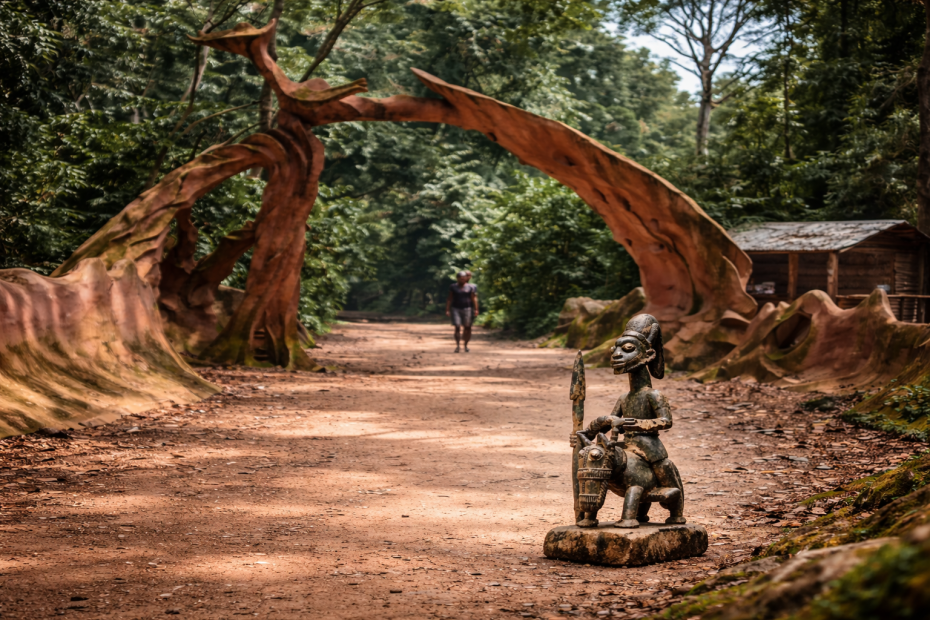
    Photo collage: Yoruba horseman in the Osun Sacred Grove, Arch of the Flying Tortoise.
    Landscape photograph by Adolphus Opara. Horseman sculpture photographed by David Norden.

    A long time ago, when the kingdoms of the Yoruba were young, the people said that a great rider sometimes appeared at the edge of the town.

    No one knew exactly where he came from.

    At dawn he would emerge from the red earth roads, seated proudly on his horse, holding a lance that caught the first light of the rising sun. Children would run to the paths to see him pass, while the elders watched in silence.

    Some said he was a warrior returning from distant lands. Others whispered that he was a messenger of the gods.

    In those days horses were rare in the forest regions of southern Nigeria. They came from the northern savannas and were precious animals, associated with kings, chiefs and powerful warriors. To ride a horse was to show authority and prestige.

    Over time the image of the mounted rider became one of the most powerful symbols in Yoruba art. Sculptors carved figures known as elesin—horsemen who embodied leadership, courage and the ability to command.

    The rider was often larger than the horse, because Yoruba artists did not aim for realism. Importance was expressed through proportion. The horse carried the rider, but the rider carried the meaning.

    Some of these figures were placed in shrines or royal spaces. Others commemorated great leaders or ancestors whose presence was believed to protect the community.

    Scholars have long noted the importance of this imagery in Yoruba culture. A beautiful example in ivory from the Dallas Museum of Art illustrates how deeply rooted the motif of the mounted rider is in the region:


    Dallas Museum of Art – Yoruba Horse and Rider

    Even earlier, archaeological discoveries such as a tenth-century bronze object from Igbo-Ukwu showing a horse and rider remind us that equestrian symbolism has deep historical roots in southern Nigeria. You can see this remarkable object, once exhibited in the Smithsonian exhibition Caravans of Gold, here:


    Igbo-Ukwu Horse and Rider – Caravans of Gold

    And perhaps that is why these sculptures still feel so alive today.

    They do not simply show a man on a horse.

    They show authority, presence, and the memory of a rider who once appeared on the road at dawn.

    Sometimes such Yoruba riders exist only in stories. And sometimes one quietly survives in wood.

    One such rider eventually found his way to my collection.

    Yoruba Horseman (Elesin), Ekiti Master Tradition

    Share and Enjoy !

    Shares
  • A Curious Visitor

    A Curious Visitor

    A Curious Visitor

    Some people enter quickly, almost by accident.

    The door opens, and they pause — just long enough to understand that this is not a normal shop.

    There are many objects. Faces, figures, quiet presences watching from shelves and walls. Some visitors step back for a moment, unsure where to look first.

    I usually let that moment breathe.

    Then I say, softly:

    “Take your time… I live with these pieces. Some of them have stayed with me for many years.”

    Something changes when they hear that.

    The space becomes less a shop, more a world.


    The First Question

    FXE49150African Art

    When the visitor begins to relax, I ask my usual question:

    “What brings you into my shop?”

    Sometimes the answer is simple curiosity.
    Sometimes they have walked past many times before daring to enter.
    Sometimes they already know a little — enough to feel drawn toward something they cannot yet name.

    I listen more than I speak.

    After many years, you learn that people reveal themselves in the way they look — not only in what they say.


    The Moment of Recognition

    FXE49157African Art

    Almost always, there is one moment.

    The visitor slows down in front of a piece.
    The rest of the room disappears for them.

    I don’t rush forward with explanations.

    Instead I might say:

    “Yes… that one has a quiet presence.”

    And then we look together.

    Sometimes they ask questions.
    Sometimes they simply stand there, surprised by their own reaction.

    This is often where a real collection begins — not with knowledge, but with recognition.


    A Cabinet Curated by an Experienced Eye

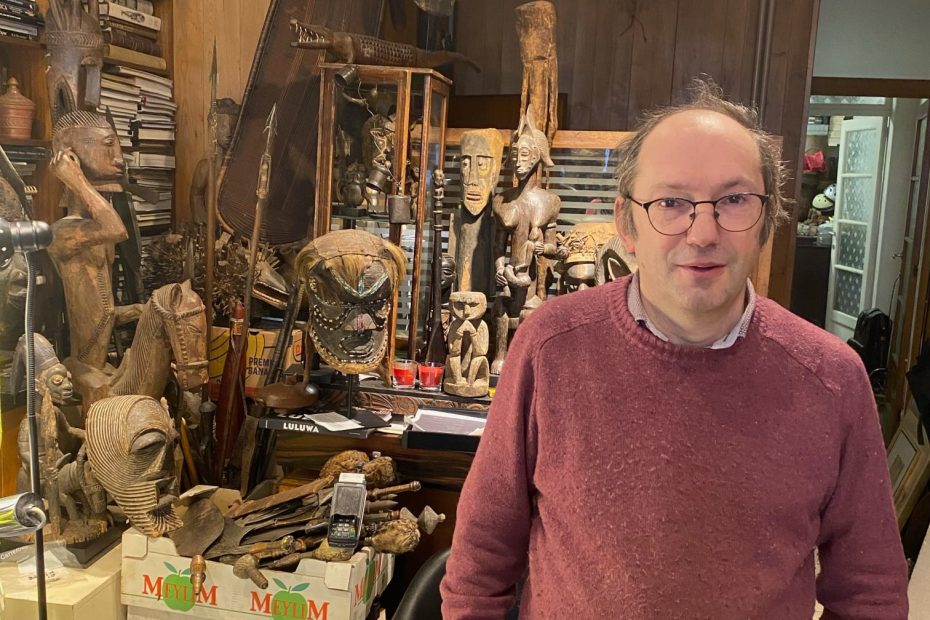
    David Norden in African Art shop

    My shop is small.

    It is not minimal, not empty, not staged like a gallery.
    It is a cabinet — a space where objects live together, where I am surrounded by forms I have chosen over more than thirty years.

    Some people find it overwhelming at first.

    But many tell me later that they feel something rare here:
    that the objects are not displayed to impress, but to be lived with.

    And perhaps that is true.

    I do not think of myself only as a dealer.

    I am someone who has spent a lifetime learning to see — and occasionally letting a piece leave when it finds the right person.


    Leaving the Shop

    FXE49163African Art

    Often visitors leave without buying anything.

    But they leave differently than they entered.

    They look again at the room before the door closes — as if memorising a feeling.

    And sometimes, days or weeks later, they return.

    Because once you have really looked at something — truly seen it — it has a way of calling you back.


    A cabinet curated by an experienced eye
    www.BuyAfricanAntiques.com

    Share and Enjoy !

    Shares