
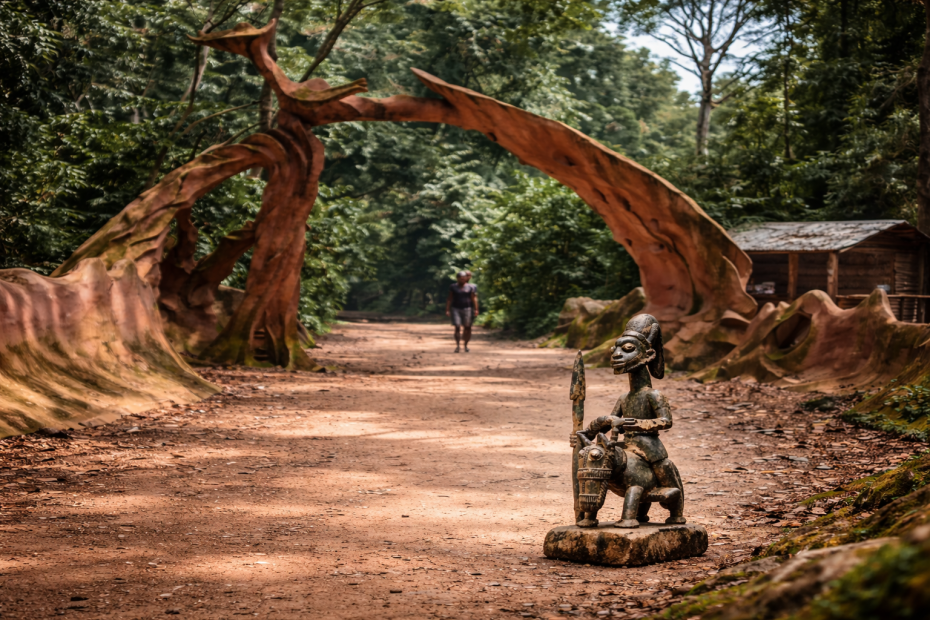
A short tale inspired by the Yoruba tradition of the horse rider — a symbol of leadership, prestige and authority in West African art.
Photo collage: Yoruba horseman in the Osun Sacred Grove, Arch of the Flying Tortoise.
Landscape photograph by Adolphus Opara. Horseman sculpture photographed by David Norden.
A long time ago, when the kingdoms of the Yoruba were young, the people said that a great rider sometimes appeared at the edge of the town.
No one knew exactly where he came from.
At dawn he would emerge from the red earth roads, seated proudly on his horse, holding a lance that caught the first light of the rising sun. Children would run to the paths to see him pass, while the elders watched in silence.
Some said he was a warrior returning from distant lands. Others whispered that he was a messenger of the gods.
In those days horses were rare in the forest regions of southern Nigeria. They came from the northern savannas and were precious animals, associated with kings, chiefs and powerful warriors. To ride a horse was to show authority and prestige.
Over time the image of the mounted rider became one of the most powerful symbols in Yoruba art. Sculptors carved figures known as elesin—horsemen who embodied leadership, courage and the ability to command.
The rider was often larger than the horse, because Yoruba artists did not aim for realism. Importance was expressed through proportion. The horse carried the rider, but the rider carried the meaning.
Some of these figures were placed in shrines or royal spaces. Others commemorated great leaders or ancestors whose presence was believed to protect the community.
Scholars have long noted the importance of this imagery in Yoruba culture. A beautiful example in ivory from the Dallas Museum of Art illustrates how deeply rooted the motif of the mounted rider is in the region:
Dallas Museum of Art – Yoruba Horse and Rider
Even earlier, archaeological discoveries such as a tenth-century bronze object from Igbo-Ukwu showing a horse and rider remind us that equestrian symbolism has deep historical roots in southern Nigeria. You can see this remarkable object, once exhibited in the Smithsonian exhibition Caravans of Gold, here:
Igbo-Ukwu Horse and Rider – Caravans of Gold
And perhaps that is why these sculptures still feel so alive today.
They do not simply show a man on a horse.
They show authority, presence, and the memory of a rider who once appeared on the road at dawn.
Sometimes such Yoruba riders exist only in stories. And sometimes one quietly survives in wood.
One such rider eventually found his way to my collection.