Category: Primitive art

  • What Is a Fake in African Art?

    What Is a Fake in African Art?

    One of the questions I am most frequently asked is how one can distinguish an authentic African object from a fake. After more than thirty years spent handling traditional sculpture, I have come to believe that before speaking about fakes, one must first understand what authenticity itself means. Surprisingly often, the answer is less straightforward than many collectors imagine.

    In its strictest sense, an authentic object is one that was created according to tradition for the use of the society that produced it and that fulfilled the purpose for which it was intended. Yet reality is often more nuanced. Some objects were collected before they ever entered service and therefore never acquired the traces of use associated with ritual life. Others were made as replacements or were carved for neighbouring communities according to established conventions. Such pieces may lack the evidence of prolonged use that collectors often seek, but they nevertheless belong fully within the traditional world from which they emerged.

    History also reminds us that African art never developed in complete isolation. Artistic traditions have always absorbed influences and adapted to changing circumstances. Long before the colonial period, one finds exchanges with Europeans and with neighbouring peoples. The Sapi ivories, the Benin plaques, certain Kongo figures and even some Yombe maternity figures reveal that outside influences were not incompatible with authentic artistic expression. What mattered was not the source of inspiration, but whether the object retained its place within a living tradition.

    Objects made for trade are by no means a modern phenomenon. They existed centuries ago and became increasingly common during the first decades of the twentieth century. Some of these pieces, originally intended for sale rather than ritual use, have themselves become part of the history of collecting. The real problem begins when the object is conceived not as an expression of tradition or craftsmanship, but with the deliberate intention of deceiving.

    By the late twentieth century, entire workshops had appeared whose purpose was to satisfy the growing demand for old African art. Patinas were artificially aged, surfaces manipulated and signs of use carefully imitated. Some of these productions are crude and easily recognised. Others are considerably more sophisticated. In fact, some of the most deceptive objects are carved by talented hands and subsequently given an artificial history.

    Over the years, I have learned that no single criterion can determine authenticity. Scientific analyses can provide useful information and occasionally confirm or challenge assumptions, but neither carbon dating nor thermoluminescence can replace observation. In the end, the object itself remains the principal witness.

    Perhaps the greatest teacher is comparison. Looking at one object in isolation is rarely sufficient. By studying groups of related works, by comparing examples in museums, old collections and publications, one gradually develops an understanding of recurring forms and proportions. Traditional artists rarely signed their work, but each sculptor possessed his own way of treating volumes, eyes, mouths and surfaces. The hand of an accomplished artist leaves traces that are difficult to define and even more difficult to imitate.

    Patina is another aspect that reveals itself slowly. Collectors sometimes think of patina merely as a dark colour or an indication of age, whereas genuine surfaces are the result of decades of life. Smoke from village houses, repeated handling, sacrificial materials, pigments and countless gestures have all contributed to their formation. Certain old surfaces possess a depth and complexity that is difficult to describe. They seem less applied than absorbed by the object itself.

    Artificial patinas can occasionally be convincing, especially when they are applied to sculptures carved by talented artists. Nevertheless, they often reveal themselves through a certain uniformity or by an excess that appears intended to impress. The faussaire frequently exaggerates. Features become stronger, expressions more dramatic and surfaces heavier. By contrast, authentic objects are often quieter and more restrained. Their beauty does not always reveal itself immediately.

    The inside of a mask can sometimes be as instructive as the front. The attention of the copyist is naturally directed towards the visible appearance, whereas the interior frequently preserves evidence of use, construction and wear that receives less consideration. Some of the most revealing details are therefore hidden from immediate view.

    Provenance, too, should be approached with a certain nuance. A documented history is always desirable and an object known before the great wave of reproductions that appeared in the second half of the twentieth century inspires confidence. Yet provenance alone does not authenticate a sculpture. It places the object within time, but ultimately it remains the sculpture itself that must convince.

    From time to time I receive messages from people who believe they own a valuable collection of African art. The details vary, but the underlying story is often remarkably similar. The objects are presented as ancient, rare or exceptionally important. There may be certificates, written appraisals or stories involving museums, experts or interested buyers who, for one reason or another, never completed a purchase.

    What has always struck me is that the people making these enquiries are rarely collectors. More often they are individuals who were persuaded that they had discovered an opportunity. At some point, someone convinced them that a relatively modest investment could lead to a substantial financial return. The attraction is understandable. The dream of finding an overlooked treasure has fascinated people for centuries.

    Yet after more than thirty years in this field, I have found that the most interesting collections are seldom built in this way. Their owners were first attracted by the sculpture itself, by its craftsmanship, its history and its aesthetic qualities. They spent time looking, comparing and learning. Gradually they developed confidence and, more importantly, judgment. If their collections later acquired significant value, this was usually the consequence of years of thoughtful collecting rather than the original objective.

    This difference between the collector and the speculator is perhaps more important than it first appears. The speculator begins with the hope of discovering value and then searches for arguments that support that hope. The collector begins with curiosity. He studies, questions, compares and slowly develops an eye for quality. One approach is guided primarily by expectation, the other by observation.

    Sadly, many supposed treasures are the result not merely of misunderstanding but of organised scams. Fear of missing out and the hope of easy profit are powerful emotions, and unscrupulous individuals have long understood how to exploit them. In that respect, the world of African art is no different from many other areas of collecting.

    There are, in my opinion, no real shortcuts in African art. Museums remain indispensable because they allow one to compare and to study. Books preserve the memory of old collections and old publications often contain information that has since disappeared. Conversations with fellow collectors, with dealers and with specialists are equally important. Much can also be learned by visiting fairs and exhibitions and simply by spending time with objects.

    Perhaps the most common mistake made by beginners is to buy too quickly. Enthusiasm is valuable, but patience is even more so. A collection is built over decades and not over months. The first dealer with whom one establishes a relationship often plays an important role, because a good dealer does more than sell objects. He helps to educate the eye, encourages curiosity and assists the collector in building a coherent collection rather than simply accumulating pieces.

    Looking back, I sometimes think that collecting African art is not really a race to acquire objects. It is a long process of learning to see. Even after thirty years, I still find that every object teaches something new, and perhaps that is one of the enduring pleasures of this field.

    Hidden treasures do occasionally exist, but the most rewarding collections are usually built slowly, guided by knowledge, patience and genuine curiosity. In the end, an educated eye is worth far more than the promise of easy profit.

    Share and Enjoy !

    Shares
  • Close Encounters with African Sculpture

    Close Encounters with African Sculpture

    Not long ago, a client entered my gallery and paused in front of a small group of figures from northeastern Nigeria. After looking at them for a while, he smiled and said:

    “They remind me of Japanese robots.”

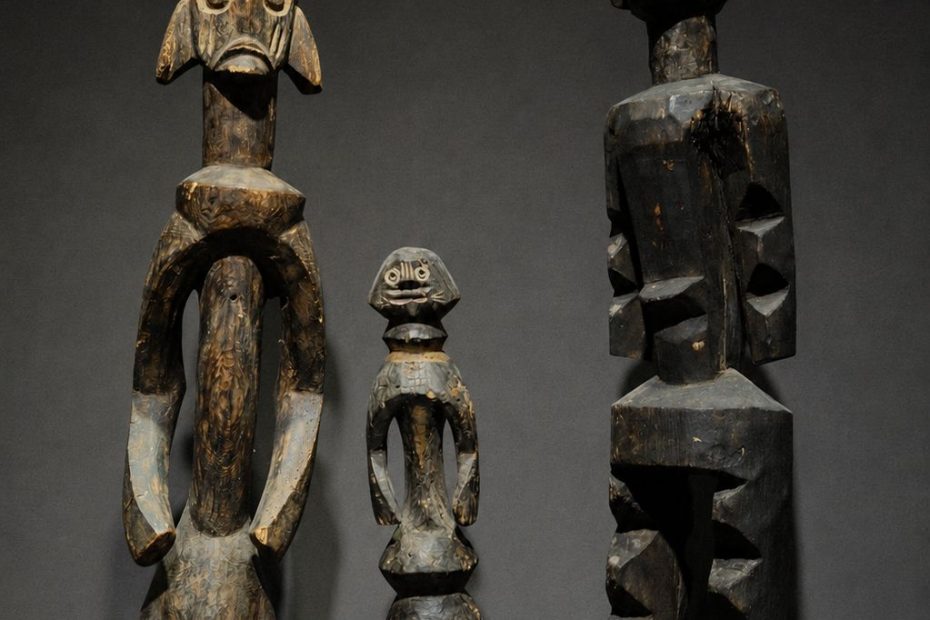
    It was not the first time I had heard such a remark. Over the years, visitors have compared certain Mumuye figures to robots, science-fiction characters, and occasionally even scenes from Star Wars. Looking at their elongated bodies, angular forms and almost articulated limbs, one understands why.

    Yet perhaps the opposite is closer to the truth.  Our robots and imaginary worlds sometimes look like African sculpture.

    African art is not merely an ethnographic curiosity. Its forms influenced twentieth-century modernism and continue to resonate in contemporary visual culture. The same qualities that fascinated Picasso and Modigliani — abstraction, geometry and expressive power — still speak to us today through cinema, science fiction and design.

    In 1984, a journalist writing for The New York Times suggested that one celebrated Mumuye figure may have inspired the helmeted head of Darth Vader. George Lucas himself later explained that the famous helmet was based on Japanese samurai armour, but the comparison remains interesting. Even if there was no direct influence, the visual similarities are striking.

    The Mumuye and Their Sculptures

    The Mumuye are an agricultural people living in the rocky hills south of the Benue River in northeastern Nigeria. Comprising several related groups sharing a common language and traditions, they remained relatively isolated until the middle of the twentieth century.

    Their sculptures were not created as decorative objects. Most were associated with medicine, divination and protection. They belonged to healers, diviners, rainmakers, blacksmiths and other influential individuals. Some were kept in sanctuaries known as tsafi, where initiation ceremonies also took place.

    Anthropologist Mette Bovin recorded that certain figures, known as janari — “figures that speak” — could be used to restore harmony, ward off epidemics, identify thieves and help maintain social order. A single sculpture might serve different purposes during its existence, making it difficult to assign one fixed function to a particular figure.

    One of the more intriguing interpretations concerns the angular arms and stepped zigzag legs found on many examples. According to Bovin, these forms may symbolize lightning and the swift action of spiritual forces. The sculptures were conceived as vigilant beings, ready to intervene on behalf of their owners. White kaolin circles around the eyes emphasized their ability to perceive what ordinary people could not.

    Why Collectors Continue to Appreciate Mumuye Sculpture

    When Western collectors first encountered Mumuye sculpture in the 1950s and 1960s, they were struck by its originality. Unlike many sculptural traditions with strongly codified forms, Mumuye artists explored an astonishing variety of proportions and compositions.

    Some figures are compact and powerful, others slender and elongated. Helmet-like coiffures alternate with openwork ears. No two figures are exactly alike. What collectors have long appreciated is this sense of freedom and individuality.

    More than half a century after their discovery by Western collectors, Mumuye figures remain among the most distinctive sculptural traditions of Africa. Their originality still feels fresh.

    An Experienced Eye

    When visitors tell me that a Mumuye figure reminds them of a robot, I always find the comparison interesting.

    Not because these sculptors were anticipating science fiction, but because our visual world has changed. During the twentieth century, artists, designers and filmmakers became increasingly comfortable with abstraction and simplified forms. The qualities that attracted Picasso and Modigliani to African sculpture are now familiar to all of us.

    Perhaps that explains why a visitor entering an antique shop in Antwerp in 2026 can look at a sculpture made in northeastern Nigeria generations ago and think of Japanese robots or Star Wars.

    For me, such reactions are another reminder that African sculpture deserves to be approached not only as ethnographic material, but also as art.

    Mumuye

    Three Close Encounters

    The three figures illustrated below have been living together in my gallery for some time. Seen side by side, their personalities become immediately apparent.

    The figure on the left, with its large circular eyes and elongated body, possesses a quiet elegance and simplicity. The smaller central figure has a more playful character, while the larger figure on the right — probably Montol rather than Mumuye — has a more architectural quality, with powerful geometric volumes and deeply carved forms.

    Looking closely at their faces, one begins to understand why visitors occasionally think of robots or science-fiction characters. Yet these works were created by artists from northeastern Nigeria generations before the age of cinema.

    FXE41605Mumuye

    Mumuye figure, Nigeria
    Height: 45 cm
    Price: €1,450

    Mumuye 34cm

    Mumuye figure, Nigeria
    Height: 34 cm
    Price: €950

    Mumuye 54cm

    Montol figure, Nigeria (?)
    Height: 54 cm
    Price: €1,950

    Happy and curious,

    David Norden

    African Antiques From Antwerp — One Eye, 30 Years of Selection

    For collectors building a serious collection: buy fewer, but better.

    Share and Enjoy !

    Shares
  • A Collector’s Guide to Traditional African Art

    A Collector’s Guide to Traditional African Art

    A Collector’s Guide to Traditional African Art

    By David Norden • BuyAfricanAntiques.com • Antwerp

    For more than 30 years, I’ve helped collectors discover authentic African masks, figures, and ritual objects created for social, political, and spiritual purposes. Traditional African art is one of the world’s most diverse and historically meaningful art forms — yet many collectors don’t know where to begin.

    This guide will help you understand what makes these works significant, what to look for, and how to evaluate quality and authenticity. Whether you are new to collecting or deepening an established passion, learning the background of each object enriches the experience.


    1. Explore as Many Works as Possible

    Africa is home to hundreds of cultures, each with its own visual language and artistic traditions.
    But the first question to ask is: what tribe or style speaks most to you?

    Examples of major traditions you’ll encounter:

    Baulé and Senufo (Ivory Coast)
    Refined carvings, elegant proportions, and balanced features.

    Fang and Kota (Gabon)
    Reliquary guardians with extraordinary spiritual charge.
    Historically, many of the finest pieces entered major wealthy collections — and today, authentic high-quality examples often exceed €20,000. Beginners should be aware of this before choosing these groups.

    Dogon (Mali) and Mumuye (Nigeria)
    Dogon figures feature elongated forms and cosmological symbolism;
    Mumuye works show cubistic shapes that inspired artists like Picasso.

    • Yoruba (Nigeria)
    Ibeji twins, Shango staffs, beadwork, divination objects, and regal carvings.
    A very large population means many authentic objects — and many fakes — exist on the market.

    FXE48503african art jungle
    Yoruba Ibeji Figure with Cowrie Vest – Provenance: Ursula Voorhuis, “Grand Old Lady of Yoruba Art”

    • Congo region — Luba, Tabwa, others (DRC)
    Refined figures and masks associated with leadership, initiation, and healing.

    A book every collector should own

    The Tribal Arts of Africa by Jean-Baptiste Bacquart— 800 photos, maps, and cultural explanations.

    The Tribal Arts of Africa by Jean Baptiste Bacquart

    https://amzn.to/3XyVYC7

    The more you look — through museums, reference books, exhibitions, and curated collections — the more your eye sharpens. In my Antwerp shop and on BuyAfricanAntiques.com, I encourage collectors to compare forms, patinas, and stylistic variations to learn how each culture expresses beauty and power.

    Personally, I would get bored collecting only one type of object, but for beginners it is recommended to focus on one type or one group. This helps you recognize subtle variations in quality and discover what truly moves you.


    2. Materials & Techniques That Tell a Story

    In African art, materials are never random. They reveal origin, use, cultural purpose, and — through wear — an approximate age.

    Environmental exposure (sun, wind, humidity), offerings, handling, and ritual use all leave recognizable traces.

    • Wood

    The most common material in African carving.

    Signs of genuine age and use include:

    • Deep, natural patinas formed by years of handling and ritual activity

    • Logical wear on edges, handles, and interior surfaces

    • Hand-tool marks (adze, knife, chisel, even stone carving depending on region)

    Identifying local woods and tool marks is often key to determining authenticity.

    • Bronze & Brass

    Used for centuries in Benin, Yoruba, Akan, and other cultures through the lost-wax casting method.

    Look for:

    • Crisp details

    • Age-appropriate oxidation

    • A weight consistent with traditional alloys

    Be cautious: damaged or incomplete wax castings are sometimes intentionally produced to mimic age.

    • Beads, Textiles, Shells, Pigments

    These additions carry spiritual meaning and ceremonial power.
    Original materials surrounding a carving are often a strong sign of authenticity.

    • African Terracotta & Stone

    Often linked to ancient, archaeological, or ancestral contexts in Ghana (Komaland), Mali (Bankoni), Nigeria ‘Nok), etc .
    Authenticity here requires expertise;for more expensive items, carbon-14 testing is sometimes used when provenance is unclear.

    Bankoni terracotta figure Mali
    Bankoni Terracotta Figure, Mali – Belgian Estate Provenance

    3. Authenticity: What Makes a Traditional Piece Genuine

    Because African art has been reproduced extensively for the tourist trade, discernment is essential.

    Key indicators include:

    • Natural patinas, not artificially applied

    • Wear that looks natural, not exaggerated or forced

    • Traditional tool marks, never machine-smoothed surfaces

    • Cultural coherence — the object matches known forms and traditions of its ethnic group

    • Historical documentation:

      • old dealer labels

      • collector numbers

      • early photographs

      • museum or gallery history

      • publications

      • listings in databases such as the AHDRC

    These factors increase both confidence and value.

    With three decades of experience, I select each piece personally.
    I do not sell tourist-made or contemporary decorative pieces — only authentic, traditional works.


    4. The Meaning Behind Traditional African Art

    Traditional African art was almost never made for decoration.
    Each piece had a living function, such as:

    • Honoring ancestors

    • Initiation and coming-of-age rituals

    • Political or spiritual authority — whether in royal kingdoms like the Kuba, or in animistic societies

    • Healing practices

    • Divination and protection

    • Ensuring fertility, harmony, or good harvests

    • Maintaining continuity within the community

    Understanding these purposes transforms your perception.

    A mask becomes a performer calling for good crops or guiding youth into adulthood.
    A figure becomes an intermediary between the visible and invisible worlds, or a symbol of fertility or royal power.

    The power of African art comes from its function first, and its beauty second.
    The best carvers were respected, but an object’s effectiveness — its spiritual force — was always more important than its appearance.


    5. How to Start or Build Your Collection

    Choose pieces that speak to you

    A meaningful connection is the foundation of any collection.
    Ask yourself:

    • Do I want to collect one type of object?

    • One specific tribe?

    • A theme such as fertility, initiation, protection, or agriculture?

    • Do I prefer heavily used objects or crisp, “clean” sculptures?

    Focus on quality

    It is better to acquire one powerful, authentic piece than several mediocre ones.
    The price is soon forgotten — but the quality stays with you forever.

    Work with experts

    A trusted dealer helps you navigate authenticity, cultural context, provenance, and value — and helps you build a coherent, meaningful collection.

    Collect respectfully

    These objects were created with purpose.
    Always ask for an object’s past history and learn about its function.


    Why Buy From BuyAfricanAntiques.com?

    • Over 30 years of hands-on experience

    • Only authentic, traditional African art — selected individually

    • Clear cultural and historical information with each piece

    • A physical shop in Antwerp + an online webshop

    • In-house international shipping

    • Personal guidance for collectors at all levels

    Each piece is chosen the way a curator selects for a collection:
    with care, knowledge, and respect.


    Conclusion: The Joy of Collecting African Art

    Traditional African art carries history, identity, spirituality, and a profound sense of human presence.
    Collectors often tell me that once they hold their first authentic mask or figure, they feel an immediate connection — as if they’re touching a living tradition.

    My mission is to help you discover pieces that inspire that connection. You can begin your exploration in my online shop:
    👉 www.BuyAfricanAntiques.com/shop

    But to see my full inventory and truly get to know my approach, I recommend visiting me in Antwerp — or simply sending me a private message to share your collecting goals. I’ll be happy to guide you personally.

    The End of Year African Jungle selection:

    https://buyafricanantiques.com/product/komaland-terracotta-coned-figurine/

    Yoruba Ibeji Twin Figure, Cowrie-Covered Tunic – Ex-Collection Ursula Voorhuis (1932–2021)

    Double Head Dayir Lobi figure – Burkina Faso

    Dogon Hermaphrodite Figure – ex-Collection Quittenbaum

    Ikhokho Pendant Pende Mask

    https://buyafricanantiques.com/product/mumuye-statue/

    Bamana Bush Pig Mask – Mali

    Bankoni Terracotta Figure – Mali

    Share and Enjoy !

    Shares
  • Primitive Art in Antwerp

    Primitive Art in Antwerp

    Lire en Français Art Primitif à Anvers.

    Lees in Nederlands Primitieve Kunst in Antwerpen.

    We visited David Norden, an esteemed antique dealer with a passion for African art.
    We captured his story in three days, focusing on his personal life as an antiques dealer
    and how he gained his knowledge.
    “My father and grandfather already had an antique shop. That’s how my knowledge about this has grown.”
    During the documentary, his view of the art world and his passion for what he believes in emerge:
    “For me, artefacts are ambassadors of a country’s culture and we will remain that way
    aware of what those people have done.”

    primitive art in Antwerp

    Video (c) by StampMedia under creative commons, byMatias Ramos, ter Maat and Kiza Kobé.

    Nowadays everything always seems so busy. Everyone is on their way to work or thinking about their future.
    Shops are full and everything seems to be in constant motion. But hidden among all this hustle and bustle you occasionally find a shop where time seems to stand still.

    “David Norden Primitive Art”

    D.N. My name is David Norden. I am sixty years old and in daily life I am a dealer in African art.
    Yes, I have been doing that for about thirty years. I have had a trade register since 1988. I was a professional photographer for five years.
    I switched to more African art and in the beginning I also did some general antiques.

    Shop Karel Israel Norden-Spui 164-Den Haag-1962

    And my father and my grandfather also all had an antique shop. And yes, when those people came, I was still a child. I then had to help serve the coffee, or arrange the pieces from the stock nicely and I liked to do that.

    (photo of David Norden’s mother Nadya Levi with Werner Gillon, former curator of the British Museum African art)

    Then I went to England with my mother at auctions and then yes, that’s how my knowledge about it grew a bit. But when I was a child I did not immediately want to become a trader myself, I studied biology at university. But I didn’t complete that, and then studied photography and became professional photographer.
    African art is just self-study, I have never done specific studies for that. But it’s not that I wanted to do something with that. I just knew it. It wasn’t until later when… I was a photographer, but there were a lot of people who just didn’t pay me properly as a photographer. It is a service sector, and then I thought for a moment about trying something different.

    K.K. – How do you even start with that? What, how do you get those objects into the store?

    D.N. Today I mainly buy via online auctions. And sometimes I also have a collector who has a lot of pieces and who says David I have a few pieces here that I no longer fit in my collection and you have something that I would like to have. Can we exchange or part money and exchange? So that’s how I get my pieces

    K.K. Then the maintenance of such objects. Do you spend a lot of time on that or is there a lot of effort?

    D.N. In fact not really, but what is nice: if you have a beautiful piece, sometimes presentation can add something… sometimes you have a pedestal made if they do not hold straight.
    Also with masks, if you don’t want to hang them on the wall, you can have a stand made for them and then it presents better.
    I know there are also dealers who work with repairers to fill gaps and sometimes trim or repatinate pieces
    but I don’t concern myself with that. I usually leave the pieces as they are, as they come in.
    The oldest pieces I have can sometimes be two or three thousand years old.

    Yes, I have another statue that has an interesting story. This is a Teke statue that comes from Congo before 1930.


    TEKE Statue taken out from the fire by Claude Lehuard and collected in Congo-Brazzaville between 1924 & 1933

    At that time the missionaries wanted to burn those figures. These were “fetishes“, they were supposedly evil spirits, and the Africans had to become Catholic and in fact they had to renounce their religion. And then the missionaries put all those statues on a large pyre.
    That man (Claude Lehuard) was able to save a few of those statues from the pyre in time.
    And if you look at the image, you will see that there are still traces of the fire on it.

    I noticed that I was gaining a little weight with age and thought, how am I going to fix that? By having a little more physical activity. But I personally don’t really feel the need to go to a gym or anything like that. So I thought I might do a little gardening.

    So my wife bought a house in France where I have a large vegetable garden of 500 square meters, and I can actually combine that a bit with my shop. So in the winter I let some seeds germinate with an artificial light. In the summer I just put them outside. And when I go to France, I just put those plants that have grown a in the car to plant in my vegetable garden. So that’s also kind of my hobby.
    And yes, I have a shop here that is not like all the other shops, because in most African art shops the dealers do it very clean, a bit like in a museum. And then you see five or ten pieces and they cost a lot of money. But then you are only addressing people who really have a lot of money and that is not really my intention here, so I am not concerned with that.

    K.K. And one of my last questions is, why did you choose the name “Primitive Art” as the name for your store?

    D.N. Yes, that’s a name that is a bit controversial. Usually I would say just African art. But since I’m a bit wider and sometimes also collect oceanic art or Eskimo (Inuit) art or non-European art, I first chose Primitive Art, but in fact every name is wrong so to speak. In my sense, it’s more the original meaning. But now they have also called that primary arts. Ultimately it is difficult to always please everyone with a name. It actually doesn’t say much at all.

    K.K. I have done some additional research and it appears that there are a few countries that do ask for their art back from antique institutions and museums that then deal in “Primary Art” or yes “Primitive Art”. What is your opinion on that?

    D.N. Yes, that is in fact a thing. At this moment we are in fact questioning history. So there are many countries that indeed say yes, you have robbed us of our art over time, sometimes by force and we would like to have those art objects back in our country because that is our culture. Personally, I don’t think that is 100% correct. For me, the artifacts are more ambassadors of a culture of a country, and that also ensure that other people discover a culture of a country and that also ensure that other people, in fact, yes, stay informed about what those people have done. Many pieces arrived in the XIX century. I just see something among colonials who had a plantation in Congo and then it is in the attic of those parents who are dying. I’m called, the house has to be cleared. Are you interested in buying those things from us? OK, I’ll buy them. Sometimes there are documents included, but often I don’t know under what circumstances those objects ended up here. So you can’t say if it was all stolen or not. No, it often needs to be nuanced a bit. It’s not all black or white, good or bad. There are many shades of gray in between.

    K.K. Thank you for your opinion.
    D.N. Yes you’re welcome.

    Share and Enjoy !

    Shares