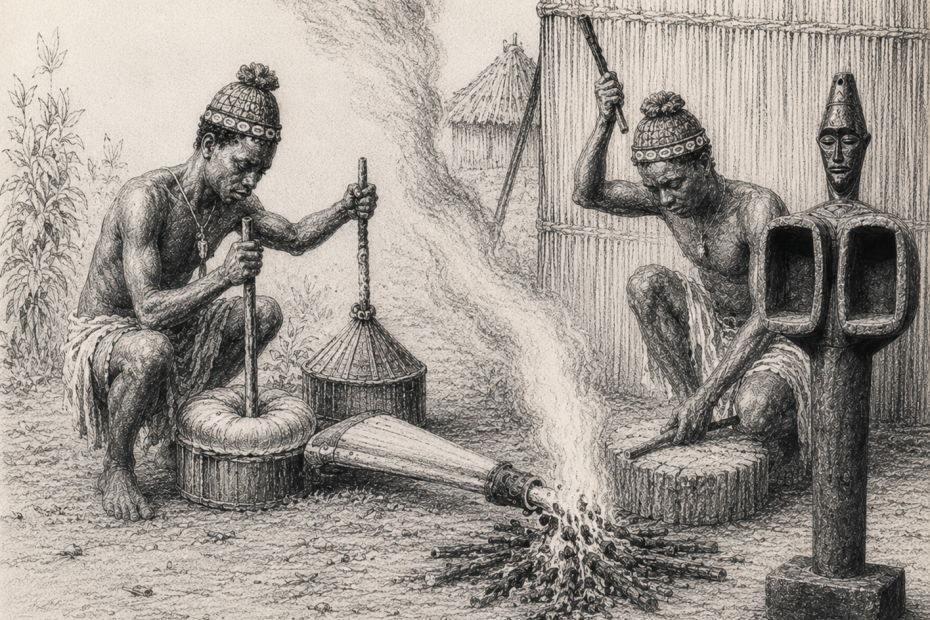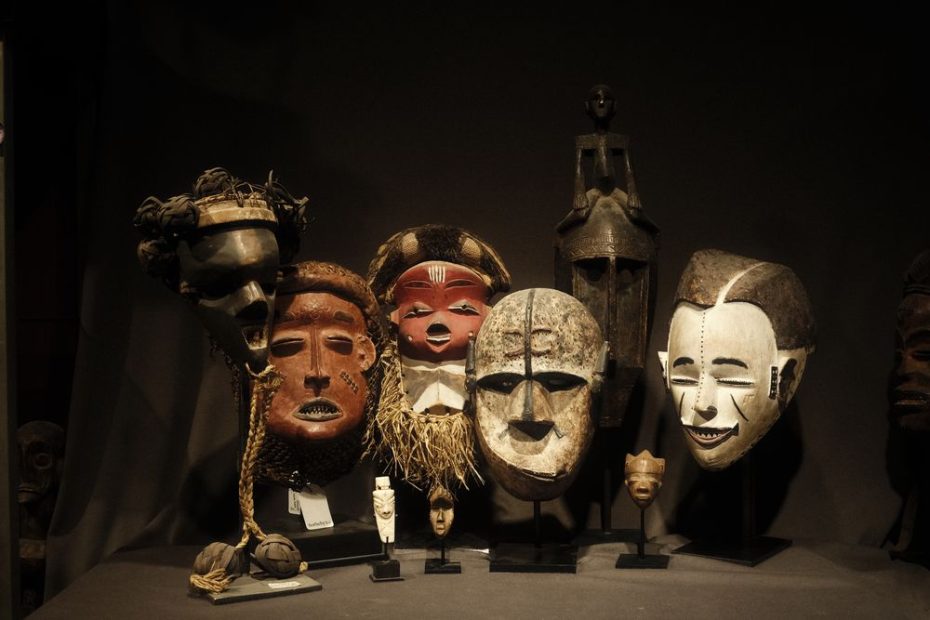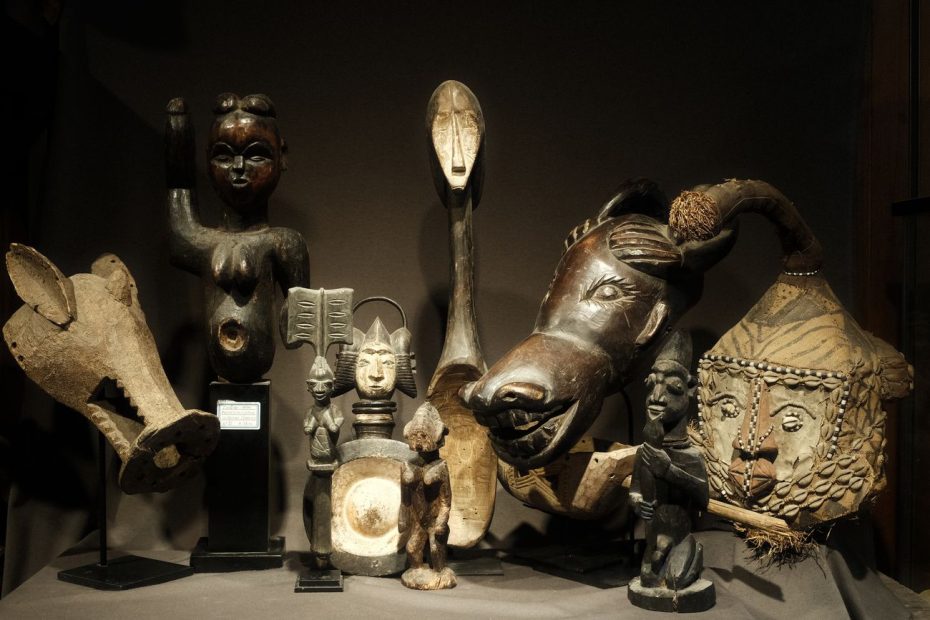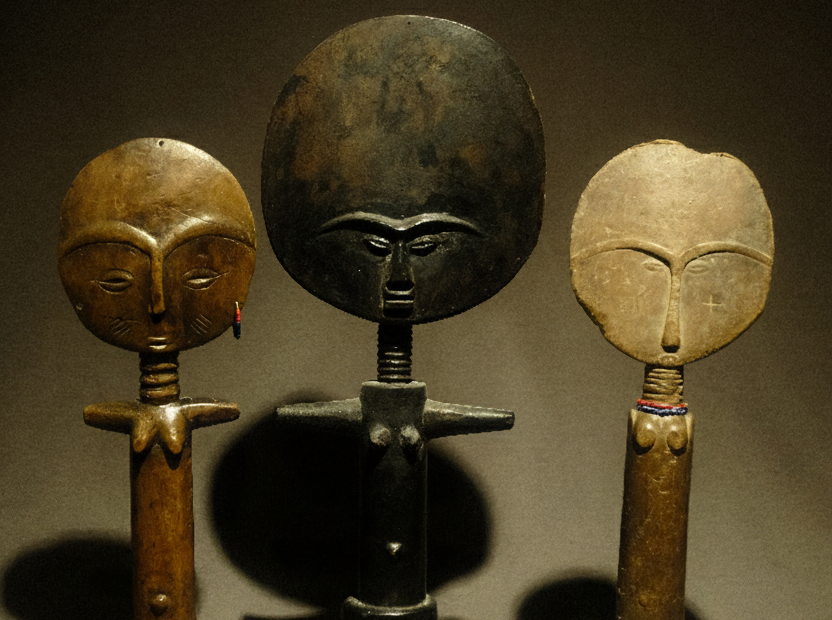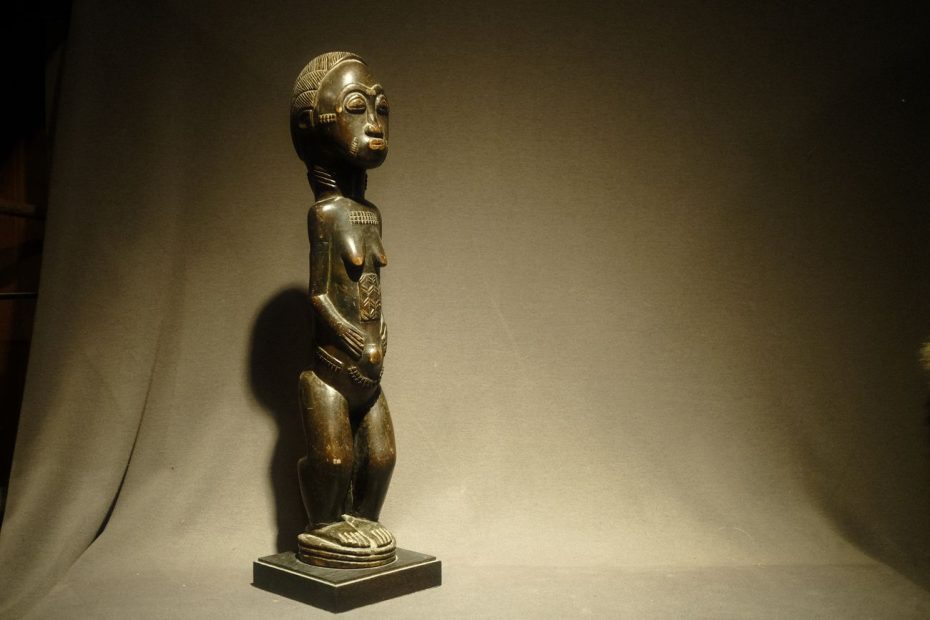
When I first brought this old Kuba Lele blacksmith’s bellows into my Antwerp shop, it did not look like a sculpture waiting for a pedestal. It looked like something that had worked hard for a very long time. Dust still rested deep inside the chambers, the wood smelled faintly of smoke, and the black surface carried the soft sheen that only repeated human touch can create. I turned it over several times before placing it on a stand. The head was what stopped me. Those closed eyes did not seem carved for decoration; they seemed carved to remember.
In the Kasai region of the Democratic Republic of Congo, among the peoples linked to the Kuba kingdom and its related groups such as the Lele, blacksmiths occupied a place that was never entirely ordinary. They were the men who could persuade earth to become iron and iron to become useful. A hoe that opened the soil, a knife that cut meat, a spear that protected a village, a bracelet worn by a chief—all began with fire, breath, and metal. The forge was therefore not merely a workshop; it was a place of transformation.
The Kuba kingdom developed one of the most sophisticated court cultures of Central Africa. Its rulers encouraged weaving, carving, music, ceremonial life, and the crafts that gave the kingdom both wealth and prestige. Among the remembered rulers stands Shamba Bolongongo, celebrated in Kuba tradition as a wise and peace-loving king associated with refinement, order, and the flourishing of the arts. The Lele, who lived within the broader Kuba cultural sphere, shared certain artistic ideas with their Kuba neighbors while preserving a more austere sculptural language of powerful silhouettes and restrained geometry.
Old Central African traditions often speak of the world as something animated by hidden forces. Trees, rivers, animals, and ancestors could possess presence and intention. A blacksmith worked at the boundary between these visible and invisible worlds. He took ore from the ground, fed it to fire, and drew from it a new form. It is not difficult to understand why such work attracted stories.
An elder from the Kasai might have told a tale like this.
Long ago, in the time when the great Kuba kings were still remembered by name, a young hunter called Shamba wandered beyond the cultivated fields and entered the deep forest at dusk. He had grown up hearing stories of Shamba Bolongongo, the ruler who valued peace more than war and who protected the craftsmen whose work sustained the kingdom.
As night fell, the hunter heard a strange sound—slow, rhythmic breathing, as if the forest itself were asleep. He followed the sound to a clearing where a fire glowed beneath a mound of clay. Beside it stood a tall figure with a face dark as charcoal and eyes half closed. The stranger worked a pair of wooden bellows. Each time he pressed them, the fire brightened; each time he released them, the flames sank back into shadow.
Shamba asked, “Who keeps a fire alive in the middle of the forest?”
The stranger replied, “I keep the breath that awakens iron.”
He showed the hunter stones hidden along the riverbank and taught him how to build a furnace of clay. He taught him that fire grows weak when it is denied breath, and that breath must move in rhythm, like the heartbeat of a living being. Before dawn the stranger disappeared into the smoke, leaving the bellows beside the dying embers.
Shamba returned to his village and shared what he had learned. Iron tools appeared where there had once been only stone and wood, and the people prospered. Yet he repeated one warning throughout his life: “Never mock the breath of the bellows. It is the breath that turns darkness into usefulness.”
Whether such a tale was ever told exactly in this form matters less than the truth it carries. Across much of Central Africa, tools were not entirely separated from spirit, labor was not entirely separated from ritual, and breath itself was understood as a force that gives life. Looking at this bellows, I can easily imagine generations of hands pressing those chambers in steady rhythm while sparks rose into the night.
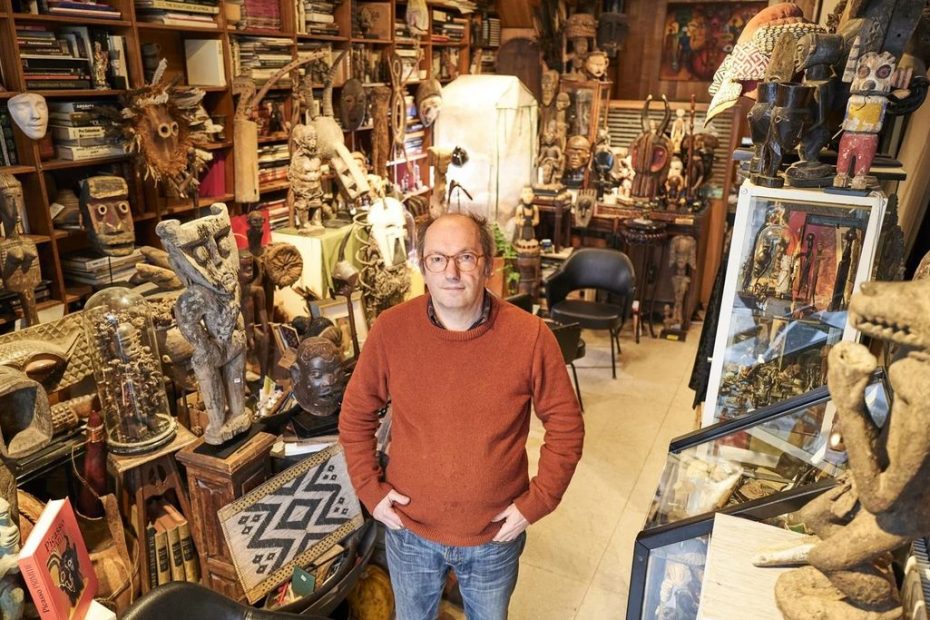
Collectors sometimes ask me whether I prefer masks, figures, or utilitarian objects. I usually deal in masks and statues, and I confess that figurative sculpture remains what moves me most deeply. A powerful face, a charged posture, a figure shaped by ritual use—these are the objects that first drew me into African art more than thirty years ago. Bellows, stools, or other utilitarian pieces are less common in my collection and often much harder to find in convincing old condition.
Perhaps that is why this bellows stayed with me. Although it was made to work rather than to be admired, it possesses an unmistakably figurative presence. The elongated head, the calm closed eyes, the pierced crest, and the broad twin chambers give it the authority of a standing figure. It stands today as sculpture, yet it was born as a tool, and that tension between usefulness and beauty is exactly what makes it memorable.
This exceptional Kuba Lele blacksmith’s bellows, standing 85 cm high (92 cm including its display base), is now available in my collection.
View the complete object, detailed photographs, condition report, and acquisition information in the African Art webshop.
Most people begin collecting African art by asking the wrong questions.
They ask about the tribe, the age, the provenance, or the price. Those things certainly matter, but they are not where true connoisseurship begins.
The first question should always be: Is this a good piece of sculpture?
After more than thirty years of handling thousands of African objects, visiting museums across Europe, studying important collections, and making both good and bad buying decisions, I have learned that exceptional works reveal themselves in ways that photographs, labels, and certificates alone never can. Quality lives in proportion, balance, surface, craftsmanship, expression, and the subtle presence that only the finest objects possess.
An experienced eye is not a gift. It is something that can be developed through careful observation, comparison, and patience.
Rather than presenting a catalogue of ethnic groups or historical facts, this guide focuses on how to see. You will learn practical methods for judging craftsmanship, recognizing authentic age and patina, understanding what separates an ordinary object from an exceptional one, and avoiding many of the mistakes that beginning collectors often make.
One of the most valuable ways to train your eye is by studying the very best examples. Throughout this guide we therefore examine masterpieces from major museum collections, including remarkable Fang, Baule, Djennenké, Kota, Bangwa, Kongo, Songye, and Yoruba sculptures. These objects are not included simply because they are famous, but because they demonstrate the qualities that collectors should learn to recognize wherever they encounter African art.
Whether you are considering your very first mask or building a serious collection, the principles remain the same. The goal is not to buy more objects, but to buy better ones—pieces that continue to reward careful study for years to come.
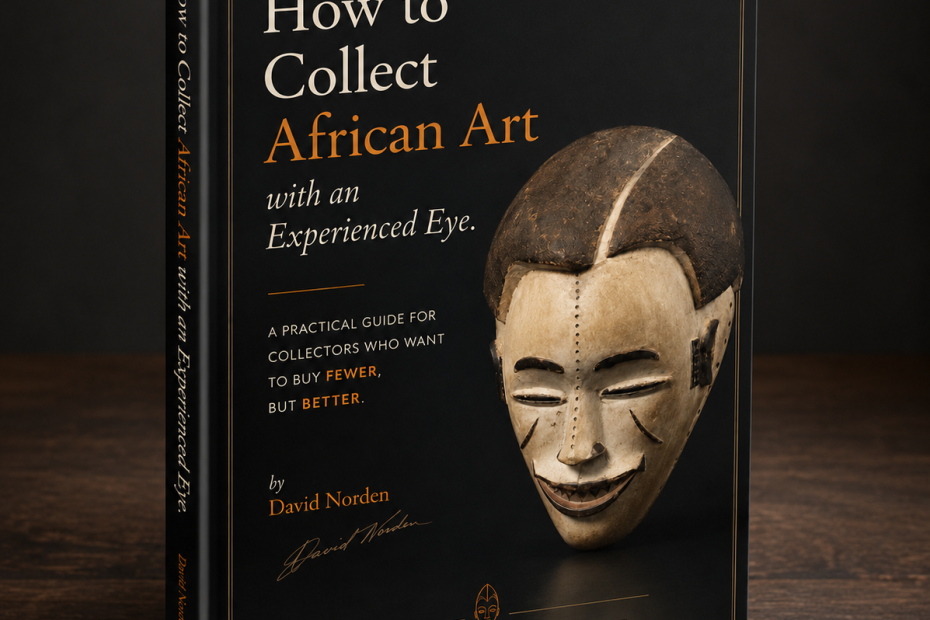
This is an Early Edition of How to Collect African Art with an Experienced Eye. At present it contains 45 illustrated pages, but it is intended to grow into a much more comprehensive guide. New chapters, museum case studies, photographs, and collecting insights will be added regularly as the project develops. As the content expands, the retail price will gradually increase, while everyone who already owns a copy will receive all future updates free of charge.
My hope is that this book becomes more than an illustrated collector’s guide. I hope it helps you cultivate the most valuable tool any collector can possess: an experienced eye.
One of the questions I am most frequently asked is how one can distinguish an authentic African object from a fake. After more than thirty years spent handling traditional sculpture, I have come to believe that before speaking about fakes, one must first understand what authenticity itself means. Surprisingly often, the answer is less straightforward than many collectors imagine.
In its strictest sense, an authentic object is one that was created according to tradition for the use of the society that produced it and that fulfilled the purpose for which it was intended. Yet reality is often more nuanced. Some objects were collected before they ever entered service and therefore never acquired the traces of use associated with ritual life. Others were made as replacements or were carved for neighbouring communities according to established conventions. Such pieces may lack the evidence of prolonged use that collectors often seek, but they nevertheless belong fully within the traditional world from which they emerged.
History also reminds us that African art never developed in complete isolation. Artistic traditions have always absorbed influences and adapted to changing circumstances. Long before the colonial period, one finds exchanges with Europeans and with neighbouring peoples. The Sapi ivories, the Benin plaques, certain Kongo figures and even some Yombe maternity figures reveal that outside influences were not incompatible with authentic artistic expression. What mattered was not the source of inspiration, but whether the object retained its place within a living tradition.
Objects made for trade are by no means a modern phenomenon. They existed centuries ago and became increasingly common during the first decades of the twentieth century. Some of these pieces, originally intended for sale rather than ritual use, have themselves become part of the history of collecting. The real problem begins when the object is conceived not as an expression of tradition or craftsmanship, but with the deliberate intention of deceiving.
By the late twentieth century, entire workshops had appeared whose purpose was to satisfy the growing demand for old African art. Patinas were artificially aged, surfaces manipulated and signs of use carefully imitated. Some of these productions are crude and easily recognised. Others are considerably more sophisticated. In fact, some of the most deceptive objects are carved by talented hands and subsequently given an artificial history.
Over the years, I have learned that no single criterion can determine authenticity. Scientific analyses can provide useful information and occasionally confirm or challenge assumptions, but neither carbon dating nor thermoluminescence can replace observation. In the end, the object itself remains the principal witness.
Perhaps the greatest teacher is comparison. Looking at one object in isolation is rarely sufficient. By studying groups of related works, by comparing examples in museums, old collections and publications, one gradually develops an understanding of recurring forms and proportions. Traditional artists rarely signed their work, but each sculptor possessed his own way of treating volumes, eyes, mouths and surfaces. The hand of an accomplished artist leaves traces that are difficult to define and even more difficult to imitate.
Patina is another aspect that reveals itself slowly. Collectors sometimes think of patina merely as a dark colour or an indication of age, whereas genuine surfaces are the result of decades of life. Smoke from village houses, repeated handling, sacrificial materials, pigments and countless gestures have all contributed to their formation. Certain old surfaces possess a depth and complexity that is difficult to describe. They seem less applied than absorbed by the object itself.
Artificial patinas can occasionally be convincing, especially when they are applied to sculptures carved by talented artists. Nevertheless, they often reveal themselves through a certain uniformity or by an excess that appears intended to impress. The faussaire frequently exaggerates. Features become stronger, expressions more dramatic and surfaces heavier. By contrast, authentic objects are often quieter and more restrained. Their beauty does not always reveal itself immediately.
The inside of a mask can sometimes be as instructive as the front. The attention of the copyist is naturally directed towards the visible appearance, whereas the interior frequently preserves evidence of use, construction and wear that receives less consideration. Some of the most revealing details are therefore hidden from immediate view.
Provenance, too, should be approached with a certain nuance. A documented history is always desirable and an object known before the great wave of reproductions that appeared in the second half of the twentieth century inspires confidence. Yet provenance alone does not authenticate a sculpture. It places the object within time, but ultimately it remains the sculpture itself that must convince.
From time to time I receive messages from people who believe they own a valuable collection of African art. The details vary, but the underlying story is often remarkably similar. The objects are presented as ancient, rare or exceptionally important. There may be certificates, written appraisals or stories involving museums, experts or interested buyers who, for one reason or another, never completed a purchase.
What has always struck me is that the people making these enquiries are rarely collectors. More often they are individuals who were persuaded that they had discovered an opportunity. At some point, someone convinced them that a relatively modest investment could lead to a substantial financial return. The attraction is understandable. The dream of finding an overlooked treasure has fascinated people for centuries.
Yet after more than thirty years in this field, I have found that the most interesting collections are seldom built in this way. Their owners were first attracted by the sculpture itself, by its craftsmanship, its history and its aesthetic qualities. They spent time looking, comparing and learning. Gradually they developed confidence and, more importantly, judgment. If their collections later acquired significant value, this was usually the consequence of years of thoughtful collecting rather than the original objective.
This difference between the collector and the speculator is perhaps more important than it first appears. The speculator begins with the hope of discovering value and then searches for arguments that support that hope. The collector begins with curiosity. He studies, questions, compares and slowly develops an eye for quality. One approach is guided primarily by expectation, the other by observation.
Sadly, many supposed treasures are the result not merely of misunderstanding but of organised scams. Fear of missing out and the hope of easy profit are powerful emotions, and unscrupulous individuals have long understood how to exploit them. In that respect, the world of African art is no different from many other areas of collecting.
There are, in my opinion, no real shortcuts in African art. Museums remain indispensable because they allow one to compare and to study. Books preserve the memory of old collections and old publications often contain information that has since disappeared. Conversations with fellow collectors, with dealers and with specialists are equally important. Much can also be learned by visiting fairs and exhibitions and simply by spending time with objects.
Perhaps the most common mistake made by beginners is to buy too quickly. Enthusiasm is valuable, but patience is even more so. A collection is built over decades and not over months. The first dealer with whom one establishes a relationship often plays an important role, because a good dealer does more than sell objects. He helps to educate the eye, encourages curiosity and assists the collector in building a coherent collection rather than simply accumulating pieces.
Looking back, I sometimes think that collecting African art is not really a race to acquire objects. It is a long process of learning to see. Even after thirty years, I still find that every object teaches something new, and perhaps that is one of the enduring pleasures of this field.
Hidden treasures do occasionally exist, but the most rewarding collections are usually built slowly, guided by knowledge, patience and genuine curiosity. In the end, an educated eye is worth far more than the promise of easy profit.
Not long ago, a client entered my gallery and paused in front of a small group of figures from northeastern Nigeria. After looking at them for a while, he smiled and said:
“They remind me of Japanese robots.”
It was not the first time I had heard such a remark. Over the years, visitors have compared certain Mumuye figures to robots, science-fiction characters, and occasionally even scenes from Star Wars. Looking at their elongated bodies, angular forms and almost articulated limbs, one understands why.
Yet perhaps the opposite is closer to the truth. Our robots and imaginary worlds sometimes look like African sculpture.
African art is not merely an ethnographic curiosity. Its forms influenced twentieth-century modernism and continue to resonate in contemporary visual culture. The same qualities that fascinated Picasso and Modigliani — abstraction, geometry and expressive power — still speak to us today through cinema, science fiction and design.
In 1984, a journalist writing for The New York Times suggested that one celebrated Mumuye figure may have inspired the helmeted head of Darth Vader. George Lucas himself later explained that the famous helmet was based on Japanese samurai armour, but the comparison remains interesting. Even if there was no direct influence, the visual similarities are striking.
The Mumuye and Their Sculptures
The Mumuye are an agricultural people living in the rocky hills south of the Benue River in northeastern Nigeria. Comprising several related groups sharing a common language and traditions, they remained relatively isolated until the middle of the twentieth century.
Their sculptures were not created as decorative objects. Most were associated with medicine, divination and protection. They belonged to healers, diviners, rainmakers, blacksmiths and other influential individuals. Some were kept in sanctuaries known as tsafi, where initiation ceremonies also took place.
Anthropologist Mette Bovin recorded that certain figures, known as janari — “figures that speak” — could be used to restore harmony, ward off epidemics, identify thieves and help maintain social order. A single sculpture might serve different purposes during its existence, making it difficult to assign one fixed function to a particular figure.
One of the more intriguing interpretations concerns the angular arms and stepped zigzag legs found on many examples. According to Bovin, these forms may symbolize lightning and the swift action of spiritual forces. The sculptures were conceived as vigilant beings, ready to intervene on behalf of their owners. White kaolin circles around the eyes emphasized their ability to perceive what ordinary people could not.
Why Collectors Continue to Appreciate Mumuye Sculpture
When Western collectors first encountered Mumuye sculpture in the 1950s and 1960s, they were struck by its originality. Unlike many sculptural traditions with strongly codified forms, Mumuye artists explored an astonishing variety of proportions and compositions.
Some figures are compact and powerful, others slender and elongated. Helmet-like coiffures alternate with openwork ears. No two figures are exactly alike. What collectors have long appreciated is this sense of freedom and individuality.
More than half a century after their discovery by Western collectors, Mumuye figures remain among the most distinctive sculptural traditions of Africa. Their originality still feels fresh.
An Experienced Eye
When visitors tell me that a Mumuye figure reminds them of a robot, I always find the comparison interesting.
Not because these sculptors were anticipating science fiction, but because our visual world has changed. During the twentieth century, artists, designers and filmmakers became increasingly comfortable with abstraction and simplified forms. The qualities that attracted Picasso and Modigliani to African sculpture are now familiar to all of us.
Perhaps that explains why a visitor entering an antique shop in Antwerp in 2026 can look at a sculpture made in northeastern Nigeria generations ago and think of Japanese robots or Star Wars.
For me, such reactions are another reminder that African sculpture deserves to be approached not only as ethnographic material, but also as art.
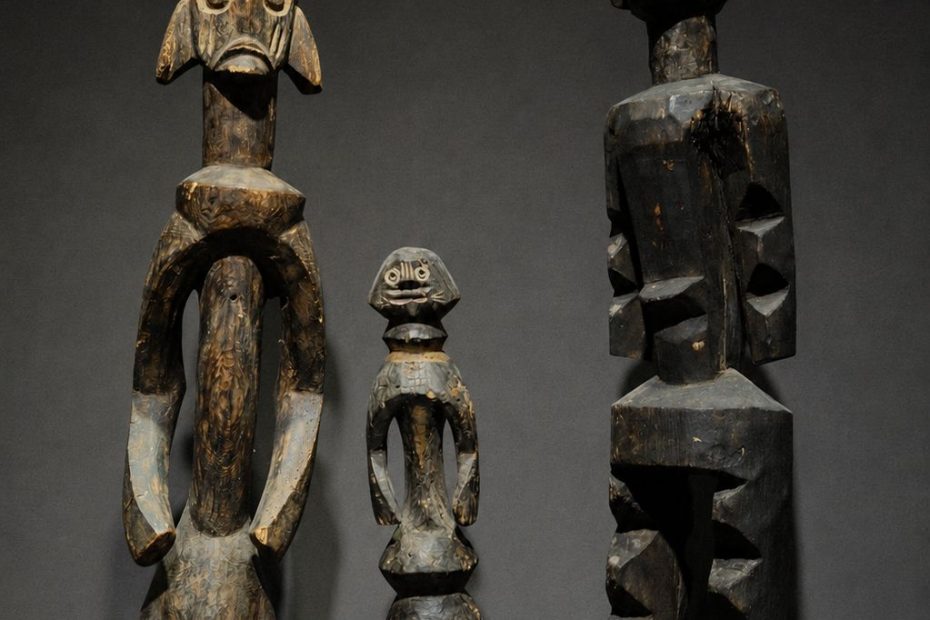
Three Close Encounters
The three figures illustrated below have been living together in my gallery for some time. Seen side by side, their personalities become immediately apparent.
The figure on the left, with its large circular eyes and elongated body, possesses a quiet elegance and simplicity. The smaller central figure has a more playful character, while the larger figure on the right — probably Montol rather than Mumuye — has a more architectural quality, with powerful geometric volumes and deeply carved forms.
Looking closely at their faces, one begins to understand why visitors occasionally think of robots or science-fiction characters. Yet these works were created by artists from northeastern Nigeria generations before the age of cinema.
Mumuye figure, Nigeria
Height: 45 cm
Price: €1,450
Mumuye figure, Nigeria
Height: 34 cm
Price: €950
Montol figure, Nigeria (?)
Height: 54 cm
Price: €1,950
Happy and curious,
David Norden
African Antiques From Antwerp — One Eye, 30 Years of Selection
For collectors building a serious collection: buy fewer, but better.
There is an old story I once heard from a collector who spent years traveling through mountain villages between Nepal and Tibet.
He told me that certain masks should never be looked at too quickly.
“At first,” he said, “they are only wood.”
But then, after some time, the face begins to change.
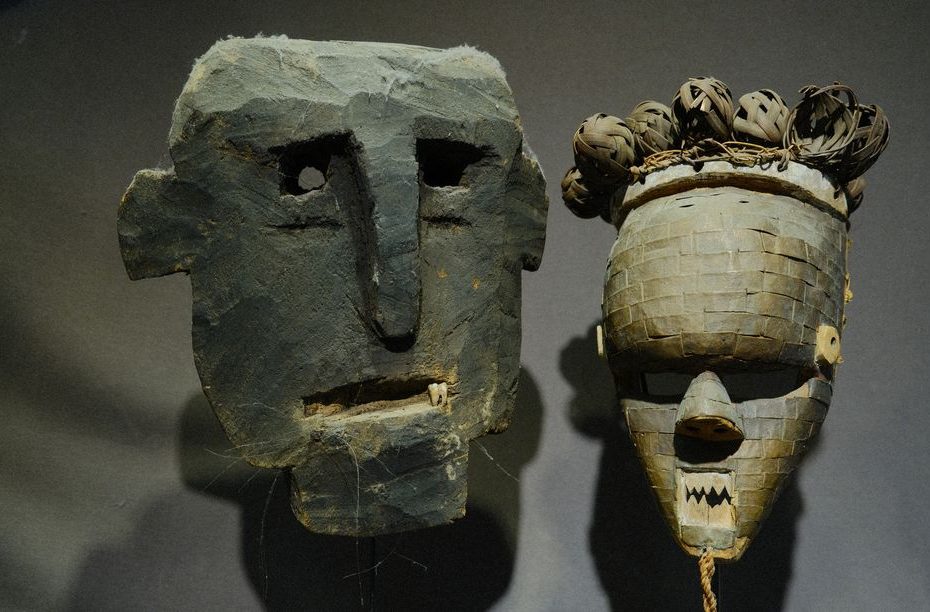
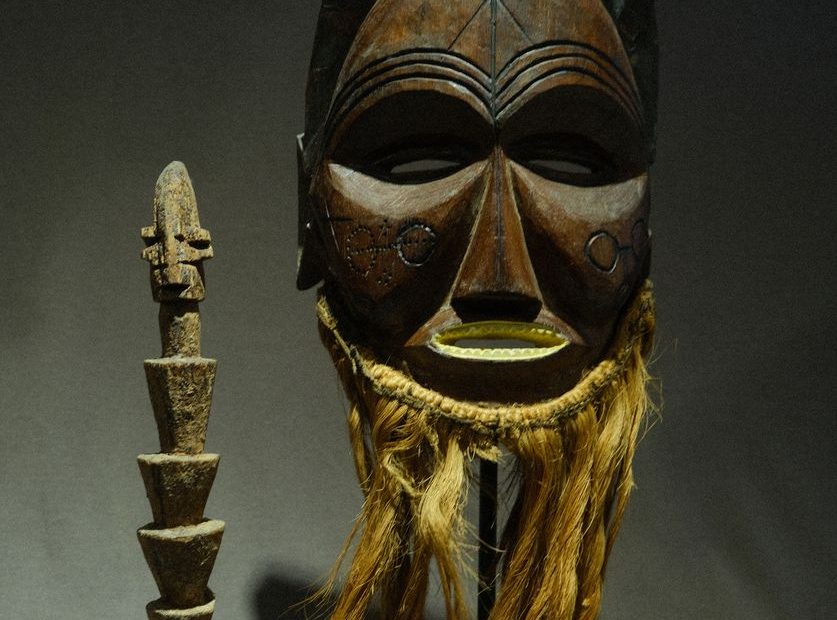
One evening, while arranging objects in my gallery, I placed two masks beside each other almost accidentally. A Nepalese shamanic mask and a Salampasu mask from Congo.
Different continents. Different beliefs. Different peoples.
And yet, the room suddenly became strangely quiet.
The Nepalese mask was the first to emerge from the darkness. Its face was dry and ancient, with deep shadows around the eyes and mouth. At first glance, it seemed almost humorous — a crooked grin, exaggerated teeth, a theatrical expression.
Then I noticed the tooth.
Not carved.
Human.
The collector’s story returned immediately.
In Himalayan ritual traditions, masks were never merely decorations. They were instruments used by shamans during ceremonies of healing, protection, and exorcism. Some antique examples even incorporated real human or animal teeth into the carving itself, strengthening the presence of the spirit inhabiting the mask.
The mouth was not symbolic.
It was active.
Nearby, the Salampasu mask watched silently.
Its mouth was entirely different — rectangular, aggressive, armed with rows of sharpened teeth beneath a massive domed forehead covered in metal strips. The woven beard ended in a tightly braided sphere like a final punctuation mark.
The Salampasu people of Congo were known as hunters and warriors. Their masks belonged to initiation societies reserved for men, appearing during ceremonies marking passage into adulthood. Among the Salampasu, the sharpening of human teeth formed part of identity itself. The body became an extension of ritual force, much like the masks they carved.
And suddenly the two objects no longer seemed far apart.
One carried an actual human tooth.
The other transformed human teeth into sculpture.
Both understood something ancient:
The mouth is power.
The mouth speaks. Threatens. Invokes. Breathes life into chants and names. It is where invisible force leaves the body and enters the world.
Perhaps this is why ritual masks remain so compelling even after leaving their original cultures. Long after the ceremonies disappear, something still survives inside the sculpture itself.
Not literally perhaps.
But enough to make us look twice.
Later that evening, before turning off the lights, I glanced once more toward the wall.
For a brief moment, the Nepalese mask almost appeared to smile.
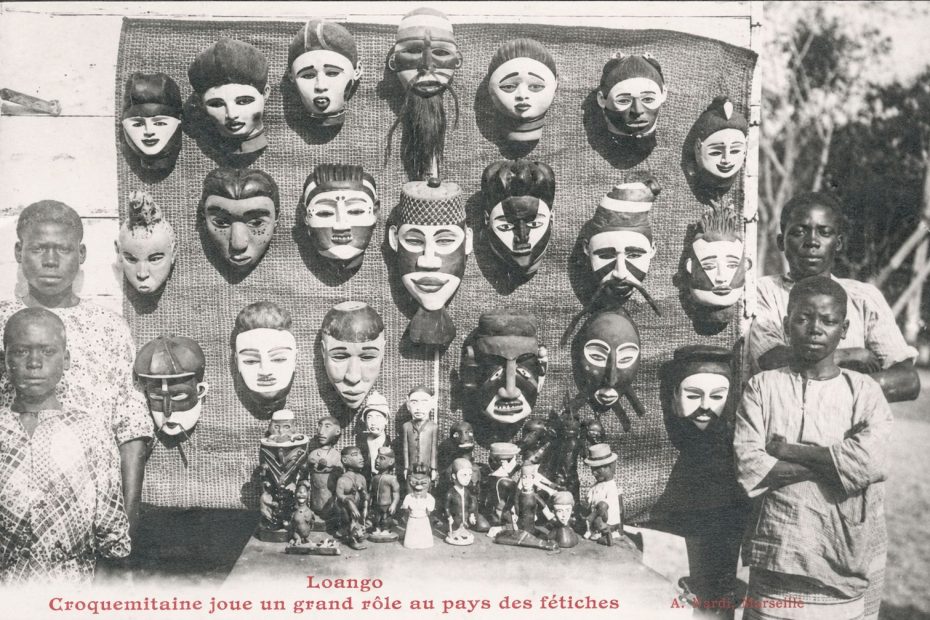
Recently I revisited a fascinating postcard from the Loango coast, dating from around 1910. At first sight, it appears to confirm exactly what many collectors hope to see: African masks and figures photographed “in the field,” offered in an open-air market during the colonial period.
For many collectors, such early documentation immediately creates reassurance. The older the publication or photograph, the more authentic the objects are assumed to be.
But when one looks carefully at the postcard, the situation becomes far more interesting — and far more complex.
Some masks seem clearly inspired by Kongo traditions, yet several also appear simplified, repetitive, or intentionally carved for trade. In other words, this postcard may already document an early tourist and export market. This should not surprise us. Along the Loango coast, artists had already been producing works for European traders, sailors, and colonials since the 19th century, alongside objects made for local use.
And yet here lies the paradox: some of the masks shown in this postcard resemble works that later entered museum collections — and it is entirely possible that some of these very masks eventually did so themselves.
That uncomfortable reality challenges many simplistic ideas about authenticity.
Today, objects are often divided into rigid categories:
authentic or commercial
ritual or tourist
traditional or made for the market
But history was rarely so clean.
The postcard shows an African world already deeply connected to trade, foreign demand, colonial presence, and artistic adaptation. African artists were not passive creators frozen in an untouched past. They responded intelligently to changing realities around them.
Colon Figures and a Forgotten Category
One detail particularly caught my attention: at the level of the bellies of the two men standing on either side of the image, several small colon figures representing Europeans can be seen, probably displayed on a table placed in front of the masks.
These figures are fascinating witnesses to a changing society where African artists were already observing and interpreting colonial presence.
One example from my own collection can be seen here:
What is interesting is that colon figures still occupy a somewhat uncertain position in the market today. Compared to more classical ritual sculpture from the same period, they often remain surprisingly affordable. Many collectors still hesitate on how to classify them:
ethnographic curiosity
colonial souvenir
transitional object
or serious sculptural work
And perhaps this uncertainty explains why they remain intellectually undervalued within African art history.
Yet these figures are historically important. They show African artists observing Europeans, reacting to colonial society, and adapting their visual language to a rapidly changing world. They are not outside African art history — they are part of it.
The Colonial Gaze
The inscription on the postcard is equally revealing:
“Croquemitaines joue un grand rôle au pays des fétiches.”
The term croque-mitaine refers to the bogeyman used to frighten children. The masks are therefore presented not as sophisticated cultural creations, but as exotic and frightening curiosities for a European audience.
The postcard tells us not only about African art, but also about the colonial imagination looking at it.
A collector friend formulated it very well during an online discussion:
“This postcard is less an ethnographic record than a visual statement of early 20th-century colonial perception.”
That observation is important. The word fétiche itself says more about European misunderstanding than about the cultures that produced these objects.
What were once living objects — used in ritual, performance, initiation, healing, and social structure — became transformed into exotic curiosities for outsiders.
And yet, despite this colonial framing, the objects still speak.
Even through the limitations of the postcard, one can still sense:
the diversity of styles
the individuality of forms
the sculptural intelligence behind certain pieces
and the artistic strength that later attracted museums and collectors.
“Made for the Market”
When I posted this image online, reactions were surprisingly divided.
Some collectors immediately dismissed the objects as “made for the market.” Others argued that these works should finally be recognized as a legitimate category of African art history in their own right.
One comment struck me particularly:
“These pieces can very well be antiques and art.”
Exactly.
The existence of a market context does not automatically destroy artistic value. Artists have always adapted to patrons, markets, and changing societies. This was true in Europe, in Asia, and equally in Africa.
At the same time, it is also true that many objects visible in the postcard appear freshly carved and intended for trade. Both realities can exist simultaneously.
That is precisely why the postcard is so interesting.
It forces us to move beyond simplistic categories and confront the historical complexity of African art itself.
Museums, Provenance, and the Eye
Interestingly, several masks illustrated in museum publications and research on Loango and Kongo material show striking formal similarities to examples visible in the postcard, further complicating simplistic distinctions between “museum art” and “market production.”
For readers interested in exploring this further, the following research publication from the AfricaMuseum (in French) is worth consulting:
At the same time, age alone can never be enough to guarantee authenticity or quality.
An old postcard, an old label, or an early publication may strengthen an object and change its perception and value — but they can never replace the eye.
Museums and postcards do not only preserve history or certainty.
Sometimes they preserve historical complexity.
You cannot change the past — but you can change the way you look at it.
Happy and curious,
David Norden
African Antiques From Antwerp — One Eye, 30 Years of Selection
For collectors building a serious collection: buy fewer, but better.
This morning, before opening the shop, I placed these two next to each other.
Not because they belong to the same tradition. They clearly do not.
But sometimes objects begin to speak differently when they share the same space for a while.
One is a mask from Zambia, in the Mbunda style.
The other, a small Lobi figure from Burkina Faso and Ivory Coast.
The mask immediately takes control of the table.
Its construction is unusually deliberate. The repeated lines above the eyes almost feel architectural, as if the face was assembled rather than carved. It reminded me of older Mbunda masks I had seen years ago — those powerful faces balancing authority and restraint.
But what interested me most here was not the attribution.
It was the tension.
The mask feels calm, but not passive. The symmetry is controlled, though never rigid. Even the surface has settled in a convincing way, without the heavy-handed restoration or artificial aging one so often encounters today.
At first glance, it almost disappears next to the mask.
But after some time, it became the piece I kept looking back at.
The composition is extremely reduced — almost like a narrow ladder with a head placed on top. Very little is described. And yet the figure holds together remarkably well.
There are traces of sacrificial material still attached to the surface, forming a dense encrusted patina that gives the object its physical weight and history.
There are objects that one first encounters as forms, and only later understands as systems.
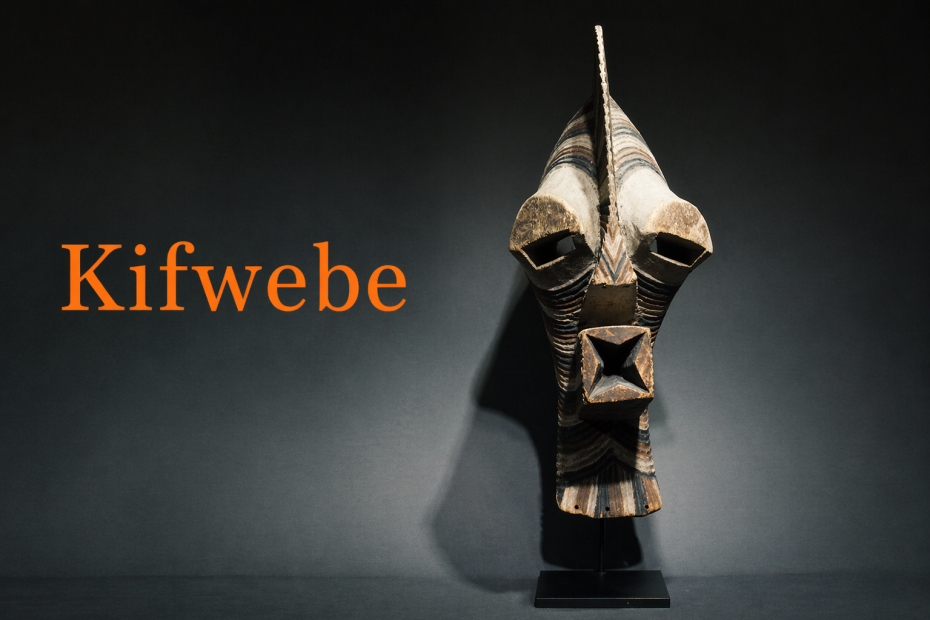
The Songye Kifwebe mask belongs to this category.
At first glance, it is defined by its structure: a face reduced to essential volumes, covered with rhythmic striations, interrupted by projecting eyes and a mouth that breaks the plane. The geometry is direct, almost abrupt. It is easy to understand why such forms would later resonate with Cubism.
But this clarity is not aesthetic invention. It comes from function.
An Object of Authority
Kifwebe masks were created within the Bwadi Bwa Kifwebe society, a powerful institution among the Songye. These were not decorative objects, but instruments used to regulate social order, enforce authority, and accompany important rituals.
They appeared in moments of tension: initiation, illness, funerals, or the presence of power. Their role was active, not symbolic.
Early observers already noted the dual nature of these masks—at once controlled and unsettling. A balance between order and distortion, beauty and force.
Structure Before Style
What defines a Kifwebe mask is not its decoration, but its construction.
The surface is organized through incised striations, often enhanced with pigments—white, red, or black. These are not ornamental. They structure the face, guiding the eye, creating rhythm and tension across the volume.
The central crest indicates a male mask, associated with authority. White masks, often considered female, form the basis from which other variations developed.
Over time, the style evolved:
earlier examples show more restrained, curvilinear forms
later masks become more geometric, more exaggerated
by the mid-20th century, some forms reach a near abstract intensity
This evolution is not linear, but it shows a constant exploration of structure.
Kifwebe Songye bifwebe masquerade photographed in the Congo in 1934
Early Encounters
The first documented Kifwebe masks entered Western collections at the end of the 19th century.
Explorers, colonial officers, and early ethnographers collected them—often without fully understanding their meaning. The German ethnologist Leo Frobenius, during his expedition of 1905–1906, gathered several examples and recorded fragments of their context.
What emerges from these early accounts is a sense of distance:
the masks were difficult to obtain
their meaning was only partially revealed
and their use remained, in many ways, deliberately obscured
Even at that time, they were already considered powerful objects.
From Ritual to Collection
Today, these masks exist in a different context.
Removed from their original function, they have entered collections—private and institutional. Their role has shifted. No longer active within a social system, they are now observed, studied, and lived with.
And yet, something remains.
The structure still holds. The tension is still present. The object does not collapse into decoration.
This is perhaps why Kifwebe masks have had such a lasting impact. Not only within African art, but also in the way Western artists began to rethink the human face—breaking it down into planes, volumes, and essential forms.
Experienced Eye
When looking at a Kifwebe mask, it is useful to step away from the idea of “mask” as an object, and to see it instead as a construction of forces.
The lines are not drawn—they are carved to control movement. The volumes are not shaped—they are positioned to assert presence.
This is what gives certain examples their strength.
And this is also why, once placed within a collection, some of these masks do not simply sit among others—they tend to organise the space around them.
From Kifwebe to Verstockt — a shared language of structure
Not long after acquiring this mask, I discovered an additional layer to its history.
On the reverse, a label identified it as having been part of the collection of Mark Verstockt (1930–2014), the Antwerp-based artist whose work focused on geometry, repetition, and structure.
What interested me was not only the provenance, but the connection.
Verstockt’s work often reduces form to its essential elements—lines, rhythm, and controlled variation. Looking again at the mask, one begins to see a similar logic at play. The striations are not decorative; they organize the surface. The face is not modeled, but constructed.
Two very different worlds, yet a shared way of thinking through form.
I had, in fact, worked with Verstockt years ago, as a photographer, on the book Het teken Mens, centered on Chinese calligraphy. At the time, the connection to African sculpture was not something I considered.
Only later, with this mask in front of me, the parallel became clear.
Closing
The Kifwebe mask is often approached through its striking appearance.
But its true interest lies elsewhere.
Not in what it represents, but in how it is built.
African Art Gallery — Step Inside the David Norden Cavern
When people search for an African art gallery, they are often looking for beauty.
But seasoned collectors are looking for something else entirely: truth, age, rarity, and presence.
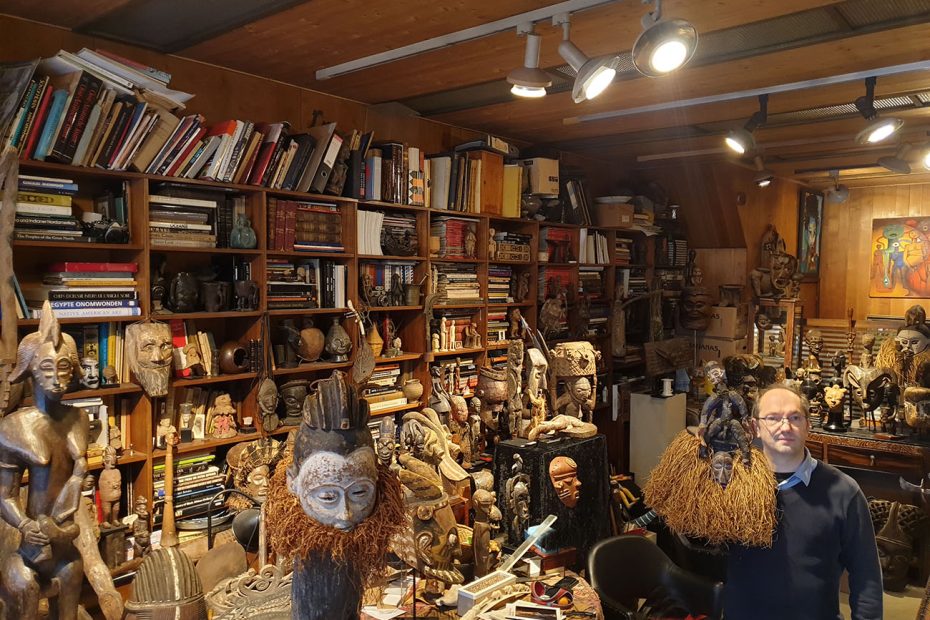
The other day, something happened in my Antwerp gallery that made me smile.
The director of the African Art department at the Musée du quai Branly in Paris walked in.
He looked around, paused, and said:
“This is amazing, it looks like the Alibaba cavern.”
I told him: “No, this is the David Norden cavern.”
And in a way, that says everything.
The Difference Between Display and Selection
Many galleries present African art.
Few truly select it.
An experienced eye does not start with aesthetics.
It starts with questions:
Has this object lived a life before arriving here?
Does the surface show real use, or artificial aging?
Is the form consistent with known hands and traditions?
Does it hold presence when you stand in front of it?
These are not things you can fake convincingly.
And they are not things you can always explain quickly either.
A Cavern, Not a Showroom
A true African art gallery is not always minimal, white, and silent.
Sometimes, it is layered.
Dense.
Full of discoveries.
You don’t take it in at once—you enter it.
It took me 33 years to build it.
That is how I have always built my space:
not as a showroom, but as a place where objects live together until the right collector finds them.
Yes, it may feel like a cavern.
But every piece in it has been chosen, one by one, over 33 years.
Not only private collectors buy from me—museums do as well.
What you see there is a carefully selected group of pieces.
But the full collection is something else entirely.
Many objects never make it online.
They are part of a deeper selection—available to those who take the time to ask, to look, and to engage.
If something speaks to you, the best way is simple:
Send me a message to ask for more information or arrange a wire transfer
Use the online shop to purchase directly
Or arrange an appointment to see it in Antwerp
The gallery is often open without one—
but the real experience is always better when there is time and attention.
Buying African Art Is Buying an Eye
Collectors sometimes think they are buying an object.
But over time, they realize they are buying something else:
They are buying someone else’s judgment, refined over decades.
That is what turns an African art gallery into something worth returning to.
Not just what is there—
but how it got there.
A Quiet Suggestion for Collectors
If you are building a collection, don’t rush.
Visit African art galleries.
Visit museums.
Buy books.
Look, compare, and then return again.
Over time, try to understand what you are really seeing:
Is the object alive, or does it feel empty?
Does it create a strong emotional response, or is it just a pale copy—made quickly, without depth?
Ask yourself:
Did the artist take the time to bring this piece to life?
Or was it simply produced?
Because in African art, the difference is not subtle.
A true piece carries presence.
A lesser one only imitates it.
African Antiques From Antwerp — One Eye, 30 Years of Selection
Not an inventory. A perspective. Collected slowly, chosen carefully, offered with certainty.
And there are those who live with objects for a long time before letting them go.
Not long ago, an anthropologist came to see a Dogon figure.
He didn’t come alone.
He came with his wife, and they spent time with the piece — quietly, without deciding.
Nothing happened that day.
Which, in hindsight, was already meaningful.
Two weeks later, he returned.
This time, not to negotiate.
But with a different kind of proposal.
He was ready to let go of pieces he had lived with for years, in order to take one with him.
An anthropologist looks differently.
Not in terms of categories or completeness.
But in terms of use.
How an object has been handled. Returned to. Integrated into a life.
And over time, that changes what is kept.
The group that came from this exchange was not assembled.
It had already taken shape, slowly, over years.
African, but not only African.
Objects that lived alongside Oceanic works, Pre-Columbian pieces, and traces of archaeology.
Not separated, but understood in relation.
That kind of collecting leaves marks.
Not always visible at first.
But present in the surface. In the choices. In what was not discarded.
Some pieces reveal themselves immediately.
Others take longer.
Those are often the ones that remain.
Looking back, the exchange was simple.
Not a transaction.
But a moment where two ways of seeing aligned — just long enough for objects to change hands.
Below are some of the pieces that came from that moment. (click on the images to enlarge)
Mossi Mossi figure — ex New York collection, Bonhams New York Mossi — a bit older than usual with a balance that doesn’t need explanation. Height 47 cm
Boki Boki figure — ex Ursula Heijs Voorhuis collection Boki — strong hands the rest follows slowly. Height 38 cm
Dan mask Dan mask — French collection, later Netherlands Dan — almost dreaming not fully awake. Height 22 cm (32 cm on stand)
Dan divination figure Dan divination figure — French collection Dan — a form that calls the spirits the forest still responds. Height 35 cm
Igbo (Ikenga) Igbo figure (Ikenga) — collection Nancy & John Hyde DeVoe, New York (1950s–70s) Igbo — Ikenga a figure of strength, held over time — and across the ocean. Height 57 cm
Ibibio Ibibio panel — Danish collection Ibibio — quiet construction with a presence that builds slowly. Height 27 cm
Pende Pende mask — ex Hans Schoute, The Hague Pende — light in appearance but not without structure. Height 23 cm
If one of these speaks to you, feel free to get in touch.
I’ll be happy to share more images, provenance, or details.
Chibinda Ilunga figure, Chokwe, Angola — Museum RietbergThis article is based on a recent newsletter I sent to collectors.
Over the years, I’ve noticed that most collectors are not lacking interest — they are lacking orientation.
Where do you look?
What do you trust?
And how do you train your eye?
In this guide, I share three practical directions that I personally use — and that can quietly transform the way you see African art.
1. Train Your Eye: Use Museum Collections
If there is one habit I would recommend to any collector, it is this: spend time with museum collections.
Not only in person — but also online.
Today, many major institutions offer access to thousands of documented objects. You can study proportions, surfaces, patina, and even small details that rarely appear in books.
In the guide below, you’ll find direct and active links to museum databases, along with a selection of objects that I personally find particularly interesting.
Over time, something shifts — you begin to recognise what feels right… and what doesn’t.
Collector insight:
The more time you spend with strong, documented objects, the more confident your decisions become when a good piece appears.
2. Understand What You Are Really Looking At
One of the most common mistakes I see is confusion between authentic objects and decorative pieces.
The difference is not always obvious — especially at the beginning.
But authentic objects tend to have a certain internal coherence:
the proportions make sense, the wear follows use, the surface has depth, and the object carries a presence that is difficult to imitate.
In the article below, I explain how I approach this distinction in practice:
Collector insight:
Once you have seen enough authentic pieces, decorative ones start to feel strangely empty — even when they look convincing at first glance.
While writing this, I was reminded of a mask I have kept in the collection for some time — an Ibibio “Chanel” mask.
At first glance, it may seem unusual or even playful. But if you take a closer look, you begin to see the coherence in the carving, the balance in the proportions, and the way the surface has evolved through handling and use.
It is also a good example of how African artists could absorb and reinterpret external influences, while remaining rooted in their own visual language.
This is exactly the kind of object where experience matters — not because it is obvious, but because it reveals itself over time.
African art is often simplified — sometimes too much.
Certain names are used so loosely that they can become misleading.
Take the Kuba, for example.
Behind this single label lies a complex network of workshops, styles, and neighbouring cultures. Not everything labelled “Kuba” is what you might expect — and understanding that can completely change how you evaluate an object.
In the article, I also touch on the figure traditionally associated with the founding of the Kuba Kingdom, and why that history still matters when looking at objects today.
If you want to look beyond the label and discover the story behind it:
This guide for collectors and enthusiasts reflects how I personally use museum collections as a collector and dealer to evaluate and understand African art.
It is illustrated with a selection of objects that have particularly caught my eye.
Over the years, many collectors have asked me how to distinguish genuine African art from purely decorative pieces.
In essence, it comes down to recognition — building a visual memory by studying important collections, well-curated auctions, and fairs where you can see, touch, and even smell the objects.
But above all, it comes from visiting museums.
Below is a selection of museums with significant African holdings. Some are well known, others less so, but all are worth exploring. Whenever possible, I include direct links to the online collections, which are extremely valuable for research and comparison, as well as interesting references to historical photographs taken in situ.
The Metropolitan Museum houses one of the most important African art collections in the world. The recently reinstalled Michael C. Rockefeller Wing presents masterpieces from West and Central Africa including Fang reliquary figures, Yoruba sculpture and Kongo power figures. The Met’s digital collection is one of the most powerful research tools available to collectors.
The Quai Branly holds one of the largest collections of African art in Europe, with tens of thousands of objects. Its digital catalogue allows detailed searches across cultures, regions and materials.
The British Museum’s African collections include archaeological objects, sculpture, textiles and royal regalia. Particularly famous are the Benin bronzes, which continue to play an important role in discussions about cultural heritage and restitution.
In the Chokwe country-side A village [graphic] :Photo: Gorlia around 1910
Part of the Smithsonian Institution, this museum is entirely dedicated to African art. Its collection includes both traditional sculpture and modern works.
Baltimore Art Museum BMA
A spectacular early male Kifwebe mask 1984 gift of Robert and Nancy Nooter, Washington, D.C.
One of the most important collections of African art in the United States, the BMA’s African art collection features works from more than 200 African cultures in a full range of media.
Located near Brussels, this museum holds one of the most extensive collections of Central African objects anywhere in the world, including masks, sculptures, textiles and ritual objects from the Congo basin. It is also used by everyone having an interest in the old colony of Congo resources, and is today also actively working with the diaspora
Luba stool Collections online. Given in 1911 to the Pitt Rivers Museum.
The Pitt Rivers Museum is famous for its unique display style and its enormous ethnographic holdings. The online database provides access to a wide range of African objects collected over the last century.
Formerly known as the National Museum of Ethnology, the Wereldmuseum holds extensive ethnographic collections from Africa gathered during the nineteenth and early twentieth centuries.
The Museum Rietberg in Zurich is one of the most important museums in Europe devoted to non-European art. Its African collection contains around 2,400 objects, mainly from West and Central Africa, covering more than six centuries of artistic traditions.
Figure of the culture hero Chibinda Ilunga, Workshop of the Chokwe region, Angola, around 1850 Wood, Museum Rietberg, 2007.1, Gift acquired through Novartis
What makes this museum especially valuable, from a collector’s point of view, is its archive related to African art scholarship. One of the most notable is the Hans Himmelheber archive, which contains thousands of field photographs, films and documents related to African artists and workshops.
Nigeria’s national museum preserves important archaeological and cultural treasures including Nok terracottas and Yoruba sculptures. It plays a key role in preserving and studying Nigerian cultural heritage.
A museum about Yoruba art, traditions and masquerades. https://www.jrandlecentre.com
Lagos Island, Lagos 102273, Lagos. +234 807 891 8190. museum@jrandlecentre.com
AI Overview
The
National Museum of Lubumbashi (Musée national de Lubumbashi) is located at 750 Avenue du Musée, Lubumbashi, Democratic Republic of the Congo. It is known for its extensive collection of ethnographic, archaeological, and contemporary art, housed in a distinctive building designed by Claude Strebelle
Africa itself holds many more important museums and collections — far more than can be listed here.
Lesser-Known Museums with Valuable African Collections
Many collectors are familiar with the large institutions in Paris, London or New York, but a number of other museums also hold remarkable African objects and sometimes provide excellent online access.
For collectors and researchers, smaller museum databases often contain fascinating objects that rarely appear in publications. They can help identify regional styles, compare carving traditions, and sometimes reveal historical provenance information.
These institutions are often overlooked but can be extremely useful for research and comparison. Exploring these lesser-known collections can lead to surprising discoveries and a deeper appreciation of African artistic traditions.
Museum aan de Stroom (MAS) — Antwerp
Being based in Antwerp myself, I enjoy browsing the MAS collection regularly. It sometimes reveals objects connected to Belgium’s early collecting history and the long relationship between Antwerp and Central Africa.
This Luba bowl entered the Mas collection of African Art in 1958. The bowl was filled with white clay and other objects of power.
The MAS museum in Antwerp has made its entire collection accessible online. More than 600,000 objects can be searched through the database, including African masks, sculptures and ethnographic material.
One particularly interesting aspect of the MAS database is that it includes not only objects currently on display but also those kept in storage.
Ofika Mbole Mas Museum Henry Pareyn
You can search in the database for the objects from Henry (Henri) Pareyn wo started collecting and dealing in African art (mostly from the Belgian Congo) in the 1890s.
Based in Antwerp, he amassed huge collections. Two major sales took place during his lifetime: in around 1910 and notably, in 1920 when the City of Antwerp purchased 1600 ‘Congo objects of all kinds’ which formed the basis of the Antwerp Ethnography Museum’s Central African collections. After his death in 1928, his widow offered his entire collection to the City of Antwerp for 350,000 Belgian Francs. This offer was declined and the collection was put up for auction at the Grand Hotel, Antwerp in 10-15 December 1928.
This 5 day auction with almost 2,000 lots raised 2,000,000 Belgian Francs. Many of the lots were sold to external buyers, among them Sir Henry Wellcome (from whom much came to the BM). See Waterfield & King p.71 for a rumour that an English dealer had bought half the sale for Sir Henry Wellcome. The lot numbers of items in the Pareyn sale were written in ink on a white paper disc that was pasted to the front of the object; this enables many of Wellcome’s purc hases from the Pareyn sale to be recognised, like also Henry Pareyn in the Fowler museum.
Portugal’s National Museum of Ethnology holds important collections from Africa, especially from former Portuguese territories such as Angola, Mozambique and Guinea-Bissau. The museum preserves valuable documentation of traditional cultures and colonial collecting history.
Museum of the Lisbon Geographical Society — Lisbon
This museum is rarely mentioned in discussions of African art but and can only be visited by appointment, but it contains remarkable historical collections gathered during Portuguese exploration and colonial expeditions. Among the highlights are impressive Congo and Chokwe materpieces objects . The museum of the Lisbon Geographical Society is one of the best-kept secrets in Lisbon. It inherited its collection from what was once the “Colonial Museum” and assumed an ethnographic focus from early on. It grew through a campaign of acquisitions and the donations of collectors and travellers who accompanied the Portuguese outposts in the former empire. Discover ceramics, sculptures, furniture, paintings, fabrics, glass, tiles and even scientific instruments from the most disparate of sources: Angola, Guinea, Mozambique, São Tomé and Príncipe, Cape Verde, Timor and Macau. A unique exhibition, which brings together art and scientific/everyday objects and which shows the habits and depictions of distant lands. Be a 21st-century explorer and travel in time at this 19th-century society.
Rua das Portas de Santo Antão, 100, 1150-269, Lisboa
The Minneapolis Institute of Art has developed one of the strongest African art collections in the United States. The museum is known for carefully selected masterpieces and scholarly exhibitions devoted to African sculpture.
The Fowler Museum is highly respected among scholars of African and Oceanic art. Its digital database includes many objects from Africa some also from Henry Pareyn and often provides good photographic documentation.
I remember that I got a wonderfull and instructive private viewing from the curator during an exhibition they did in Paris in collaboratin with the Quai Branly Museum about the Lega objects from the Jay Last collection.
Fine Arts Museums of San Francisco (de Young Museum)
Luba artist, Figure, 19th century, Democratic Republic of Congo. Wood, metal, and fiber, 10 1/4 x 2 x 1 7/8 in. (26 x 5.1 x 4.8 cm). Fine Arts Museums of San Francisco, Gift of Richard Scheller, 2019.1 A Luba Figure: An Expression of Ideals of Beauty and a Locus for Memory
The de Young Museum holds a significant African art collection, particularly strong in West African sculpture. Its digital catalogue allows visitors to explore objects from many regions of the continent.
The Horniman Museum has an important ethnographic collection that includes African masks, musical instruments and ritual objects collected during the late nineteenth and early twentieth centuries.
Need to discover more African Art museums around the World ?
The Yale archives include the Van Rijn Archive up to 2012 for free and the Ross Archive, which contain historical photographs before 1920’s, field documentation and research material related to African art collecting and scholarship. These archives are widely used by researchers.
8.990 items images from before 1921 from the Ross Archives
The AHDRC is one of the most important digital research platforms dedicated to African art. The archive contains thousands of historical photographs, field documentation and publications, and allows also to get access to the price history and exhibitions and publications the objects where in and has a good search engine.
Access is subscription-based (approximately €250 per year) and the platform is widely used by professional researchers, dealers and scholars.
To get a taste, on Jstor you can access for free the database updated till 2012, and search among 111.580 items
Artkhade provides a digital platform for cataloguing artworks at auctions and collections and is used by museums, galleries and collectors to manage documentation and provenance information. It is increasingly used within the professional art world for price setting.
Why Museum Databases Matter for Collectors
Museum collections remain one of the most valuable resources for anyone interested in African art. They allow collectors to:
compare objects with documented museum examples
study regional styles and carving traditions
explore historical provenance information
examine high-quality photographs of important works
Many museums now provide high-definition images, and some allow images to be used for scholarly or educational purposes. These digital collections have become an essential tool for collectors, researchers and enthusiasts who wish to deepen their understanding of African sculpture.
Even after many years working with African art, I still find museum collections — both in person and online — an endless source of discovery. If you know other museum databases with strong African art collections, feel free to let me know. I am always interested in discovering new resources.
And if this article has made you curious to go further, you can explore a selection of African masks and figures — each chosen through the same eye I’ve developed over 30 years of looking:
Following the publication of this guide, several collectors kindly shared additional museums worth exploring. Many of these are less frequently discussed but can offer valuable insights for collectors and researchers.
The AMNH holds one of the most important ethnographic collections in the world, including a celebrated Mangbetu collection and extensive photographic archives.
👉 Particularly valuable for historical field documentation and early collecting context.
🇩🇪 Germany
Germany holds some of the most important ethnographic collections in Europe.
One of Italy’s most important ethnographic museums, with significant African collections.
👉 Particularly relevant for colonial-era collecting and documentation.
Final Note
These additional museums confirm something I have learned over the years: good objects are not only found in the major institutions.
Often, it is in lesser-known collections that you begin to recognise subtleties — variations in style, unusual forms, or objects that have not yet been widely published. For a collector, this is where the eye sharpens.
If you have the opportunity, I would encourage you to visit some of these museums, explore beyond the obvious, and, whenever possible, meet local collectors along the way.
And if your travels lead you to interesting discoveries — whether in museums or private collections — I would be very interested to hear from you. Exchanges between collectors are often where the most meaningful pieces change hands.
I am always open to discussing objects, helping to place important pieces, or simply sharing thoughts about what you have seen.
Traditional African art is one of the most powerful artistic traditions in the world. Across hundreds of cultures and thousands of communities, artists created masks, sculptures, and ritual objects that served social, spiritual, and political purposes.
Unlike modern decorative art, authentic African art was created to function inside living traditions. Masks danced in ceremonies, figures protected villages, and ritual objects mediated between the living and the ancestors.
For collectors today, these objects offer something rare: a chance to hold a piece of cultural history shaped by belief, ritual, and time.
For more than 30 years, I have helped collectors discover authentic traditional African art through my gallery in Antwerp and through my website:
This rare helmet mask from the Bena Biombo people of the Congo features distinctive chameleon-like eyes symbolizing transformation and adaptability. Masks like this were used during royal funerary ceremonies and masquerades that connected the living community with ancestral spirits. ‘read also the article about the Kuba tribe since they are not what you think.
Other masks currently available include:
Ibibio “Chanel” mask. This striking Ibibio mask originates from the Ekpo secret society of Nigeria, a powerful institution that maintained social order through fear and ancestral … https://buyafricanantiques.com/product/ibibio-chanel-mask/
This impressive sculpture represents the ancestral couple of the Lobi clan and was traditionally placed in shrine spaces where it protected the community and embodied ancestral authority.
Another fascinating example of Lobi artistic tradition is this iron sculpture:
Hand-hammered by a Lobi blacksmith, the bird represents the remarkable metalworking skills of West African artisans and reflects the symbolic role animals play in African cosmology.
Other sculptural objects currently available include:
Each object carries its own cultural narrative and history of use.
The Materials of African Tribal Art
African artists worked with a wide range of materials depending on regional traditions and available resources.
Art form
Typical materials
Cultural role
Masks
Wood, pigments, raffia
Ritual dances and masquerades
Figures
Wood, iron, terracotta
Ancestors, protective spirits
Metal objects
Iron, bronze, brass
Prestige objects and ritual implements
Dolls and figures
Wood and beads
Fertility and spiritual symbolism
These materials were rarely chosen for decoration alone. They were selected for their symbolic meaning and ritual function.
How African Art Influenced Modern Art
When European artists encountered African masks and sculptures in the early twentieth century, the impact was profound.
Artists such as Picasso and Modiglianiwere inspired by the bold geometry, stylized faces, and expressive power of African sculpture. These encounters helped shape movements such as Cubism and modernism.
But what fascinated these artists was not merely style.
It was the realization that in African cultures art was inseparable from life, ritual, and belief.
Collecting Authentic African Art Today
Today, the biggest challenge for collectors is distinguishing authentic traditional objects from decorative reproductions.
Many pieces offered online were made for the tourist market and were never used in African communities.
Recognizing genuine objects requires experience:
knowledge of carving traditions
understanding of surface and patina
familiarity with ritual use and cultural context
After more than three decades working with African art, I still find that the most reliable guide is simply this:
having seen thousands of objects over many years.
That experience shapes the selection you see on my website.
Explore Authentic African Masks and Sculptures
If you would like to explore authentic African art currently available, you can browse the collection here:
Most people think they understand what “Kuba” means.
A tribe. A style. A familiar category.
But that’s usually where the misunderstanding begins.
What we call the Kuba is not a single people in the usual sense. It is a kingdom — or more precisely, the result of one. Nearly twenty different groups, brought together and held within a structure that did not exist before. (https://en.wikipedia.org/wiki/Kuba_Kingdom)
And that structure still shows in the objects.
If you spend enough time with Kuba work, you begin to notice something subtle. Even when a surface feels playful, even when a pattern seems to wander, there is always a sense that it could not have been otherwise.
That feeling has a beginning.
In the early 17th century, this was not yet a kingdom. It was a region of separate groups, without a real center. Then a man appeared — or returned, depending on the version of the story.
His name was Shyaam a-Mbul a Ngoong. He ruled circa 1625-1640) and is remembered as the founder of Kuba civilisation, but not because he simply took power. What he did was more interesting than that. He reorganized what existed. He introduced titles, created a court, and brought different groups into a single system. (https://encyclopaediaafricana.com/shyaam-ambul-angoong/)
Some accounts describe him as an outsider, even someone who had to disguise himself and move carefully before taking control. Others emphasize that he travelled, learned from other kingdoms, and returned with knowledge that allowed him to reshape the region. (Encyclopaedia Africana)
Either way, the result is clear.
What had been a collection of communities became something ordered. A court. A system with roles, hierarchy, and continuity.
And once that exists, everything changes. Because art is than no longer just made as such. It takes its place in the society.
At the Kuba court, objects are tied to position and recognition. Surfaces are not simply decorated — they are worked, built, adjusted, until they sit exactly where they need to be.
The masks are made to welcome people from neighboring tribes and tell the stories from the Kuba.
Even the textiles, which at first glance feel free, are the result of collaboration and control. The woven base and the embroidered surface come together slowly, within a shared understanding of pattern and variation.
You begin to see that what looks spontaneous is often deeply informed.
About the Masks
The masks belong to this same world, but they move within it differently.
At the Kuba court itself, masks are part of performance. They appear in dances that tell stories about origin, power, and legitimacy. They are not simply representations of spirits — they stage relationships.
But as you move outward, into related groups, the tone shifts.
The Lele, the Bena Biombo, and others remain connected to this broader cultural field, yet they resolve it in their own way. The forms are familiar — helmet structures, raffia, strong volumes — but the balance changes.
Some feel more restrained. Others more direct.
And that is where things become interesting.
Because you are no longer looking at a single style, but at a language spoken differently across neighboring groups.
This mask here
Helmet Mask, 20th Century Bena Biombo people Bowers Museum.
It sits slightly away from the Kuba court, but not outside its influence.
You can still feel the shared structure — the controlled surface, the clarity of form, the sense that nothing is arbitrary. But the expression is different. More direct. Less mediated by courtly layering.
There is a kind of decisiveness in it.
And when you place it next to a Kuba helmet mask, or even a Lele example, what becomes visible is not similarity or difference alone, but a relationship.
A movement away from the center, without losing it entirely.
In the end, the Kuba ask for a different way of looking.
Not as a tribe, but as a court.
Not as something improvised, but something constructed.
And never as fixed as it first seems.
Because if you follow it back far enough, you arrive at a moment where someone made a decision — to bring order, to define roles, to create a center.
And what you are looking at now is not just the object.
It is the result of that decision, carried forward.
A short tale inspired by the Yoruba tradition of the horse rider — a symbol of leadership, prestige and authority in West African art.
Photo collage: Yoruba horseman in the Osun Sacred Grove, Arch of the Flying Tortoise.
Landscape photograph by Adolphus Opara. Horseman sculpture photographed by David Norden.
A long time ago, when the kingdoms of the Yoruba were young, the people said that a great rider sometimes appeared at the edge of the town.
No one knew exactly where he came from.
At dawn he would emerge from the red earth roads, seated proudly on his horse, holding a lance that caught the first light of the rising sun. Children would run to the paths to see him pass, while the elders watched in silence.
Some said he was a warrior returning from distant lands. Others whispered that he was a messenger of the gods.
In those days horses were rare in the forest regions of southern Nigeria. They came from the northern savannas and were precious animals, associated with kings, chiefs and powerful warriors. To ride a horse was to show authority and prestige.
Over time the image of the mounted rider became one of the most powerful symbols in Yoruba art. Sculptors carved figures known as elesin—horsemen who embodied leadership, courage and the ability to command.
The rider was often larger than the horse, because Yoruba artists did not aim for realism. Importance was expressed through proportion. The horse carried the rider, but the rider carried the meaning.
Some of these figures were placed in shrines or royal spaces. Others commemorated great leaders or ancestors whose presence was believed to protect the community.
Scholars have long noted the importance of this imagery in Yoruba culture. A beautiful example in ivory from the Dallas Museum of Art illustrates how deeply rooted the motif of the mounted rider is in the region:
Even earlier, archaeological discoveries such as a tenth-century bronze object from Igbo-Ukwu showing a horse and rider remind us that equestrian symbolism has deep historical roots in southern Nigeria. You can see this remarkable object, once exhibited in the Smithsonian exhibition Caravans of Gold, here:
The door opens, and they pause — just long enough to understand that this is not a normal shop.
There are many objects. Faces, figures, quiet presences watching from shelves and walls. Some visitors step back for a moment, unsure where to look first.
I usually let that moment breathe.
Then I say, softly:
“Take your time… I live with these pieces. Some of them have stayed with me for many years.”
Something changes when they hear that.
The space becomes less a shop, more a world.
The First Question
When the visitor begins to relax, I ask my usual question:
“What brings you into my shop?”
Sometimes the answer is simple curiosity. Sometimes they have walked past many times before daring to enter. Sometimes they already know a little — enough to feel drawn toward something they cannot yet name.
I listen more than I speak.
After many years, you learn that people reveal themselves in the way they look — not only in what they say.
The Moment of Recognition
Almost always, there is one moment.
The visitor slows down in front of a piece. The rest of the room disappears for them.
I don’t rush forward with explanations.
Instead I might say:
“Yes… that one has a quiet presence.”
And then we look together.
Sometimes they ask questions. Sometimes they simply stand there, surprised by their own reaction.
This is often where a real collection begins — not with knowledge, but with recognition.
A Cabinet Curated by an Experienced Eye
My shop is small.
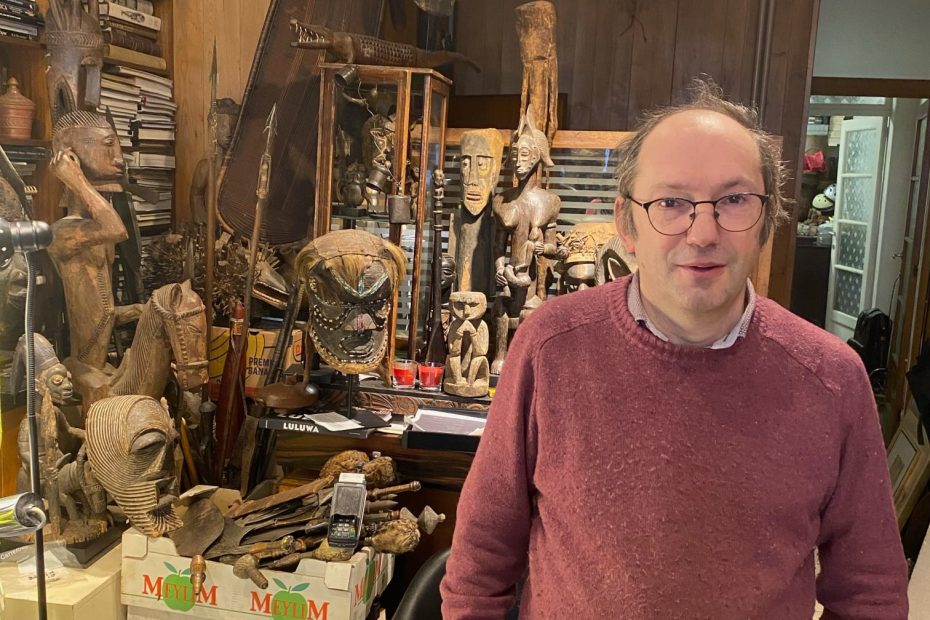
It is not minimal, not empty, not staged like a gallery. It is a cabinet — a space where objects live together, where I am surrounded by forms I have chosen over more than thirty years.
Some people find it overwhelming at first.
But many tell me later that they feel something rare here: that the objects are not displayed to impress, but to be lived with.
And perhaps that is true.
I do not think of myself only as a dealer.
I am someone who has spent a lifetime learning to see — and occasionally letting a piece leave when it finds the right person.
Leaving the Shop
Often visitors leave without buying anything.
But they leave differently than they entered.
They look again at the room before the door closes — as if memorising a feeling.
And sometimes, days or weeks later, they return.
Because once you have really looked at something — truly seen it — it has a way of calling you back.
Traveling to Warsaw to study a private African art collection reminded me once again that objects never exist in isolation. They live between people, ideas, institutions — and sometimes between different definitions of knowledge itself.
My days there included examining a private collection, discussing objects with scholar Dariusz Skonieczko, and visiting the National Ethnographic Museum in Warsaw.
What emerged was not simply an evaluation of objects, but a reflection on where African art stands today — between scholarship, connoisseurship, ethics, and changing museum narratives.
Scholarship and connoisseurship — two necessary but different languages
One of the recurring misunderstandings in African art is the idea that scholarship and connoisseurship are interchangeable. They are not.
Scholarship builds context: archives, ethnography, historical research, documentation, and theoretical frameworks. It situates an object within a wider cultural and academic narrative.
Connoisseurship begins elsewhere — in the object itself. It grows from decades of looking, handling, comparing, and sensing the internal logic of carving, surface, proportion, and presence.
Scholarship asks: What does this object mean historically? Connoisseurship asks: What is this object actually doing in front of me?
Both perspectives are valuable — but they answer different questions. The strongest understanding comes when they are allowed to remain distinct yet in dialogue.
Perhaps the most challenging reality today is that certainty itself has become more complex. The line between historical objects, later traditional production, reinterpretation, and contemporary creation is not always clear-cut. This does not mean that connoisseurship disappears — only that careful looking, humility, and dialogue have become more important than ever.
Geography still shapes collections
Another observation that became clear during my stay concerns a simple historical reality.
Many of the strongest African works entered Europe through countries with colonial histories such as Belgium, France, and the United Kingdom. These historical channels — however complicated and ethically charged — meant that early field-collected material accumulated there first.
Countries without that history, including Poland, developed collections differently and often later, through dealers, secondary markets, or educational initiatives rather than early field acquisition.
This is not a judgment. It is simply the historical trajectory of how objects travelled.
But it does influence what one finds — and how collectors learn to see.
Museums between ethics and knowledge
My visit to the National Ethnographic Museum in Warsaw also highlighted a broader museum conversation that many institutions across Europe are facing today.
The museum’s permanent exhibition “African Expeditions, Asian Ways” presents nearly 1,300 objects and explicitly reflects on how African and Asian heritage has been represented historically, including through new “interventions” that add contemporary voices and perspectives.
Recent years have pushed institutions toward self-critical reflection — including questions around colonial narratives, representation, and provenance.
This creates a fascinating tension:
ethics and representation on one side
object knowledge and historical reference on the other.
Museums today increasingly collaborate with source communities and include contemporary works or voices to nuance older narratives.
The challenge — and it is not an easy one — is maintaining depth of knowledge while reshaping the narrative.
The central question becomes:
When does a museum document living culture, and when does it preserve historical benchmarks that help us understand artistic development over time?
There is no simple answer, but the conversation itself is shaping the future of ethnographic museums.
Collaboration rather than opposition
A meaningful aspect of this visit was the dialogue with PhD Dariusz Skonieczko, whose work focuses on education and public engagement with African art.
Our approaches come from different traditions — academic research and object-based connoisseurship — yet conversations like these are precisely where the field becomes productive. Scholarship expands context; experience with objects grounds it.
In my view, this dialogue is more important than ever if we want future collectors to look carefully, think independently, and remain curious.
A quiet conclusion
Warsaw reminded me of something simple.
African art today lives in a space where narratives are being renegotiated — by museums, by scholars, by collectors, and by the objects themselves.
The real challenge is not choosing between ethics or aesthetics, between scholarship or the eye. The challenge is keeping them in conversation without losing the ability to truly see.
For me, the most rewarding part of these journeys is always the same: staying happy and curious — and allowing the objects to keep surprising us.
I always encourage readers to look carefully and form their own impressions. Images never replace seeing objects in real life, but they can be a starting point for reflection and dialogue.
As always, these reflections represent my personal observations as a connoisseur and dealer, based on direct engagement with objects.
Acknowledgement
I would like to warmly thank Ryszard Stolarski for the invitation to Warsaw, for his generous hospitality, and for supporting the opportunity to study and discuss his African art project in depth. Encounters like these — where collecting, scholarship, and curiosity meet — are always enriching.
Some dealers would like you to believe that all African art is rare and priceless.
But we should remember that this is the art of an entire continent, home to hundreds of cultures and carving traditions — meaning there is truly something meaningful to collect at every level.
While many of the pieces I offer are valued in the thousands of euros, today I would like to focus on a selection of small, beautiful, and affordable African antiques — all priced below €1000 — which I have personally selected.
None of these objects were collected by me in Africa — in fact, I have never been to Africa. As I often say: “You don’t need to go to the Middle Ages to collect medieval art.”
What matters is experience, knowledge, and careful selection.
Over the years, many clients have become friends. I try to guide collectors in the same way I would advise someone close to me — helping them build a collection they will enjoy living with for years.
A few years ago, a long-time client told me — half joking, half serious — that with prices rising so quickly, he might stop collecting African art altogether and start collecting Barbie dolls instead.
At the time, the market felt overheated. Everything looked expensive. Everyone sounded confident.
What many collectors were really afraid of wasn’t price — it was getting it wrong.
Today, with the benefit of hindsight, something has become very clear:
not all African art will rise, and not all African art will fall.
Only the best pieces remain convincing, in any market.
A strong collection is not built by buying what is cheap, but by choosing objects that create an emotional response — because you will always forget the price you paid, while the quality you chose remains.
How these pieces are chosen
In today’s art market, many objects pass through layers of buyers, consultants, and assistants before reaching a gallery.
My business works differently.
For more than 30 years, I have personally selected every object I offer. No junior buyers, no assistants sent out to source material, no anonymous purchasing trips. If a piece is here, it is because I chose it myself.
And that matters.
African art is not decorative production. These objects were used, handled, repaired, and lived with. Recognizing the difference between a powerful authentic object and a clever imitation takes experience — and mistakes learned from decades of looking.
This applies just as much to an affordable object as to a major piece.
Why affordable doesn’t mean ordinary
Every object in my shop follows the same standards, regardless of price. Each piece comes with:
• A confirmed tribal origin, provenance, and cultural background explaining its original use
• Clear explanations of the traditions surrounding the object, and whenever possible historical photographs or maps
• Over 30 years of experience behind each selection — objects must carry emotion and genuine carving skill, because an object only has a soul when it was made for a purpose, not to please passing tourists
• All packing and shipping handled in-house, allowing me to personally ensure safe delivery
Collector’s note
You will always forget the price you paid — but your collection will always reflect the quality you chose.
Below you’ll find this week’s affordable discoveries: honest objects with history, character, and craftsmanship — ready to quietly earn their place in a collection.
African Antiques From Antwerp — One Eye, 30 Years of Selection
Personally chosen with curiosity and experience — so you can collect with confidence, not guesswork.
He Collected African Art for Years — Until One Comment Changed Everything
A few years ago, a long‑time client sat across from me in my Antwerp gallery, visibly uneasy.
He had been collecting African art for decades. Good eyes, serious commitment, many fine pieces. But that afternoon he wasn’t talking about masks or figures. He was talking about prices.
“It’s getting crazy,” he said. “Everything is expensive now. I think I’ll stop collecting African art… maybe I’ll collect Barbie dolls instead.”
He laughed — but not entirely.
At the time, the market was running hot. Prices were rising fast, fairs were buzzing, and suddenly everyone seemed to be an expert. For seasoned collectors, that moment created a very specific fear:
What if I buy now — and later it turns out I bought the wrong things?
That fear is more powerful than price itself.
The Comment That Changes Everything
Every serious collector knows this moment.
You’re standing in your own home. A guest — maybe another collector, maybe a curator — pauses in front of a piece you once felt proud of.
They tilt their head and say something harmless on the surface:
“Interesting… I’ve mostly seen these made later.”
Nothing dramatic. No accusation.
But something shifts.
Suddenly the object feels different. The confidence you had when you bought it quietly drains away. You start replaying the purchase in your head.
That single comment can undo years of collecting pleasure.
This isn’t about money. It’s about credibility.
Fast Forward: What the Market Actually Did
Today, with the benefit of hindsight, that client’s anxiety tells us something important.
Yes — prices have come down on many African artworks.
Yes — the market corrected itself.
But not evenly.
What we’re seeing now is very clear:
Average pieces suffered
Decorative objects struggled
Works made for later demand lost momentum
And at the same time:
Exceptional pieces held their ground
Objects with strong ethnic attribution remained desirable
Works with real age, use, and cultural context continued to sell well
The market didn’t reject African art.
It rejected uncertainty.
What Survives When the Noise Fades
When prices rise quickly, almost everything looks convincing.
When the market cools, only a few things still speak clearly:
Quality of carving
Depth of patina
Cultural coherence
Internal consistency
Honest wear from ritual use
These qualities have always mattered.
They don’t call attention to themselves. They simply remain convincing over time.
Why Experience Matters More Than Ever
In a rising market, enthusiasm can carry you far.
In a correcting market, experience becomes decisive.
The collectors who are still confident today are not the ones who bought the most.
They are the ones who bought selectively.
They chose fewer pieces.
Better pieces.
Pieces that do not need excuses.
Back to the Barbie Dolls
I sometimes think back to that client and his half‑joking remark.
Barbie dolls, by the way, have their own serious collectors.
But African art was never the problem.
The problem was buying without enough certainty in a moment when everything looked expensive and everyone looked confident.
Today, the lesson is simpler:
Not all African art rises.
Not all African art falls.
Only the best African art remains convincing — in any market.
Collecting Without Regret
The real goal of collecting is not to beat the market.
It’s to live with objects you never feel the need to defend.
Objects that, when someone pauses in front of them and asks a question, allow you to answer calmly — or say nothing at all.
At first, very simply, because it is big. Eighty-one centimeters high, heavy, not easy to handle. For my in-house expeditions, it was never a convenient object. It always required more space, more care, more effort.
But that was not the real reason.
There is an elegance in its rudeness that gave me pleasure from the beginning. The expression is not pleasing. The arms and legs are very thin, almost fragile, while the belly is bulging and heavy. The proportions are not meant to comfort the eye. They create tension.
It is not an object that tries to seduce.
Lobi figures like this one were kept in shrine houses, usually placed slightly aside from the village. Their role was protection. These shrine houses are not clean or ordered places. They are often messy. You can feel the traces of offerings — chicken blood, residue, layers of use accumulated over time.
This figure carries that history quietly.
I also kept it because of its authenticity. Because nothing here has been softened or corrected. Because it has not been made easier to live with.
And yes — because living with it gave me pleasure. Not decorative pleasure, but the pleasure of presence. Of an object that resists you a little, and asks for time.
After many years, I decided it was time to let it go.
If this Lobi figure speaks to you, you can find a link to the sales page below. If you prefer a more detailed approach, you can also contact me directly and I will send you a PDF with a complete description, additional images, and provenance information.
Not everything is easy to sell. Some objects ask you to hesitate first.
Among the many sculptural traditions of Nigeria, Dakakari (Dakarkari) terracotta funerary sculpture remains one of the least known and least documented. Yet precisely this marginal position — geographically, culturally, and historically — explains both its rarity and its importance.
A Small People, a Specific Tradition
The Dakakari are a small ethnic group living in the hilly regions of the Zuru Federation in northwest Nigeria. For centuries, their society was based primarily on agriculture and military service, with only two crafts holding particular cultural importance: ironworking and pottery.
Pottery was — and still is — practiced exclusively by women. While all women could produce utilitarian vessels, the creation of religious and funerary ceramics was restricted to certain families. This specialized knowledge was transmitted from mother to daughter, preserving both technical skill and ritual meaning over generations.
Sculpture Made for the Grave, Not the Market
In the history of African art, the Dakakari became known almost exclusively through their terracotta grave sculptures. These figures were never intended as decorative objects, nor were they produced for exchange or sale. Their sole function was funerary.
As described by Karl-Ferdinand Schaedler in Earth and Ore:
“The Dakarkari burial statues are placed on the graves of important personalities. Ordinary citizens receive only household pottery on their burial mounds as a sign of remembrance.” (Schaedler, Earth and Ore, p. 258)
Only individuals of high status — such as village heads, war heroes, renowned hunters, leading blacksmiths, prominent farmers, and senior members of the secret men’s society Oknu — were commemorated with figurative sculpture. These individuals were often buried together with their wives and unmarried daughters.
The human figures themselves, both male and female, are known as “sons of the grave”, and in some regions are understood as servants of the deceased, accompanying them into the afterlife.
Technique and Style
Dakakari funerary figures are made using the ring-building (coil) technique, allowing the sculptor to conceal joints beneath decoratively shaped coils of clay. Arms, legs, and other anatomical features are typically implied rather than fully modeled, resulting in a schematic and highly expressive sculptural language.
Schaedler notes:
“Arms as well as characteristics of animals and humans are only suggested. The mouths, almost always open, are regarded in some villages as a sign of mourning.” (Schaedler, Earth and Ore, p. 258)
These figures were traditionally placed outdoors on burial mounds, exposed to weather and time. As a result, many surviving examples are fragmentary, and fully preserved pieces are particularly rare.
An Unexpected Stylistic Connection
One of the most intriguing aspects of Dakakari sculpture is its stylistic relationship to the art of the Igala, a people whose territory lies several hundred kilometers away. According to Schaedler, some Dakakari burial figures — especially the small androgynous examples — show striking formal similarities to Igala masks and sculptures.
Through stylistic comparison and what Schaedler describes as trans-reminiscence, some of these androgynous figures have been tentatively dated to as early as the 17th century. Later examples sometimes include fetal forms reminiscent of Igala star figures, though these affinities gradually weaken as Dakakari sculpture develops a more abstract idiom.
Why Dakakari Terracottas Remain Rare Today
Several factors explain why Dakakari terracottas are seldom encountered on the market:
They were never made for trade, only for funerary use
Production was limited to a small population and restricted families
Many figures were lost or damaged due to outdoor placement on graves
The tradition remained largely undocumented until the late 20th century
Their specificity has meant little incentive for forgery or reproduction
As a result, authentic Dakakari terracotta figures usually surface only through older European collections or long-established field acquisitions.
A Quietly Important Sculptural Tradition
Dakakari funerary terracottas do not seek visual dominance. Their power lies in restraint, abstraction, and cultural specificity. They are sculptures of memory rather than display — objects created to serve the dead, not the living.
For collectors and scholars alike, they represent one of the last truly under-recognized funerary sculptural traditions of Nigeria, where rarity is not the result of fashion, but of belief.
Wishing you a year of discovery, passion, and beautiful African art!
Dear African Art Lover,
As we step into 2026, I want to thank you for being part of this community of collectors, explorers, and admirers of traditional African art. May the coming year bring you joyful discoveries, meaningful finds, and deepening appreciation for the stories and spirits behind every mask, figure, and artifact.
Looking back on 2025, we shared insights and narratives that helped many of you navigate the fascinating world of authentic African antiques. Here’s a summary of the most memorable posts on BuyAfricanAntiques.com from the past year:
🧠 1. A Collector’s Guide to Traditional African Art
We explored what makes traditional African art so unique — ritual use, historical context, and cultural meaning. This guide remains a cornerstone for anyone building a serious, meaningful collection. Traditional African Art
🪶 2. Navigating the World of Authentic African Masks
In this essential piece, I shared lessons from 30 years of experience on how to distinguish authentic ritual masks from decorative or commercial pieces — invaluable for every collector. Authentic African Masks
🔱 3. What Are Popular and Expensive African Art Masks and Statues?
This post highlighted some of the highly valued African masks and statues, from Benin bronzes to Dan and Bamana Chi Wara masks, giving context to price, rarity, and cultural importance. Expensive African Art
🪓 4. A Power Vodun Figure from the Dahomean Frontier
A narrative exploration into Vodun art and one extraordinary figure with ceremonial power and historical resonance. Vodun Figure
🌍 5. Top 15 African Art Museums in the World
We shared a list of must-visit museums globally that hold spectacular traditional African collections — inspiring you both with museum highlights and objects that shaped how we see African art. Top 15 African Art Museums
2.This article explores two African works that seem strikingly “modern”: an Ibibio ritual mask with a motif resembling a Chanel logo, and a Bakongo colon figure portraying a European official. Far from appropriation, both reveal how African artists observed, interpreted, and commented on the world around them—long before contemporary debates about influence and ownership.
🥂 Cheers to a 2026 rich with heritage, stories & discoveries
Thank you for reading, collecting, and connecting with the deep traditions behind these incredible works of art. I look forward to bringing you even more insights, rare finds, and stories in 2026 — may it be your best year yet in African art collecting.
By David Norden • BuyAfricanAntiques.com • Antwerp
For more than 30 years, I’ve helped collectors discover authentic African masks, figures, and ritual objects created for social, political, and spiritual purposes. Traditional African art is one of the world’s most diverse and historically meaningful art forms — yet many collectors don’t know where to begin.
This guide will help you understand what makes these works significant, what to look for, and how to evaluate quality and authenticity. Whether you are new to collecting or deepening an established passion, learning the background of each object enriches the experience.
1. Explore as Many Works as Possible
Africa is home to hundreds of cultures, each with its own visual language and artistic traditions. But the first question to ask is: what tribe or style speaks most to you?
Examples of major traditions you’ll encounter:
• Baulé and Senufo (Ivory Coast) Refined carvings, elegant proportions, and balanced features.
• Fang and Kota (Gabon) Reliquary guardians with extraordinary spiritual charge. Historically, many of the finest pieces entered major wealthy collections — and today, authentic high-quality examples often exceed €20,000. Beginners should be aware of this before choosing these groups.
• Dogon (Mali) and Mumuye (Nigeria) Dogon figures feature elongated forms and cosmological symbolism; Mumuye works show cubistic shapes that inspired artists like Picasso.
• Yoruba (Nigeria) Ibeji twins, Shango staffs, beadwork, divination objects, and regal carvings. A very large population means many authentic objects — and many fakes — exist on the market.
The more you look — through museums, reference books, exhibitions, and curated collections — the more your eye sharpens. In my Antwerp shop and on BuyAfricanAntiques.com, I encourage collectors to compare forms, patinas, and stylistic variations to learn how each culture expresses beauty and power.
Personally, I would get bored collecting only one type of object, but for beginners it is recommended to focus on one type or one group. This helps you recognize subtle variations in quality and discover what truly moves you.
2. Materials & Techniques That Tell a Story
In African art, materials are never random. They reveal origin, use, cultural purpose, and — through wear — an approximate age.
Environmental exposure (sun, wind, humidity), offerings, handling, and ritual use all leave recognizable traces.
• Wood
The most common material in African carving.
Signs of genuine age and use include:
Deep, natural patinas formed by years of handling and ritual activity
Logical wear on edges, handles, and interior surfaces
Hand-tool marks (adze, knife, chisel, even stone carving depending on region)
Identifying local woods and tool marks is often key to determining authenticity.
• Bronze & Brass
Used for centuries in Benin, Yoruba, Akan, and other cultures through the lost-wax casting method.
Look for:
Crisp details
Age-appropriate oxidation
A weight consistent with traditional alloys
Be cautious: damaged or incomplete wax castings are sometimes intentionally produced to mimic age.
• Beads, Textiles, Shells, Pigments
These additions carry spiritual meaning and ceremonial power. Original materials surrounding a carving are often a strong sign of authenticity.
• African Terracotta & Stone
Often linked to ancient, archaeological, or ancestral contexts in Ghana (Komaland), Mali (Bankoni), Nigeria ‘Nok), etc . Authenticity here requires expertise;for more expensive items, carbon-14 testing is sometimes used when provenance is unclear.
3. Authenticity: What Makes a Traditional Piece Genuine
Because African art has been reproduced extensively for the tourist trade, discernment is essential.
Key indicators include:
Natural patinas, not artificially applied
Wear that looks natural, not exaggerated or forced
Traditional tool marks, never machine-smoothed surfaces
Cultural coherence — the object matches known forms and traditions of its ethnic group
Historical documentation:
old dealer labels
collector numbers
early photographs
museum or gallery history
publications
listings in databases such as the AHDRC
These factors increase both confidence and value.
With three decades of experience, I select each piece personally. I do not sell tourist-made or contemporary decorative pieces — only authentic, traditional works.
4. The Meaning Behind Traditional African Art
Traditional African art was almost never made for decoration. Each piece had a living function, such as:
Honoring ancestors
Initiation and coming-of-age rituals
Political or spiritual authority — whether in royal kingdoms like the Kuba, or in animistic societies
Healing practices
Divination and protection
Ensuring fertility, harmony, or good harvests
Maintaining continuity within the community
Understanding these purposes transforms your perception.
A mask becomes a performer calling for good crops or guiding youth into adulthood. A figure becomes an intermediary between the visible and invisible worlds, or a symbol of fertility or royal power.
The power of African art comes from its function first, and its beauty second. The best carvers were respected, but an object’s effectiveness — its spiritual force — was always more important than its appearance.
5. How to Start or Build Your Collection
Choose pieces that speak to you
A meaningful connection is the foundation of any collection. Ask yourself:
Do I want to collect one type of object?
One specific tribe?
A theme such as fertility, initiation, protection, or agriculture?
Do I prefer heavily used objects or crisp, “clean” sculptures?
Focus on quality
It is better to acquire one powerful, authentic piece than several mediocre ones. The price is soon forgotten — but the quality stays with you forever.
Work with experts
A trusted dealer helps you navigate authenticity, cultural context, provenance, and value — and helps you build a coherent, meaningful collection.
Collect respectfully
These objects were created with purpose. Always ask for an object’s past history and learn about its function.
Only authentic, traditional African art — selected individually
Clear cultural and historical information with each piece
A physical shop in Antwerp + an online webshop
In-house international shipping
Personal guidance for collectors at all levels
Each piece is chosen the way a curator selects for a collection: with care, knowledge, and respect.
Conclusion: The Joy of Collecting African Art
Traditional African art carries history, identity, spirituality, and a profound sense of human presence. Collectors often tell me that once they hold their first authentic mask or figure, they feel an immediate connection — as if they’re touching a living tradition.
My mission is to help you discover pieces that inspire that connection. You can begin your exploration in my online shop: 👉 www.BuyAfricanAntiques.com/shop
But to see my full inventory and truly get to know my approach, I recommend visiting me in Antwerp — or simply sending me a private message to share your collecting goals. I’ll be happy to guide you personally.
Over the past weeks, several collectors have told me how difficult it is to navigate the world of African masks online. Too many choices, too many claims of “authenticity,” and far too many pieces that were never used in ritual at all.
I understand the frustration. When I began 30 years ago, I made my share of mistakes too. Today, I’ve handled thousands of traditional masks, and I’ve seen the entire spectrum—from sacred instruments of ceremony to tourist replicas built to deceive.
That experience is exactly why I wrote my latest article: to help you feel confident, informed, and inspired when you add a mask to your collection.
What New and Experienced Collectors Should Know
In simple terms, here are a few key points I cover:
✔️ Why authentic masks are meaningful
Real masks were not created for decoration. They were made to serve the community—whether to honor ancestors, guide initiates, invoke protection, or embody spirits. This gives them a presence that modern copies simply cannot reproduce.
✔️ Which types are most heavily reproduced today
Masks from popular ethnic groups—Baule, Dan, Songye, and Fang—are often copied because of demand. The reproductions might look pleasing at first glance, but they lack the subtle traits of long use: wear from handling, smoke absorption, repairs, ritual additions, and layers of history.
✔️ Regions that offer safer pathways for new collectors
Certain areas of Central and West Africa still retain strong traditions and offer well-documented masks on the market. Understanding regional practices can help you recognize which pieces are more likely to be genuine.
✔️ What true age, patina, and use really look like
Authentic masks show earned surface details—not artificially rubbed, sanded, or chemically aged textures. A true layered patina tells a story of sweat, dust, ritual substances, smoke, and human hands. It doesn’t feel “designed”; it feels lived.
✔️ Why provenance matters more than people think
Provenance is not a luxury—it is protection. Knowing who collected the mask, when, where, and under what circumstances is essential. As a dealer, I expect the same proof I would demand if I were the buyer myself. And remember, provenances can also be faked, so use your sellers wisely.
If you haven’t seen real masks in museums or international vetted fairs, I think you’ll enjoy my African Art Shop. Descriptions are clear, honest, and based on decades of working with real traditional pieces, not workshop replicas.
The Personal Side: Why I Continue Searching
Many people believe African masks are mainly decorative. But once you hold an authentic one—one that has danced, protected, instructed, or comforted its community—you feel the difference immediately.
These are not just objects. They carry memory, presence, and dignity.
This is the reason I continue to search for them, study them, and bring them to collectors who honor their origins. Finding a mask that has served its community is a privilege. Preserving it is a responsibility.
Explore Authentic Masks
If you’re thinking about adding a mask to your collection—or if you simply want to see what authentic examples look like—feel free to explore the selection on my webshop.
At the old border between Benin and Togo, the landscape changes little, but belief changes everything. The line we know today—704 kilometers of straight segments, river bends and coastal lagoons—was not drawn by the Fon priests who worked with spirits. It was the product of 19th-century European treaties between France and Germany, and a precise delimitation in 1912. The boundary endured, even after the Great War stripped Germany of Togoland. In 1960, when Benin and Togo became independent, they inherited the line that had already cut through an older, shared spiritual territory.
It is in this region—the Dahomean heartland of Vodun—that the figure I present today was born.
Unlike the small, easily portable boccio often commissioned for domestic protection, this example belongs to a stronger tradition: a commanding Bo—a ritual mechanism of power. Standing 53 cm high, wrapped in layers of cloth, fiber, and sacrificial matter, this double-headed figure bears the unmistakable signs of long activation. The Fon do not “decorate” their sculptures. They feed them. They bind them. They coax or force invisible entities to work on behalf of the living.
One head appears male, the other female. This polarity is purposeful. In Fon cosmology, a single perspective protects only part of the self. A second head grants more than vision—it grants balance, complementarity, and symmetry of spiritual forces. What one side cannot see or endure, the other can guard or absorb.
The surface of the figure is a vocabulary of ritual history:
Slots and cavities cut into the torso and heads—made for the insertion of medicines, fetish charges, and pharmaco-magical matter.
Feathers and residue of offerings—mute records of sacrifices that nourished the spirit within.
Blue discoloration, rare and telling—blue is a cooling, pacifying color in Vodun. It tempers anger, diminishes sorcery, and calms destructive spirits.
Iron chain, aged and oxidized—iron is the realm of Ogun, a binding metal that traps intrusion, neutralizes malediction, and seals contracts with spirits.
Objects like this are never simply “carved.” They are negotiated into existence by a Vodun priest—often a Fa diviner—who mediates between human need and the spirits’ price. They begin as wood, and only become sacred when charged with what the Fon call bo—the active ingredient of agency. Once animated, they are not touched casually. They are installed, fed, and consulted like an elder or an ally.
Unlike the more portable single-bodied boccio, this work is constructed as two separate human bodies tied together, positioned back to back, each with its own pair of legs. The duality is intentional and operational: the two bodies embody complementary forces and vigilance in opposing directions. They are not a single two-headed persona, but two cooperating entities, bound to address threats arising from multiple fronts.
This figure comes from a South French private collection, far from the shrines or communal spaces where it once stood. Its textile wrappings have hardened into a second skin, and the patina of offerings remains untouched. Nothing about it was made for tourists, salons, or the polite art market. It existed to act.
Collectors who gravitate toward the elegant refinement of Baule figure or the sculptural serenity of Luba figures often pause before a Bo like this one. It asks something different of us. It does not beautify life—it defends it. It does not commemorate the dead—it confronts the living challenges of jealousy, illness, conflict, or injustice.
In the Dahomean world, art and spirit are inseparable. A Boccio or Bo is not a statue with a story; it is the story—an object that has already worked, already taken risks, already absorbed blows meant for its owner.
If you would like to explore this figure further, Please discover more details and images in the webshop:
Masques africains à vendre : comment choisir des masques authentiques et éviter les contrefaçons
Lorsque vous recherchez des masques africains à vendre, vous trouverez une multitude d’options en ligne. Mais distinguer un masque décoratif, un objet touristique ou une véritable pièce rituelle provenant d’une communauté africaine traditionnelle n’est pas toujours évident.
Avec plus de 30 ans d’expérience dans l’art tribal, je vous explique comment faire un choix éclairé et quelles erreurs éviter.
Pourquoi les masques africains sont-ils si prisés ?
Les masques traditionnels sont utilisés lors de rituels, d’initiations, de funérailles, de cultes des ancêtres ou de cérémonies de sociétés secrètes. Ils ne sont pas de simples objets d’art : ce sont des vecteurs culturels porteurs de :
symbolisme
structures sociales
protection spirituelle
traditions historiques
Quiconque collectionne un masque africain authentique constitue une collection de véritable valeur ethnographique.
Masques africains populaires : magnifiques mais souvent contrefaits
Certains masques du Gabon et du Congo sont très recherchés dans le monde entier — et donc parmi les plus contrefaits. Notamment :
Masques Fang (Gabon)
Masques Punu (Gabon)
Figures reliquaires Kota et Fang
Masques Songye et Luba (Congo)
Ces masques sont esthétiques, largement publiés dans les musées et emblématiques dans l’imaginaire occidental. En conséquence, les exemplaires authentiques sont très coûteux et présentent un risque élevé de falsification.
Pour ceux qui recherchent un masque décoratif, cela n’est pas problématique. Mais pour ceux qui souhaitent constituer une collection authentique, la prudence est indispensable.
Meilleures options pour débuter : des ethnies avec moins de falsifications
Les débutants qui souhaitent éviter les contrefaçons onéreuses ont souvent intérêt à choisir des masques provenant de groupes ethniques où :
plus de matériel traditionnel est encore disponible
les styles sont moins spéculatifs
circulent moins de faux
Groupes recommandés pour des masques fiables et de qualité :
Masques Dan (Côte d’Ivoire)
Masques Bassa (Liberia / Côte d’Ivoire)
Masques Mossi (Burkina Faso)
Masques du Nigeria (Igbo, Yoruba, Ibibio, etc.)
Masques de Côte d’Ivoire en général (Senufo, Baoulé, Guro)
Ce sont d’excellents points d’entrée pour bâtir une collection authentique sans les prix élevés et les risques liés aux pièces gabonaises ou congolaises.
Que faut-il vérifier avant d’acheter un masque africain ?
1. Origine et attribution ethnique
Un vendeur fiable doit toujours indiquer :
le groupe ethnique
la région
la fonction traditionnelle
2. Patine et traces d’usage
Éléments essentiels :
marques de fumée (les vieux masques n’ont souvent plus d’odeur)
couches de pigments naturelles
raffia vieilli (plus fin, plus fragile)
traces d’usure et de manipulation (attention aux usures artificielles !)
3. Matériaux et techniques
Les masques authentiques sont généralement :
sculptés à la main dans des bois durs
pigmentés naturellement
décorés de perles, coquillages ou matériaux traditionnels
sans vernis moderne, peinture synthétique ou patine chimique
4. Description écrite (indispensable !)
Toujours demander :
une description écrite
une estimation d’âge
une provenance ou historique de collection
C’est particulièrement crucial pour les masques coûteux du Gabon et du Congo.
5. Consulter un spécialiste pour les pièces majeures
Pour l’achat de masques Fang, Punu, Songye, Luba ou autres pièces importantes :
demander un second avis
acheter uniquement auprès de marchands reconnus
éviter les achats impulsifs en ligne
Il vaut mieux payer un peu plus pour un masque fiable que d’être trompé deux fois.
Masques africains à vendre ? Achetez avec connaissance et confiance
Que vous recherchiez des masques décoratifs ou que vous souhaitiez constituer une collection de qualité, une bonne compréhension de la provenance, de l’âge et du marché vous évitera bien des déceptions.
African Masks for Sale: How to Choose Authentic Masks and Avoid Counterfeits
When you search for African masks for sale, you’ll find an overwhelming amount of options online. But distinguishing between decorative masks, tourist pieces, and authentic ritual objects from traditional African communities is often challenging.
With over 30 years of experience in tribal art, I explain how to make an informed choice—and which traps to avoid.
Why African Masks Are So Highly Valued
Traditional masks are used during rituals, initiations, funerals, ancestor veneration, and secret society ceremonies. They are not just art objects; they are cultural vehicles carrying:
symbolism
social structure
spiritual protection
historical traditions
Anyone who collects an authentic African mask is building a collection with real ethnographic value.
Popular African Masks: Beautiful but Often Counterfeited
Certain masks from Gabon and Congo are highly sought after worldwide—and therefore the most frequently faked. Especially:
Fang masks (Gabon)
Punu masks (Gabon)
Kota and Fang reliquary figures
Songye and Luba masks (Congo)
These masks are aesthetically powerful, widely published in museums, and iconic in the Western imagination. As a result, authentic examples are very expensive and come with the highest risk of forgery.
For buyers seeking decorative masks, this is not necessarily a problem. But anyone wishing to build an authentic collection must proceed with caution.
Better Options for Beginning Collectors: Tribes with Fewer Forgeries
Collectors who want to start their collection without falling into the trap of costly counterfeits are often better off choosing masks from ethnic groups where:
more traditional material is still available
styles are less commercially targeted
fewer forgeries circulate
Recommended tribes for high-quality and reliable masks:
Dan masks (Ivory Coast)
Bassa masks (Liberia/Ivory Coast)
Mossi masks (Burkina Faso)
Nigerian masks (Igbo, Yoruba, Ibibio, etc.)
Masks from Ivory Coast in general (Senufo, Baoulé, Guro)
These are excellent entry points for building an authentic African mask collection without the extreme prices and risks associated with Gabonese or Congolese works.
What to Look for When Buying African Masks
1. Origin and Ethnic Attribution
A trustworthy dealer will always specify:
the ethnic group
the region
the traditional function
2. Patina and Wear
Key indicators include:
smoke marks (older pieces often no longer smell of smoke)
layered pigments consistent with age
raffia showing natural aging (older raffia is often finer and more fragile)
wear from handling and dance use (but beware of artificially created “wear”)
3. Materials and Techniques
Authentic masks are typically:
hand-carved from durable woods
colored with natural pigments
decorated with beads, shells, or traditional materials
not coated with modern varnishes, paint, or synthetic patinas
4. Written Description (Essential!)
Always ask for:
a written description
an estimated age
provenance or collecting history
This is especially important for expensive masks from Gabon and Congo.
5. Consult a Specialist for High-End Pieces
When purchasing Fang, Punu, Songye, Luba, or other major works:
always ask for a second opinion
buy only from reputable dealers
avoid impulsive online purchases
It is better to pay more once for a reliable piece than to be deceived twice.
African Masks for Sale? Buy with Knowledge and Confidence
Whether you’re looking for decorative African masks or want to build a high-quality collection, a solid understanding of provenance, age, and the market will help you avoid disappointment.
Wanneer je zoekt naar Afrikaanse maskers te koop, vind je online een overvloed aan aanbod. Maar tussen decoratieve maskers, toeristenwerk en authentieke rituele stukken uit traditionele Afrikaanse gemeenschappen is het verschil vaak moeilijk te zien. Met meer dan 30 jaar ervaring in tribale kunst leg ik uit hoe je een doordachte keuze maakt en welke vallen je moet vermijden.
Waarom Afrikaanse maskers zo gewaardeerd worden
Traditionele maskers worden gebruikt tijdens rituelen, initiaties, begrafenissen, voorouderverering en geheime genootschappen. Ze zijn niet enkel kunstobjecten, maar culturele dragers van:
symboliek
sociale structuren
spirituele bescherming
historische tradities
Wie een authentiek Afrikaans masker verzamelt, bouwt een collectie op met echte etnografische waarde.
Populaire Afrikaanse maskers: prachtig maar vaak vervalst
Bepaalde maskers uit Gabon en Congo zijn wereldwijd geliefd — en daardoor ook het vaakst vervalst. Vooral:
Fang-maskers (Gabon)
Punu-maskers (Gabon)
Kota- en Fang-reliquairefiguren
Songye en Luba maskers (Congo)
Deze maskers zijn esthetisch sterk, museaal bekend en gevangen in de westerse verbeelding. Daardoor zijn authentieke exemplaren erg duur én vormen ze de grootste risicocategorie voor vervalsingen.
Voor wie decoratieve maskers zoekt, is dit niet per se een probleem. Maar voor wie een authentieke collectie wil opbouwen, vereist dit veel voorzichtigheid.
Betere keuzes voor beginnende verzamelaars: stammen met minder vervalsingen
Wie zijn collectie wil starten zonder in de val van dure vervalsingen te lopen, kiest vaak beter voor maskers uit etnische groepen waar:
meer traditioneel materiaal beschikbaar is
minder gevraagde stijlen zijn
minder vervalsingen circuleren
Aanbevolen stammen voor kwaliteitsvolle én betrouwbare maskers:
Dan-maskers (Ivoorkust)
Bassa-maskers (Liberia/Ivoorkust)
Mossi-maskers (Burkina Faso)
Nigeria maskers ( Igbo, Yoruba, Ibibio, etc…)
Maskers uit de Ivoorkust in het algemeen (Senufo, Baoulé, Guro)
Dit zijn uitstekende toegangspunten voor een authentieke Afrikaanse maskerverzameling, zonder de extreme prijzen en risico’s van Gabonese of Congolese stukken.
Waar moet je op letten bij Afrikaanse maskers te koop?
1. Herkomst en etnische toeschrijving
Een betrouwbare verkoper vermeldt altijd:
de stam of etnische groep
de regio
de traditionele functie
2. Patina en gebruikssporen
Ook in meervoud blijft dit essentieel:
rooksporen (oude maskers verliezen hun geur met de tijd)
pigmentlagen (overeenkomend met hun leeftijd)
raffia die ouderdom toont (oud raffia is vaak fijner geweven)
slijtagesporen en zweet sporen door dansgebruik (pas op als ze onnatuurlijk eruit zien, zijn ze waarschijnlijk ook vervalst)
3. Materiaal en technieken
Handgesneden hout (echte maskers zijn vaak, maar niet altijd in hardere hout soorten) met de juiste instrumenten gesneden, natuurlijke pigmenten, kralen, schelpen, dierlijke materialen — geen moderne coatings.
4. Schriftelijke beschrijving (essentieel!)
Vraag altijd om:
een schriftelijke beschrijving
een geschatte ouderdom
provenance of herkomstgeschiedenis
Dit is vooral cruciaal bij duurdere maskers uit Gabon en Congo.
5. Raadpleeg een specialist bij topstukken
Bij aankoop van Fang-, Punu-, Songye- of andere topmaskers:
altijd een tweede opinie vragen
enkel kopen bij erkende handelaars
geen impulsieve online aankopen doen
Een betrouwbaar masker is beter eenmalig duurder dan tweemaal bedrogen.
Afrikaanse maskers te koop? Kies met kennis en vertrouwen
Of je nu decoratieve Afrikaanse maskers zoekt of een hoogwaardige verzameling wilt opbouwen: een goed begrip van herkomst, ouderdom en marktwerking voorkomt teleurstellingen.
Type of wear: Evidence of use, minor local repairs, and small areas of loss (see “Condition” below).
Description (for collectors)
This exquisite Igbo maiden-spirit mask combines quiet serenity with exceptionally sharp carving. The oval, white-faced visage and delicately modelled features reflect the Igbo ideal of female beauty — small, balanced features and an elegant coiffure — traditionally represented in agbogho mmuo performances. Museum examples highlight the same compositional vocabulary: white pigment for purity, refined planes, and carved coiffure elements. artic.edu+1
The coiffure of this mask retains traces of real human hair, once attached to the hair-dress to evoke a personal and intimate connection with the person represented — a detail that collectors and museums note in authenticated examples. The Metropolitan Museum of Art
Overall: Structural and visual integrity good for a used ritual piece of this age.
Local repairs: Small, localized repairs present — conservator-stable and consistent with traditional, minimal repair techniques used in the field.
Loss: Some small areas missing where rodents accessed the wood long ago — tiny losses consistent with organic storage conditions over decades. These marks of use are visible in the close-up photos and contribute to provenance and authenticity rather than detracting from the mask’s significance.
Hair remains: The hair-dress still contains original hair fragments; if you prefer conservation cleaning or stabilization, we can quote a conservator. (Photographs show all condition points — please review them closely and ask questions before purchase.)
Provenance
This mask was purchased at a small French auction in [insert auction house & date on your product page]. While the object passed through a French sale, it likely originated in southeastern Nigeria. Important historical context: Igboland lies within present-day southeastern Nigeria — a region that fell under British colonial administration in the late 19th / early 20th century, not French West Africa. That said, French missionaries, collectors, and dealers were active across West Africa and sometimes acquired or later circulated objects from Nigeria into French collections and European markets. In short: French auction provenance is entirely plausible as a later entry point into European collections, but the cultural origin remains Igbo (southeastern Nigeria). Wikipedia+2Wikipedia+2
Provenance on file: Acquired at [French auction — add auction house/lot/date here]; available to serious buyers on request.
Cultural & historical context
Function & performance:Agbogho mmuo (maiden-spirit) masks are performed by men who embody idealized young female spirits during festivals, funerary ceremonies, and public celebrations. The mask’s white face, coiffure and composed expression express ideals of beauty, purity and social values. Museum documentation and exhibitions describe how these masks celebrated feminine grace while being theatrically danced by male masqueraders. Wikipedia+1
Why collectors prize them: The combination of fine carving, intact coiffure elements (especially when original hair fragments remain), and evidence of ritual use are markers of authenticity and rarity. Well-preserved, expressive agbogho faces are less commonly available on the market than generic decorative pieces. The Metropolitan Museum of Art+1
Display & care recommendations
Keep out of direct sunlight and away from high humidity or rapid humidity swings.
The mask has been mounted on a stable bronze stand that supports the mask’s weight evenly (avoid pressure on delicate crest elements).
Do not attempt to remove original hair fragments yourself — ask us for a conservator’s quote if you prefer stabilization or cleaning. I would advise to leave the mask as is.
We provide secure, insured and tracked shipping for all purchases and ship in house in protective packaging.
Why buy this mask from us?
Thirty years’ experience sourcing authentic traditional masks — we document condition and provenance honestly.
This object combines museum-quality carving with lived ritual history — a rare combination for discerning collectors.
We offer condition reports, close-up photos, and provenance documents on request.
After more than three decades in the world of African art, my studio has accumulated more pieces than I can properly display or promote. It’s time to make space for new discoveries — and to give collectors a rare chance to acquire genuine traditional artworks at a special price.
This studio clearance includes 10 authentic African masks and figures, all hand-selected from my stock. These are original, traditional pieces, not reproductions or contemporary copies. Each has been part of my collection and represents the spirit, artistry, and cultural depth of Africa’s tribal traditions.
To make this offer possible, all works are sold as-is and without return — but each carries my personal assurance of authenticity based on over 30 years of experience in the field.
Whether you are a new collector or looking to expand your existing collection, this is a unique opportunity to obtain real African art at an affordable price.
These three Ashanti Akuaba fertility dolls all come from the respected collection of Nadya Levi. Each one speaks with a different voice — scale, patina, and condition combine to tell a layered story about ritual use, collecting, and family legacy.
The Legend of Akua
According to Akan tradition, a woman named Akua was unable to conceive. A priest advised her to have a small wooden figure carved and to care for it as she would a child: carrying it on her back, adorning it, and treating it with devotion. The townspeople mocked her, calling the figure “Akua’s child” (Akua’ba). Soon thereafter she conceived and gave birth to a healthy daughter. The practice spread: women adopted the ritual in hope of fertility, and the carved figures came to be known as Akuaba.
The form — a flat disc-shaped head, ringed neck, and simplified body — expresses ideals of beauty, health, and prosperity, and is one of the most recognisable typologies in Akan art.
Form, Meaning & Use
Head: The broad, flattened head both accentuates an Akan ideal of beauty and allows the doll to rest comfortably against a woman’s back.
Neck rings: Carved rings suggest rolls of fat, a symbol of health and prosperity.
Surface & patina: Handling and ritual use produce warm, tactile surfaces — a direct record of devotion.
Fate after use: Many figures were returned to shrines as offerings; others became heirlooms and memorials within families.
The Nadya Levi Akuaba Trio
Available individually or together as a mini-collection.
37 cm — Monumental Akuaba
Deep black patina. The commanding centerpiece of the group.
Each doll may be purchased individually. For collectors who wish to acquire the full trio, we offer a special arrangement — please contact us to discuss options (private discount, combined shipping, or a surprise extra object included with your purchase).
Provenance & Notes
All three dolls originate from the collection of Nadya Levi. Photographs and condition reports are available on each product page. Serious collectors may request additional images or condition details by emailing david.norden@telenet.be.
When I look at the African art my mother, Nadya Levi, gathered over her lifetime, I don’t just see an African Art collection—I see her. Each piece carries a trace of her eye as a sculptor, her curiosity as a traveler, and her passion as a collector. Growing up in her world meant living in the constant presence of forms, textures, and stories that stretched far beyond our own home.
The Akuaba figures in particular remind me of the balance she saw between simplicity and power. With their large disc-shaped heads and understated bodies, they embody ideals of beauty, fertility, and protection. To me, they also reflect how my mother viewed art: not as decoration, but as living symbols infused with meaning. She would often stop to explain not just what an object was, but why it mattered—who made it, for what purpose, and how its spirit continued to resonate.
Her own work as a sculptor shaped the way she engaged with these objects. She understood the weight of wood in the hand, the patience required to carve a curve, the silent dialogue between artist and material. In her eyes, the African artists whose works she collected were not anonymous craftspeople but fellow creators, voices speaking across continents and centuries.
As her son, I now recognize how deeply this shaped me. My brothers and I inherited not just her love of art, but a way of seeing. To be raised among these pieces was to learn early that objects carry memory, that cultures converse with one another, and that collecting is not about possession but about stewardship. The pieces she chose have become part of our family story, threads linking her life to ours.
When I stand before her collection today, I feel her presence most strongly. I remember the excitement in her voice when she brought home a new find, the way her hands gestured as she explained its origin, and the quiet reverence with which she placed it among the others. These objects are more than art—they are a testament to her journey, her vision, and her enduring gift to us.
Her collection continues to live, not only in the pieces themselves but in the way they shaped who we are. Each time I look at the Akuaba dolls, I am reminded that legacy is not only something you inherit—it is something you carry forward. Available in Antwerp. More images on private request.
When I first encountered this 54 cm Baule female spirit spouse at a French auction, she wasn’t standing proudly—she had been transformed into a lampshade. For years, her sacred role had been overlooked, her presence reduced to decoration.
The Baule believe every person is married not only to an earthly partner but also to a spouse in the spirit world. Figures like this one were created to honor that bond, bringing peace, prosperity, and protection. They stood in the bedroom, where once a week the owner slept alone, joining his spirit wife in dreams. These figures even helped real couples stay together, offering a way to ease tensions and restore harmony.
I took it upon myself to restore her, giving back the dignity she was meant to carry. Today she stands again as a true Baule spirit spouse—a symbol of beauty, serenity, and balance between the seen and unseen worlds.
Sometimes, in rescuing an object, you feel as though you are also restoring a piece of its soul.
A story by David Norden. Any resemblance to actual persons, living or dead, is purely coincidental.
The night dripped neon and sweat at Club Incognito. Pavel sat in the corner booth with the two Russians — Mikhail and Vadim — both in black suits that looked expensive but smelled like they’d been worn three days too long. The table was a battlefield of half-empty vodka bottles, smeared lines of cocaine, and lipstick-stained glasses.
The music throbbed, bass rattling the ribs. A dancer with a porcelain mask on — eerily blank, like a mannequin’s face — slid by, her movements hypnotic. Pavel noticed her eyes: empty, but watching. Always watching.
Vadim, slurring: “We were supposed to meet… what’s his name, the antiques man… Norden. Buy the three pieces, eh?”
Mikhail laughed, blowing a cloud of smoke. “Picasso’s mask, Modigliani’s freak doll, and the Chanel ghost. I remember. But… look at us now.” He gestured at the powdered table. “Priorities.”
Pavel’s eyes twitched. Something felt wrong — not just the missed appointment, not just the woman who would now take the objects instead. It was the way the Russians spoke about the masks. Not like collectors, not like art lovers. Like… code.
The dancer in the mask leaned close to Pavel, whispered in his ear without moving her lips: “The lady already has them. You’re too late.”
Pavel froze. He hadn’t told anyone about the lady.
Mikhail slammed a glass to the floor. “Tomorrow we fix everything. Tomorrow we take them.”
The word take hung in the air, heavier than the music, heavier than the drugs.
And just then, the lights flickered. For a moment, the club dissolved into silence, and in the dark Pavel thought he saw the three objects — the Goli Glin Baule mask, the Bozo figure, the Ibibio mask — glowing faintly on the stage, like they were alive, like they were watching him back.
The lights snapped on. The masks were gone. Only the dancer, still moving.
Pavel rubbed his eyes. Mikhail and Vadim laughed, unaware.
But Pavel knew: something bigger was moving in Antwerp tonight.
INT. HOTEL ROOM – EARLY MORNING
Mikhail and Vadim lie passed out in a tangle of sheets and clothes. The curtains glow with sickly yellow light, like the sun is poisoned. Empty bottles rattle when the tram outside screeches by.
Pavel is not in the room. But something else is.
On the dresser sits the Ibibio mask with the Chanel logo. Impossible, since they never bought it. Its glossy surface catches the light, the interlocking C’s pulsing faintly, like a heartbeat.
Vadim stirs, his eyes bloodshot. He sees it. “Misha… Misha, look.”
Mikhail sits up groggy, rubs his face. Then freezes. The mask is no longer on the dresser. It’s on his face.
He claws at it, but his hands pass through. The mask doesn’t weigh him down — it possesses him. His voice distorts, echoing unnaturally: “The woman will own you. Unless you own her first.”
Vadim recoils. His nose bleeds. He blinks, and now all three objects are in the room:
The Baule mask hangs on the wall, its long face watching like a silent judge.
The Bozo figure slouches in a chair, its head tilted unnaturally, as if listening.
The Ibibio mask speaks through Mikhail, its Chanel logo flashing like neon.
“Art is not art,” the distorted voice continues. “It is power. The same power that made kings, that made revolutions, that made fortunes vanish.”
Vadim falls to his knees, coked-out panic turning to religious awe. “We should have gone yesterday…”
The masks shimmer, their outlines vibrating, almost alive. The Baule mask whispers now, a woman’s voice, low and seductive: “She already knows what you desire. She will pay in flesh what you cannot in rubles.”
Mikhail jerks violently, collapsing back onto the bed. The mask slips away — vanishes. The room is normal again. Empty bottles. Cigarette smoke. Sunlight.
Vadim crawls to the dresser. Nothing there. But in the mirror above it, for just a second, all three objects stand behind him, silent, waiting.
INT. DAVID’S SHOP – LATE MORNING
Sunlight filters through the old Antwerp windows, catching the dust motes that float in the air. African masks and figures stand silently in rows, their shadows long and watchful.
David (you) is arranging a display when the bell above the door almost rings — but doesn’t. A gust of cold air moves through the shop, though the door never opened.
You pause, uneasy.
Then the phone rings.
On the other end, a woman’s voice. Calm, precise, with an accent you can’t place: “Your Russian buyers… they will not come. They saw too much. The objects already chose their path.”
You grip the receiver tighter. “Who is this?”
A silence. Then the faintest echo of laughter. Feminine. Familiar. It reminds you of the mysterious lady who had taken the option.
The line clicks.
You glance around your shop. Something feels… different. The Baule mask you set aside yesterday — its expression has changed. Subtle, but undeniable. The lips curve, as if smirking.
A shadow crosses your window. You look — no one there.
Then, in the quiet, you hear footsteps upstairs. Slow. Deliberate. But you live alone.
Standing 44 cm tall, this Senufo male figure embodies the spiritual guardianship and ancestral presence central to Senufo tradition. Such figures often stood watch in shrines, believed to mediate between the living and the ancestors.
But this particular piece carries an extra layer of history. It once belonged to Margaret Füsbahn, one of the first women to fly to Africa in the 1930s. A pioneer of the skies, she journeyed where few dared, and in her travels she formed a collection of objects that spoke to her sense of discovery. Read a French article : cette-pionnière-suisse-de-l-aviation-a-voyagé-tout-autour-du-monde
When you hold this Senufo figure in your hands, you don’t just feel the artistry of the Senufo carver — you also touch the adventurous spirit of a woman who helped open the world.
In his quiet Antwerp gallery, a meticulous antique dealer is forced to choose between a career-defining sale and his ethical code when a mysterious visitor brings him a rare Yombe mask tied to Belgium’s colonial crimes in the Congo.
Characters:
DAVID NORDEN (60s): Antwerp antique dealer. Elegant, precise, with the calm of someone who knows every detail in his collection. His gallery is both sanctuary and trap.
PAVEL (50s): A Bulgarian émigré, worn down but proud. His grandfather was an officer under Leopold II in the Congo, who looted the mask and carried it back to Europe. Pavel has inherited it like a curse.
MS. ARCHER (50s): Wealthy, impatient, razor-sharp. She desires objects the way others desire air.
Setting:
David Norden’s art gallery in Antwerp. Minimalist, hushed. Glass cases glow like small chapels for masks, figures, and textiles.
SCENE START
INT. NORDEN GALLERY – DAY
Soft ambient music. The hum of climate control.
DAVID NORDEN adjusts a Dan mask with gloved precision. He steps back. Perfect.
The door opens with a soft CHIME.
PAVEL enters, shoulders heavy, travel bag in hand. He scans the gallery with sharp eyes, then sets the bag on a polished oak table.
DAVID
Good afternoon. Can I help you?
PAVEL
Mr. Norden. They said you are the one to see.
David studies him, then the bag.
DAVID
That depends on what you have.
Pavel unzips the bag. Inside: a bundle wrapped in faded indigo cloth. He unwraps it slowly.
A YOMBE MASK. Ancient. Gleaming dark wood, cracked patina, human yet otherworldly. The atmosphere in the room seems to tighten, as though the mask has drawn in the air.
David leans forward, transfixed. He puts on white gloves, lifts the mask with reverence.
DAVID
(whispering)
Yombe. Rare… see the kaolin here, still clinging to the face. Ritual libations soaked into the wood… This wasn’t carved for display. This was danced. Used. 19th century. Perhaps earlier.
(beat, sharper)
Where did this come from?
PAVEL
My grandfather. He was an officer, sent to the Congo by Leopold. He brought it back when he returned to Bulgaria.
David freezes.
DAVID
The Congo Free State…
PAVEL
He called it “the devil’s face.” My father locked it away. When he died, it became mine. It has never felt like it belongs to us.
David sets it down gently, as though it might break—or bite.
DAVID
This is not just art. It is a witness.
PAVEL
That’s why I bring it here. Not to auctions. Not to collectors. To you. They said you respect the art, not only the money.
The mask seems to drink the silence. The room feels heavier.
The CHIME of the door cuts through.
MS. ARCHER sweeps in, perfume sharp.
MS. ARCHER
David, darling! I was just passing—oh! What is this?
Her eyes lock on the mask. She stops, stunned.
MS. ARCHER
Magnificent. Terrifying. I must have it. Name your price.
David raises a hand, forcing calm.
DAVID
Ms. Archer, this is a private consultation.
MS. ARCHER
(ignoring him, enthralled)
Don’t be absurd. I want it. I’ll pay whatever it takes.
Pavel stiffens, uneasy. His eyes flick to the mask, then to Archer’s hungry stare.
David notices. He turns to Pavel.
DAVID
Pavel… go outside. Smoke one of your cigarettes. Even if they’re killing you. Let me handle this.
Pavel hesitates, relief and suspicion mixing in his eyes. Finally, he nods, pulls a crumpled pack from his coat, and leaves.
The door closes behind PAVEL. His footsteps fade. A faint cough outside as he lights his cigarette.
Silence. The mask sits between David and Ms. Archer like a third presence.
MS. ARCHER
(whispering, awed)
It’s… alive. Where did you get it?
DAVID
(flat, evasive)
Provenance is… complicated.
MS. ARCHER
(chuckling)
You’ve never let “complicated” stop you before.
David doesn’t smile. His eyes stay on the mask. The weight of it is in his hands, but also on his chest.
DAVID
This isn’t just a mask, Ms. Archer. It’s a witness. A relic of blood and conquest. It was never meant to be sold.
MS. ARCHER
(all the more thrilled)
Then I want it even more.
She steps closer. Her perfume collides with the mask’s earthy scent of wood and centuries.
MS. ARCHER
Name your price.
David doesn’t answer. Instead, he sets the mask gently on the table, adjusts its angle in the light — like bait on display. His silence sharpens the air.
MS. ARCHER
(impatient)
Don’t play games with me, David.
DAVID
(low, almost to himself)
Some things are… beyond price.
MS. ARCHER
Then let me prove you wrong.
She pulls out her phone. With a few quick taps, she turns the screen toward him: a number glowing in the six figures.
MS. ARCHER
Wire transfer. Today. You’ll never have to worry about rent, or climate control bills, or—
David’s eyes flicker at the sum. His hand trembles slightly. He steadies it by gripping the table.
DAVID
(quiet, conflicted)
You don’t understand what you’re asking.
MS. ARCHER
Oh, I understand perfectly. And so do you.
Beat. The muffled sound of PAVEL coughing outside reminds David of the promise he’s breaking.
David looks down at the mask. Then up at Ms. Archer.
CLOSE ON DAVID’S FACE. He nods — almost imperceptibly.
Ms. Archer exhales with satisfaction.
FADE TO BLACK.
EPILOGUE
INT. NORDEN GALLERY – EVENING
The gallery feels emptier than before. The oak table is bare where the mask had rested.
The door CHIMES.
PAVEL steps back inside, the faint smell of tobacco trailing him. His eyes immediately find the empty table.
PAVEL
Where is it?
DAVID
(quiet, controlled)
It’s gone. To someone who truly desires it.
David slides a printed transfer receipt across the table. The sum is staggering.
Pavel stares, disbelief giving way to relief. He exhales, almost laughing.
PAVEL
I carried it like a curse. And now… it’s freedom. Thank you, Mr. Norden. Truly.
He grips David’s hand, gratitude plain. He leaves. The door shuts behind him, the smoke from his cigarette lingering in the air.
INT. GALLERY – CONTINUOUS
David stands alone. His eyes drift to the empty space where the mask had sat. The silence feels heavier, almost alive.
DAVID
(whispering to himself)
History… not mystery.
He turns off the lights. Darkness fills the gallery.
INT. MRS. ARCHER’S PRIVATE HOME MUSEUM – NIGHT
The camera pans across polished shelves and softly lit display cases. The Yombe mask sits prominently, eyes gleaming in the lamplight.
Mrs. Archer walks among her treasures, hand brushing over them. She smiles, satisfied, almost reverently. The spirits of the mask, though silent, seem to inhabit the room — ancient and powerful — yet she is untroubled, intoxicated by their presence.
Long ago in the land of the Yoruba, where the sun paints the earth in gold and crimson, a family welcomed two children into the world—beautiful twins. Their laughter was like bells in the morning, their presence a blessing so great that the villagers whispered, “The gods have smiled on this house.”
But fate can be fragile. One twin fell ill and drifted away to the realm of the ancestors. The mother’s heart broke, her tears watering the red earth. She feared the bond of her children would be lost forever.
That night, in a dream, an old diviner appeared to her. He said: “Your child is not gone. Carve a figure in wood, and the spirit will remain with you. Care for it as you would your living child, and your family shall still know the blessings of twins.”
The next day, a skilled sculptor shaped the figure—its head large, its features calm, its presence radiant with unseen power. When the mother held it, she felt warmth in her arms, as if the twin’s laughter had returned. She fed it, clothed it, prayed to it, and soon her home was once again filled with joy.
Since that time, Ibedji figures have been cherished as guardians, companions, and symbols of love stronger than death. They remind us that the spirit of family endures beyond the limits of time.
And perhaps, if you listen closely, the wood still whispers the laughter of the twins.
Traditional African art collectors form a dedicated and knowledgeable community passionate about preserving the cultural heritage, artistry, and spiritual depth of Africa’s traditional societies. Their collections focus on authentic, ritual objects—masks, figures, and ceremonial artifacts—created for real use within African communities, not modern reproductions or decorative imitations.
Who Are Traditional African Art Collectors?
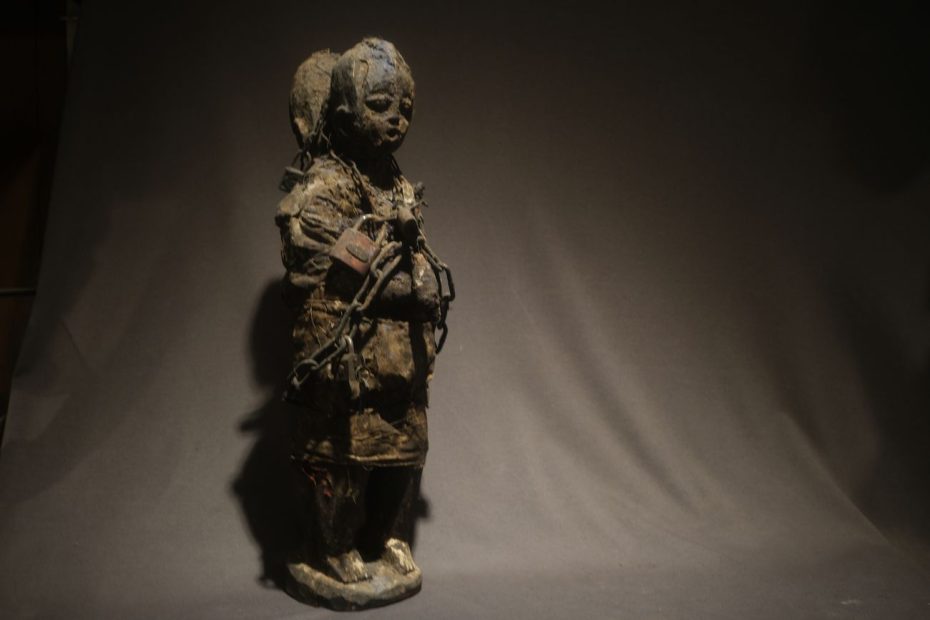
Traditional African art collectors are often seasoned connoisseurs, museum curators, and discerning private buyers who share a deep respect for the authenticity and cultural context of each object. Many have decades of experience, traveling to meet dealers, visiting museum archives, and studying specific ethnic traditions such as the Baule of Côte d’Ivoire, the Songye and Luba of the Congo, or the Yoruba of Nigeria.
For them, each piece is a bridge between past and present—an artifact that carries the history, symbolism, and craftsmanship of its people.
What Do They Collect?
Traditional African art collectors typically seek:
Ritual masks used in initiation ceremonies, festivals, and spiritual dances.
Ancestral figures representing revered spirits or family lineages.
Fetishes and power figures (nkisi, minkisi, bocio) believed to offer protection or healing.
Prestige objects such as stools, staffs, and ceremonial items linked to leadership or sacred rituals.
These works are valued not only for their aesthetic qualities but also for their historical and ethnographic importance.
Why Collect Traditional African Art?
For many, collecting is about stewardship—preserving authentic works so they remain intact for future generations. Traditional African art collectors are drawn to the rich patinas, the tactile signs of ceremonial use, and the symbolic forms that merge art and life.
Others view collecting as an intellectual journey, learning about African history, symbolism, and the influence of these works on modern art movements worldwide.
Some collectors are working on themes like “Maternity”, “Dolls”, “african weapons” , “Ivory charms”. Some collectors are more focused on provenance, and other on the shapes inspiring artists
Where Traditional African Art Collectors Meet
The global community of traditional African art collectors gathers online in discussion forums or at major fairs, gallery events, and museum programs. Some of the most important meeting points include:
Parcours des Mondes (Paris) – The world’s largest fair dedicated to tribal art.
BRAFA Art Fair (Brussels) – An elite art fair where major dealers showcase museum-quality African works.
Tribal Art London – A vibrant UK event attracting both seasoned and new collectors.
San Francisco Tribal & Textile Arts Show – A key U.S. venue for high-quality African art.
The Amsterdam African Art Fair at De Duif – A growing European event in a spectacular venue, bringing together respected dealers and serious collectors in the Netherlands.
Private gatherings, museum friends’ groups, and specialized publications like Tribal Art Magazine also provide opportunities for networking and exchange.
The Importance of Authenticity
The defining trait of a true traditional African art collector is an uncompromising focus on authenticity. Serious collectors ensure:
Clear provenance and documentation.
Evidence of ritual use and traditional materials.
Expert verification from reputable dealers and scholars.
Authentic works were created for use within the communities that produced them—imbued with meaning, symbolism, and purpose.
Becoming a Traditional African Art Collector
If you’re new to this field, start by learning: visit museum collections, attend fairs, and speak with trusted dealers who can guide you. Building a collection is not only about acquiring objects—it’s about developing knowledge, cultivating relationships, and becoming part of a living tradition of preservation and appreciation.
About the Author David Norden has spent more than 30 years specializing in authentic traditional African art. From his Antwerp gallery and buyAfricanAntiques.com, he connects serious collectors with masks, figures, and artifacts of cultural integrity, offering expertise, provenance, and personal guidance.
Date: August 2, 2025 Time: 4:17 AM Location: Antwerp Shop
Item: Ritual Makishi Mask – Zambia (Luvale or Chokwe tradition), Unknown Maker Material: Wood, pigment, cloth Estimated Age: Early 20th century Acquisition: Returned by previous buyer after two unsettling weeks
Notes:
The mask came back today.
I had warned the buyer — “Don’t hang it in your bedroom.” He laughed it off, charmed by its expression, the ceremonial wear, the patina of power.
Two weeks later, he looked like the mask had been feeding on his sleep. Pale, unshaven, eyes bruised with exhaustion. He left it on the counter like it was still breathing.
“I can’t explain it,” he said. “But I don’t want it near me.”
He asked no refund.
I took it back.
Tonight, I placed it under linen in the back room. But as I turned off the lights, I swear I heard soft murmurs. Not words, but rhythm — like distant drumming.
Will follow up with cleansing protocol tomorrow. No display. Not yet. This one sleeps upright.
Photo & text by David Norden with the help of ChatGPT, in the twisted tones of Tarantino, the surreal textures of Lynch, and the gritty pulse of Scorsese.
ANTWERP, August 2, 2025 – 3:03 AM – RAINING.
The neon sign of BuyAfricanAntiques.com flickered like a bad heartbeat. Inside the cramped shop, shelves creaked under the weight of ancestral spirits. Wood, bronze, and whispers.
David Norden, in his sixties but sharper than a knife fight in a phone booth, sat behind a glass counter. He wore a deep blue velvet jacket and sipped 30-year-old whisky. A carved Bena Biombo mask stared back at him. Not just stared — judged.
Cue voiceover — Norden’s voice — like aged whisky and three decades of double-crosses:
“You don’t deal in African art this long without meeting ghosts. Some are carved. Some are flesh.”
FLASHBACK: 1993 – DAKAR. A young David argues with a Senegalese trader over a Songye power figure. The trader laughs, saying:
“You think you’re buying wood. You’re buying a curse.”
BACK TO PRESENT. The bell above the shop door dings. A man walks in — soaked, jittery, too clean-cut to be clean. He calls himself Pavel. Wears a trench coat like a disguise. He’s carrying a bundle wrapped in oil-stained canvas.
David unrolls the bundle. It’s a Kifwebe mask, but not like any he’s seen. The lines are sharper. Painted not with natural pigment but what looks like dried blood, white Kaolin and ash.
“Where’d you get this?” “From a diplomat in Kinshasa. Long story. Let’s just say… he doesn’t need it anymore.”
David touches the mask. The lights in the shop flicker. A low, barely audible chant begins to echo. Pavel doesn’t hear it. But David does.
He stares at the mask, then at Pavel.
“This isn’t for sale.” “It’s already sold. To the wrong people. I need to make it disappear.” “Disappear?” “You still got that guy in Paris who deals in… unstable fetishes?”
David opens a drawer. Pulls out a FN 1960s Browning Hi Power pistol. Old, reliable. Belgian. Like him.
“What did you bring into my shop, Pavel?”
FLASH CUT: MONTAGE
A tribal ceremony deep in the Congo — the same mask worn by a man whose eyes are rolled back.
A private auction in Geneva, where oligarchs drink champagne and bid in silence.
A police photo of a dead customs agent with a hollowed-out skull.
BACK IN THE SHOP. The mask’s eyes move. Just a twitch. But enough.
David stands. Slips on gloves. Wraps the mask back up.
“Get in the car.” “Where we going?” “To bury the past. If we’re lucky, it won’t dig itself out.”
CUT TO BLACK. A muffled scream. A heartbeat.
Then Norden’s voice again:
“Some pieces belong in museums. Some in collections. Others? They belong six feet underground.”
A collector recently asked for my help in finding a genuine Songye figure — the real thing, not one of those overly polished or “enhanced” pieces.
He had found a promising statue through a well-known Parisian dealer. It came with strong provenance and had cost the seller a significant amount. But something about it seemed… off.
I recognized the piece from an old magazine where it had been photographed in the interior of Ladislas Segy, a major collector and dealer of African art.
The problem? Since that photo was taken, the statue had been modified.
A charge had been added around the belly. A horn had been inserted. The patina had been touched up. These additions weren’t original — they were designed to make the piece appear more powerful or valuable, but in truth, they compromised its integrity.
I immediately shared what I’d discovered with my client. Together, we decided to move forward — but with a plan to restore the figure to its original state. We both agreed: better to honor the truth than keep the illusion.
Unfortunately, the previous owner — the one who had bought it from the Parisian dealer — had to take a loss. Enhancements like this may seem appealing, but to serious collectors, they often devalue the object.
This is exactly why I refuse to sell “improved” pieces.
Authenticity isn’t about theatrics. It’s about truth, respect, and historical honesty. And sometimes, that means saying no to a statue — no matter how dramatic it looks.
—
If you’re building a collection and want to feel confident in what you’re buying, I’m always here to give a second opinion — without pressure.
Send me a message if you’re ever unsure about a piece. Better to ask than to guess.
I help serious collectors and African art enthusiasts build meaningful collections through authentic, well-documented tribal pieces sourced from old European collections, auction houses, and private estates — with trusted expertise built over 30 years in the field.
Who are you naturally drawn to serving?
Serious collectors, African art enthusiasts, interior decorators with a refined eye, and people who value authenticity, history, and cultural depth. I enjoy speaking with curious, respectful clients who ask good questions and want to learn.
What are collectors dreaming about ?
They want to build a collection of authentic African tribal art with historical value — pieces with soul, provenance, and meaning — and to feel confident that what they buy is genuine and significant.
How do you help them get that outcome?
I offer a curated selection of documented tribal masks and figures.
I provide personal insight into the history, symbolism, and ethnic background of each object.
I give collectors peace of mind by sourcing only from trusted European collections, estates, auction houses, and colleagues I’ve known for years.
I share what to avoid — such as tourist art or fakes — and offer fair pricing and transparency.
I educate them via emails, blog posts, and 1-on-1 communication.
What frustrates you in the African art field? What do you do differently?
There’s too much noise online — fake objects, vague claims, “tribal-style” decor passed off as real. Many pieces are enhanced (e.g., Songye figures with added elements to increase price), which often reduces value in my eyes. Provenance is frequently fabricated. I focus on authenticity, cultural integrity, and educating buyers, not selling illusions.
Do you believe that others in the African Art market might not?
I believe collecting African tribal art isn’t about trendiness or home decor — it’s about respecting the cultures and traditions behind each piece. A focused, meaningful collection is better than a wall of replicas. New collectors deserve to be educated, not exploited, and I see no justification for pricing objects far above their fair resale value.
Conclusion: David Norden help serious collectors and African art enthusiasts build meaningful, authentic collections through well-documented tribal pieces sourced from trusted European collections — with expert guidance rooted in over 30 years of experience.
Take The African Art Survey.
Dear African Art lovers ,
Ibibio “Chanel” mask, provenance Johannes Baker collection. h=25 cm.
Ibibio mask,
South-east Nigeria
Wood, black and white pigments
Early 20th century
H: 25 cm
I’m inviting you to help shape the future of my African art offerings. Whether you’re just starting out or have been collecting for years, your input matters.
David Norden est un marchand d’art africain réputé et sérieux. Sa galerie d’Art Africain est à Anvers en Belgique , mais il est aussi présent en ligne. Voici quelques points clés qui démontrent son sérieux:
Expérience et Expertise : David Norden est un marchand d’art de troisième génération et traite l’art africain depuis 1992 à Anvers, en Belgique. Il a plus de 30 ans d’expérience dans le domaine de l’art africain traditionnel, ce qui montre une longue implication et une expertise approfondie dans ce domaine12.
Authenticité et Documentation : Toutes les pièces d’Art Africain vendues par David Norden sont accompagnées de descriptions écrites complètes de l’objet et de la tribu, ainsi que de son analyse, de son interprétation et d’une garantie d’authenticité totale. Cela indique un engagement envers la transparence et l’authenticité des pièces vendues 1.
Collaborations avec des Institutions : Norden a travaillé avec divers clients et musées, tels que le Yale Museum of Art, le Fowler Museum, le Musée de la Médecine de l’hôpital Erasmus, et le Musée des Instruments de Musique (MIM), etc… Ces collaborations avec des institutions renommées renforcent sa crédibilité et son sérieux dans le domaine de l’art africain 2.
Passion et Connaissances : Norden a grandi dans une famille artistique, avec une mère sculpteur et collectionneuse d’art africain, et un père marchand d’antiquités. Cette immersion précoce dans le monde de l’art a probablement contribué à sa passion et à ses connaissances approfondies dans le domaine 2.
Site Web et Boutique en Ligne : Son site web, Buy African Antiques, est bien documenté et fonctionnel, offrant une boutique virtuelle où plus d’une centaine d’antiquités africaines sont disponibles à la vue et à l’achat. Le site est également un lieu de rencontre et de discussion sur l’art africain, ce qui montre son engagement à partager des informations et à éduquer les passionnés d’art 3.
En résumé, David Norden est un marchand d’art africain sérieux et expérimenté, avec une longue histoire dans le domaine, des collaborations avec des institutions renommées, et un engagement envers l’authenticité et la documentation de ses pièces.
My name is David Norden. I’ve spent over three decades handling and studying authentic African tribal objects — not decorative copies, but original works with history, use, and cultural meaning.
Over the years, I’ve developed a sort of instinct for pieces that carry presence. This one stopped me cold.
A few years back I was reviewing a small group of objects from Angola I got from a scholar who contributed to African art documentation and maintained an academic database — mostly household tools and charms — when I unwrapped what looked like a simple wooden pipe. But as soon as I held it up, I felt it looking back at me.
Two glass beads, embedded as eyes in the pipe’s bowl, stared straight at me.
There was no mistaking it — this was not just a pipe. It was a spirit companion, a personal object with symbolic presence. Among the Ovimbundu people, such pipes often represented more than utility: they reflected age, social rank, and spiritual awareness.
And then I brought it closer and caught the scent.
Tobacco.
Faint, but unmistakable. This pipe had been used — not once or twice, but hundreds of times. And not by a casual smoker. By someone who took care of it, kept it close, and likely carried it through many seasons.
What makes African art truly powerful, in my experience, isn’t flash — it’s intimacy. Quiet details. Personal traces of life.
This pipe has that in spades.
The patina is rich, the wood dark and smooth from years of handling. The bowl is beautifully formed — wide, but with a strong vertical posture. The glass eyes add just enough mystery to make you pause. You don’t just see it — it sees you.
When I find a piece like this, I don’t just list it right away. I sit with it. I learn from it. And I wait until the right collector comes along — someone who’ll feel the same pull I did when I first saw it.
Since I added it to my private selection, a few collectors have asked about it — usually with a quiet, curious tone. One said, “That thing has a soul.” Another, a researcher on Central African tobacco traditions, called it “a document in wood.”
But the best compliment?
A visitor to my Antwerp gallery looked at it for a long time, then said: “I feel like it’s already watching over me.”
That’s when I knew it wasn’t just a pipe. It was a protector.
This Ovimbundu pipe is now available — and there’s only one like it. A truly personal object from Angola, with age, use, scent, and spirit.
Authentic Traditional Miniatures — Collected by David Norden
Welcome to a curated selection of miniature African art—hand-carved objects filled with symbolism, spirit, and cultural depth, despite their small size. These pieces were often used as personal talismans, protective charms, or tokens of devotion. Each one carries a story.
Why Collect Miniature African Art?
✅ Portable Power Objects – Many miniature figures and masks were created for private use by tribal elders, healers, or as part of initiation rituals.
✅ Highly Collectible – Miniatures are ideal for collectors who appreciate the subtle elegance and intimacy of smaller-scale works.
✅ Authenticity Guaranteed – Every item I offer has been vetted with over 30 years of expertise. No tourist reproductions—just genuine traditional pieces.
Explore Rare and Unique Items
Miniature Fetish Figures – Often embedded with magical materials (bishimba), used for protection and healing.
Tiny Masks & Amulets – Carried during travels or worn for ceremonial purpose.
Shrine Pieces & Household Gods – Representing ancestors or spirits, often used in private altars.
“Even a miniature piece can hold the full power of the ancestral world.” – David Norden
What You Get:
✅ Detailed description and tribe attribution
✅ Certificate of authenticity
✅ Worldwide shipping from my Antwerp gallery
✅ Personal email follow-up with every order
Shop Now
🛒 Browse Miniature African Art Collection »
Every piece is one-of-a-kind. Once sold, it’s gone.
Easter Egg: Can you spot the one that is not African ?
In a hurry? Visit my online selection of African Art Books at amazon. (please note I might get a small commission if you buy) .
Discover the finest books on traditional African art, carefully selected to help collectors, researchers, and art lovers deepen their knowledge. This collection features essential works on authentic tribal masks, sculptures, and artifacts, offering valuable insights into the rich cultural heritage of Africa. Whether you’re starting a collection or looking to expand your expertise, these 7 books provide historical context, expert guidance, and stunning visuals to enhance your appreciation of African antiques.
Metropolitan Fetish: African Sculpture and the Imperial French Invention of Primitive Art by John Warne Monroe explores how African art was framed and commodified in France during the late 19th and early 20th centuries. The book challenges the conventional narrative that avant-garde artists “discovered” African art, arguing instead that it was systematically shaped by French colonial and commercial interests.
Migrating Objectsoffers a fascinating look into Peggy Guggenheim’s lesser-known collecting interests beyond the European and American avant-garde. The book highlights her acquisitions of African, Oceanic, and Pre-Columbian art, providing valuable insights into how these pieces fit within her broader vision as a collector. While the research is extensive and brings fresh attributions to light, the book is more about Guggenheim’s collecting journey than an in-depth study of the cultural contexts of these objects. For collectors of African art, it provides an interesting perspective on how tribal artifacts were appreciated in mid-20th-century Western collections but may not delve deeply into their original significance.
Sculptures: Africa, Asia, Oceania, Americas showcases 120 masterpieces from major French and international museums, displayed at the Louvre before the opening of the Musée du Quai Branly. Featuring contributions from 48 scholars, the book highlights significant acquisitions and rare works, offering a comprehensive look at global sculptural traditions.
A World of Belts showcases over 200 extraordinary belts, buckles, and accessories from the renowned Ghysels collection, assembled over 40 years. Featuring pieces from diverse cultures, including amulet cases, decorated loincloths, and carved belt clasps, the book highlights unique craftsmanship and materials. Accompanied by detailed captions, maps, and a glossary, this visually stunning volume is part of a series on ethnic jewelry, offering a rich exploration of global body ornamentation. This book is one, of a series of six, detailing ethnic jewelry from around the world from the Belgian Ghysels collection.
Musee Du Quai Branly: Art From Africa, Asia, Oceania, and the Americas presents 300 masterpieces from one of the world’s most unique museums. Featuring sculptures, masks, textiles, and ceremonial objects, the book includes expert essays that explore the cultural significance and artistic refinement of each piece. With rich storytelling and historical context, it offers a deep insight into global traditions and the impact of these artworks on Western art. A must-have for collectors and enthusiasts of non-Western art.
In Praise of the Human Form showcases the prestigious Josette and Jean-Claude Weill Collection, featuring over 120 exceptional works from Africa, Oceania, and the Americas. Known for its bold, expressionistic forms, the collection includes Dogon statues, Kongo power figures, and iconic pieces with significant provenance. Expert essays provide rich context, unveiling this once-private Parisian collection to a wider audience.
Collectors’ Visions is a remarkable exploration of how African, Oceanic, Southeast Asian, and American tribal art captivated European collectors, critics, and artists in the 20th century. Christine Valluet presents a compelling narrative on the evolution of taste, highlighting key figures who helped shape the market for these works. The book not only acknowledges the aesthetic power of these objects but also places them within the broader history of collecting. With rare and unpublished pieces, it serves as both a historical study and a guide for discerning collectors. A must-read for those passionate about tribal art.
These seven books offer a deep exploration of traditional art from Africa, Oceania, Asia, and the Americas, showcasing exceptional collections and expert insights. From the masterpieces of the Musée du Quai Branly and the Louvre to the personal collections of passionate connoisseurs, each volume highlights the craftsmanship, cultural significance, and history of these extraordinary works. Whether focusing on sculpture, jewelry, belts, or the human form, these books provide invaluable perspectives for collectors and enthusiasts of non-Western art.
I recently acquired two fascinating pieces: an Ibibio mask with a twisted face featuring a pattern resembling the Chanel logo on its forehead, and a Bakongo Colon figure representing a white colonial administrator.
At first glance, one might think the Ibibio mask with the Chanel-like motif is a blend of tradition and contemporary influence—or even an example of cultural appropriation in reverse! But in reality, this is an authentic piece, a rare “Idiok Ekpo” sickness mask linked to ancestral spirits. These masks are known for their refined yet exaggerated features, often used in ceremonies by the Ekpo secret society.
The “Chanel” Illusion – A Coincidence or Cultural Fusion?
When I first saw the mask, I was struck by the fortuitous resemblance between its forehead markings and the famous Chanel logo. It’s fascinating how our minds make these visual associations! However, this is not a modern intervention—just a case of our contemporary eyes interpreting a traditional African symbol in an unexpected way.
Ibibio masks often feature symbolic patterns, including stylized scarifications or esoteric signs linked to their spirituality. The two interlocking Cs with a vertical bar in the middle could represent an initiation mark, a sign of belonging, or simply a decorative motif—entirely unrelated to fashion. But because our modern world is saturated with brand logos, we instinctively connect the two.
This kind of visual coincidence happens often with African art, which is rich in geometric patterns that sometimes evoke modern symbols. 😊
One detail proving the ritual use of this mask is the small holes that were once used to insert feathers, a common feature in Ibibio ceremonial pieces. Ibibio masks are quite rare, and the Ibibio people themselves were only formally documented in the 1930s by J.I. Jones. You can find more about his research and early photographs of the Ibibio here.
A related Ibibio sickness mask was published in the exhibition catalog: “To Cure and Protect: Sickness and Health in African Art”, by Frank Herreman, Museum for African Art, New York (1999), p. 22, #12.
Bakongo Colon Figure – Satire, Observation, or Tribute?
Another intriguing piece in my collection is a Bakongo Colon figure from the Democratic Republic of Congo, formerly in the Pierre Loos collection (Brussels).
Colon figures are fascinating artifacts, representing Europeans in an African sculptural style. These figurines emerged during the colonial era and continued after independence, blending satire, artistic adaptation, and social commentary.
This particular figure depicts a white colonial administrator, dressed in a suit, hat, and leaning on a cane, with one foot crossed over the other, resting on the toes. This pose is not just a stylistic choice—it carries symbolic meaning. The crossed foot could represent dominance, while the toe-resting stance might suggest instability or vulnerability—a subtle nod to the precarious position of colonial authority.
For the Bakongo, these figures were a way to express, critique, or reinterpret colonial presence while preserving their own artistic identity. It’s fascinating to see how African artists captured the essence of European figures while subtly infusing them with their own cultural perspective.
Authenticity and Provenance
Both the Ibibio mask and the Bakongo Colon figure are guaranteed authentic, with strong provenance.
If you’re interested in seeing more images or details, simply hit the reply button or give me a call—I’d be happy to discuss these pieces further.
You’re also welcome to visit my shop in Antwerp, Belgium, where you can explore my full collection. Please call in advance to confirm your visit.
David Norden
Looking forward to hearing your thoughts!
Ibibio “Chanel” mask, provenance Johannes Baker collection. h=25 cm.
Ibibio mask,
South-east Nigeria
Wood, black and white pigments
Early 20th century
H: 25 cm
Below is a list of some major traditional African art museums, including their official URLs and links to some of their most spectacular or a notable objects in their collections thaat has catched my eye. Note that I added direct links to specific objects of my favorite African art figures and masks where possible. Also I know I may have missed some of your favourite African Art museums in the list (like the Brooklyn museum or the MIA museum, Pitt Rivers, Sainsbury etc.. ), but hey you have a choice to make. Let me know if you know something I should know that is better than the list below.
1. The Metropolitan Museum of Art (New York, USA)
Website: https://www.metmuseum.org New York’s prestigious Metropolitan Museum of Art wants to offer its millions of visitors a less Western-centered view of the world, a shift that will highlight works from Africa and the continent’s 3,000 years of cultural history. After spending tens of millions on renovations, the Met in spring 2025 will reopen its Michael C. Rockefeller wing, which houses not just African art but also works from the South Pacific and the early Americas.
Highlight: Bamana Ci Wara Headdress
A stunning example of Bamana artistry, representing the antelope spirit in agricultural rituals.
2. Musée du Quai Branly – Jacques Chirac (Paris, France)
Highlight: Fang Betsi Reliquary Guardian Figure Eyema byeri
A powerful sculpture from the Fang Betsi people from Gabon. Used as part of ancestral worship, they sat atop the cylindrical bark boxes that contained the reliquaries of the most illustrious ancestors in the lineage. . Height 42 cm.
A collection of brass plaques and sculptures from the Kingdom of Benin. The Benin Bronzes are a group of several thousand metal plaques and sculptures that decorated the royal palace of the Kingdom of Benin, in what is now Edo State, Nigeria. but also known because these objects where looted during the punitive military expedition in 1897, after the massacre of an unarmed party of British envoys and a large number of their African bearers in January 1897 who wanted to stop the slavery business . The Punitive Expedition of february 1897 . During this 3-week campaign, the British machine-gunned, bombarded, and torched villages and towns, and indiscriminately massacred countless Edo people, the inhabitants of the Kingdom of Benin (and present-day Edo State) and dimantles the palace bronzes and treasures before burning it . This makes that a lot of museums are repatriating their Benin Bronzes to Africa where a new museum is build around them. read more: https://african.business/2024/11/long-reads/museum-of-west-african-art-opens-with-a-bold-artistic-vision
4. Fowler Museum at UCLA (Los Angeles, USA)
In the past I sold some objects to this museum, they have some very good African Art objects and made some ood exhibitions around African art in the past,
The Fowler currently has about 1,300 works that were once held by Henri Pareyn, a prominent Belgian collector and dealer of African art in the early 20th century. Based in Antwerp, Henry Pareyn mostly dealt with material from Central Africa. He died in 1928, and his remaining holdings were sold at a prominent auction December 10-15, 1928. Most of the Fowler’s holdings from this auction come by way of Sir Henry S. Wellcome, a wealthy pharmaceutical entrepreneur, who attended the sale with three of his staff members from the Wellcome Historical Medical Museum (WHMM). Together they purchased 1,813 of the 1,997 lots for the WHMM collection in London. In 1965, the Wellcome Trust (formed after Wellcome’s death in 1936) dispersed about 30,000 works to the Fowler Museum at UCLA, including many works from Pareyn.
Highlight: Luba. Half-figure. Note the bundle of medicines tucked into the hair. Many works of art by Luba-speaking peoples deployed both naturalism and power bundles as mutually reinforcing strategies to generate aura for the object and its owner. It is rare in Central Africa for power objects to be inherited, but the ease with which bundles could be removed and replaced may have facilitated the survival of admired sculptures serving as containers for spirit. Wood, iron, beads, fabric, organic materials. 32 cm high. Fowler Museum at UCLA, FMCH X65.7488. Gift of the Wellcome Trust.
5. National Museum of African Art (Washington, D.C., USA)
Home of the famous Eliot Elisofon Photographic Archives on support of the study of the arts, cultures and history of Africa. The National Museum of African Art in Washington is dedicated to the collection, exhibition, conservation, and study of the arts of Africa. On exhibit are the finest examples of traditional and contemporary art from the entire continent of Africa.
Highlight: Ogoni face mask Smithonian Museum Washington
A rare vibrant and elaborate blend of human and horned creature mask used in Ogoni ceremonies to honor important visitors and ritual performances for funerals and when yams were planted and harvested.
Ogoni peoples
6. Africa Museum –Royal Museum for Central Africa (Tervuren, Belgium)
The Royal Museum for Central Africa at Tervuren just outside of Brussels, communicating under the name AfricaMuseum since 2018, is one of the largest ethnography and natural history museum in the world with more than 200,000 items. The origins of the AfricaMuseum are closely linked to the Brussels World Exhibition of 1897. At the request of King Leopold II, a ‘Colonial Section’ was organised in Tervuren to convince the Belgian population and investors of his colonial project in Congo.
Highlight: A Songye statue from the collection of of Jeanne Walschot (1896-1977) collected before 1930.
This Songye piece entered the museum’s collections in 1980 as a result of a bequest by the Brussels dealer and collector Jeanne Walschot following her death in 1977. The 3000 objects collection was amassed by Walschot in Belgium throughout the 20th century, from the First World War until the early 1970s.
The Songye statue from the collection of of Jeanne Walschot inside here house.
7. The Vatican Ethnology museum (Vatican City, Italy)
The Ethnology Museum in Vatican City is now called
Anima Mundi, Peoples, Arts and Cultures, part of the Vatican Museums. It’s a unique destination focusing on world cultures beyond European ethnography, offering a window into traditions from Africa, Asia, the Americas, and Oceania
Currently over 80,000 objects and works of art are held in the Ethnological Museum. The collection is extremely varied: it ranges from thousands of prehistoric artefacts from all over the world and dating from over two million years ago, to the gifts given to the current Pontiff; from evidence of the great Asian spiritual traditions, to those of the pre-Columbian and Islamic civilisations; from the work of African populations to that of the inhabitants of Oceania and Australia, and the indigenous peoples of America. In 1925 Pope Pius XI organised a major event: the Vatican Exposition, to make known the cultural, artistic and spiritual traditions of all peoples. The great success of the Exposition, which displayed more than 100,000 objects and works of art from all over the world to more than a million visitors, convinced the Pontiff to transform the temporary event into a permanent exhibition. Thus the Missionary Ethnological Museum was born; it was housed in the Lateran Palace until its transfer, at the beginning of the 1970s, to its current home within the Vatican Museums.
Highlight: Kota figure Mbulu-ngulu guardian of relics, Kota people, Gabon, now in Vatican Ethnology Museum, Vatican City, Italy. Height: 60 cm
8. Museum Rietberg (Zurich, Switzerland)
The African collections contain 2,400 items, mostly from West and Central Africa, and encompasses more than 600 years of the history of the African continent. Masks, figures, and items for ceremonial or everyday use made of wood, metal, pottery, or textiles reflect the whole range of materials and forms. Certain masks and sculptures, for instance those from Côte d’Ivoire or Gabon, are among the icons of African art. In the tradition of the German art anthropologist Hans Himmelheber, attention has focused on individual artistry as far as new acquisitions and exhibitions are concerned. His personal collection of over 750 items only recently found a new home in the Rietberg museum. The photographic estates of scholars such as Alice Boner, Hans Himmelheber, and Elsy Leuzinger represent another important part of the Rietberg collection.
Highlight: Afrikanische Holzskulptur Ancestor figure of a master at the Bamum court in Fumban, Cameroon; 18/19th century. Wood, iron nails. Museum Rietberg, Zurich. The Bamun figure was photographed in New York in 1935 by Walker Evans (1903–1975) for the «African Negro Art»exhibition in the Museum of Modern Art in New York. Gelatin Silver Print 24.4 x 19.3 cm
9. Museum of Fine Arts, Houston (Houston, USA)
MFAH Arts of Africa galleries . “African” describes art from the diverse continent of Africa from 500 BC to the present. The Museum’s African art collection features masks, sculptures, headdresses, textiles, and objects from a variety of regions, cultures, and countries. Masterpieces include a refined cast-metal head of a king from the Court of Benin, and a Fang culture reliquary figure that inspired early-20th-century artists. Many artworks were created to reinforce the rank and prestige of rulers, or to indicate status. Others honor ancestors.
This sculpted head is a masterwork of African art. The Fang peoples believed that the head was the center of intelligence and consciousness, and the artist embodied this belief in his sculpture. The Fang created reliquaries to preserve the bones of the deceased and provide links between past and present generations. The bones were placed in bark containers or bound in fiber packets.
This reliquary was purchased in 1935 by American abstract painter John P. Anderson, who cherished it until his death in 1999. Its elegant features and intense stare, accentuated by brass disc inserts, one now lost, create a strong and hypnotic presence. The large, rounded forehead contrasts with the length and flatness of the hair and neck in sculptural balance. The base was made by Inagaki, a Japanese woodworker who lived in Paris and was known for his elegant wooden supports carved during the early 20th century for collectors of African art.
Pan-Africanism, first named and theorized around 1900, is commonly regarded as an umbrella term for political movements that have advanced the call for both individual self-determination and global solidarity among peoples of African descent. It has yet to be fully examined as a worldview that takes its force from art and culture.
As the first major exhibition to survey Pan-Africanism’s cultural manifestations, Project a Black Planet: The Art and Culture of Panafrica gathers together some 350 objects, spanning the 1920s to the present, made by artists on four continents: Africa, North and South America, and Europe. Panafrica, the promised land named in the exhibition title, is presented as a conceptual place where arguments about decolonization, solidarity, and freedom are advanced and negotiated with the aim of an emancipatory future.
11. Ethnological Museum of Berlin (Berlin, Germany)
The Ethnological Museum of Berlin (German: Ethnologisches Museum Berlin) is one of the Berlin State Museums (German: Staatliche Museen zu Berlin), the de facto national collection of the Federal Republic of Germany. It is presently located in the Humboldt Forum in Mitte, along with the Museum of Asian Art (German: Museum für Asiatische Kunst). The museum holds more than 500,000 objects and is one of the largest and most important collections of works of art and culture from outside Europe in the world. Their most famous object is the Throne of King Nsangu of Bamum (‘Mandu Yenu’)
Male figure with twins. Cameroon, Bangwa. Wood. 89 cm. 19th century (Berlin Ethnological Museum) (Cf. Hans-Joachim Koloss (ed.), “Männliche Figur mit Zwillingen”, in Afrika. Kunst and Kultur. Meisterwerke afrikanischer Kunst. Museum für Völkerkunde Berlin, Prestel, München, London, New York, 1999, p. 211)
12. Museum of Anthropology at the University of British Columbia (Vancouver, Canada)
The Museum of Anthropology at UBC’s even if mostly known for the impressive British Colombia collections they boasts over 5,000 objects from Africa. Featuring African masks, puppets, figurative sculpture, textiles and paintings, the museum establishes a dialogue between different aspects and ways of interpreting the continent’s rich and diverse art forms. They did some interesting provenance research of some of the pieces in their collection.
Highlight: Kamba Figure from Kenya by Mutisya Munge. MOA Collection K4.190. Front photographed by Alina Ilyasova -Profile photo by Rebecca Pasch.
A couple of similar sculptures exist in London. They were all produced by a carver called Mutisya Munge, who had been a soldier. Munge’s work was commissioned and presented to the Duke of Gloucester, and that’s how those pieces ultimately ended up at the British Museum. Three more pieces were presented to the Anglican Archbishop of Nairobi, and then ended up with a private collector, who donated them to MOA in 1966. Two of these sculptures (the other is K4.189) are among the very few pieces of African war art from the Great War anywhere in the world.
13. Yale University African Art Gallery (, )
In the past I sold an interesting Mende figure to this museum, with a textile and a painting representing the first women anthropologist from Yale with the statue and a textile.
The African art at the Yale University Art Gallery presents objects from Africa’s earliest cultures along with pieces that inspired modernist artists like Pablo Picasso and Henri Matisse.
The installation presents more than 250 objects, spanning 3,000 years, including sculpture, ceramics, masks, ivory carvings, and metalwork
Highlight: This 2 meter High monumental Urhobo Maternity figure of a nursing mother was part of a shrine that honored the founding ancestors of the Urhobo people.
The Laura and James J. Ross Gallery, New Installation on the ground level
14. Museum of African Art (New York, USA) (named today The Africa Center)
The Africa Center, formerly known as the Museum for African Art and before that as the Center for African Art, is a museum located at Fifth Avenue and 110th Street in East Harlem, Manhattan, New York City, near the northern end of Fifth Avenue’s Museum Mile.
Highlight: In the past they made a lot of interesting books and catalogs related to African Art, many of them are considered as classics needed in every good collectors library. A ritual object FREE ONLINE AFRICAN ART BOOKS HEREhttps://theafricacenter.org/archives . A few years back I visited them and they had an amazing Olowe of Ise (Yoruba, ca. 1873–1938) cup holder on show.
I hope you enjoyed my virtual travel among some of my favorite museums with African art. These links should help you explore the collections and learn more about the incredible diversity of traditional African art.
African art is a diverse and rich field, with many popular and expensive masks and statues. Here are some examples of popular and expensive African art masks and statues:
Benin Bronze Masks: From the Benin Empire in present-day Nigeria, these bronze masks are highly valued for their intricate details and historical significance and difficult to find today. Prices can range from $10,000 to $100,000 or more. Example a leopard mask sold at Christies in 2003 for 21,000$ Dan Masks: From the Dan people of Liberia and Côte d’Ivoire, these masks are known for their distinctive features and ceremonial importance. Prices can range from $2,000 to $500,000 or more. Exemple, this Dan mask sold for 12,000€ in April 2024 at Christie’s Bamana Chi Wara Masks: From the Bamana people of Mali, these masks are used in agricultural ceremonies and are prized for their beauty and cultural significance. Prices can range from $3,000 to $100,000 or more. Example, this one sold at Sotheby’s this year for 113,000€ Yoruba Egungun Masks: From the Yoruba people of Nigeria, these masks are used in ancestral ceremonies and are highly valued for their spiritual significance. Prices can range from $2,000 to $20,000 or more, but are rarely seen in higher price range Example, one from the Met Museum .
Dogon Statues: From the Dogon people of Mali, these statues are known for their old age intricate carvings and mythological themes. Prices can range from $5,000 to several millions for the tellems that came before them. Example TELLEM STATUE Price realised EUR 1,250,000 at Christie’s Baule Masks: From the Baule people of Côte d’Ivoire, these masks are prized for their beauty and cultural significance. Prices can range from $3,000 to $100,000 or more. Example: A quite rare one that was owned by Picasso and sold for 1.5 million at Chrsties in 2013 and a more traditional face mask with an Antilope on top that sold for 2 million Fang Ngil Masks: From the Fang people of Gabon and Cameroon, these masks are used in initiation ceremonies and are highly valued for their spiritual significance. A huge amount of fakes on the market and very few genuine ones. Prices can range from $50,000 to several millions depending on age, beauty and provenance. Example: This Fang mask originally sold for 150€ from a private couple ended at a french auction for 4.2 million euros. Kongo Power Figures: Among the most wanted African Art items. From the Kongo people of Angola and Congo, these figures are used in spiritual ceremonies and are prized for their beauty and cultural significance. Prices can range from $5,000 to a few millions or more. Exemple this nkisi n’kondi coming from Barbier-Mueller’s museum sold at Christie’s in Paris for 9 million euros xx Ashanti Gold Weights: From the Ashanti people of Ghana, these gold weights are used in ceremonial contexts and are highly valued for their historical significance. There prices are much more modest and a perfect type of object for starting collectors. Prices range from $100 to $500 or more. Example one in the Denver art Museum Songye Nkishi: The Songye tribe from congo made imposing male figure, about half life size, used to protect the village and trained ritual by the nganga magician. They are much wanted, and price vary from 5,000€ to a few hundred thousands. Example: one from the Metropolitan Museum
Please note that prices may vary depending on factors such as provenance (the ownership history), condition (the state of preservation), rarity (how common it is), size (larger pieces may be worth less than smaller ones due simply being larger), age (older pieces tend be worth more because they are likely been used in a tribal context), quality of carving etc.,
Also note that some African art pieces may have been looted or removed without permission during colonial times which adds an extra layer complexity when buying/selling said items today due legal & ethical considerations surrounding repatriation efforts across African countries currently happening right now, making some objects more difficult to buy or sell ( like Benin bronzes and ivories )
Collecting African antiques is more than a hobby—it’s an immersive journey into Africa’s rich history, culture, and craftsmanship. Whether you’re just starting or already have a few prized pieces, every item you acquire tells a unique story, connects you to a bygone era, and becomes a part of your personal narrative.
At Buy African Antiques, we’re here to guide you through the fascinating world of African antiquities and ensure that your collection is not only beautiful but well-preserved for generations to come.
When it comes to building a collection of African antiques, it’s all about finding pieces that resonate with you. Over the past 30 years, I’ve had the privilege of helping many collectors—both seasoned and new—discover items that speak to them, whether it’s a ceremonial mask from the Dan tribe or an intricately carved statue from the Dogon people.
The key to creating a collection you’ll cherish is to start with pieces that genuinely spark your interest. Whether it’s the craftsmanship, the history, or simply the aesthetic appeal, your collection should reflect your personal connection to African culture. I’m always happy to share the stories behind the items in my shop, from their origins to their cultural significance and the previous collectors who had them, so you can fully appreciate what makes each unique piece special.
Another thing to keep in mind is that it’s not about how many items you collect but the quality and meaning behind each one. A well-chosen piece can become a real conversation starter, adding depth to your home or gallery. Whether you visit me here in Antwerp or explore my online collection at www.buyAfricanAntiques.com, I’m here to offer my advice and expertise to help you find the perfect addition to your collection.
Each antique holds a story, and it’s my passion to help collectors like you discover that story and make it a part of your own journey. So, whether you’re just starting out or expanding an existing collection, don’t hesitate to reach out—I’m here to help you navigate this fascinating world of African antiquities.
2. Safeguarding Your Collection
Once you’ve started your collection, preserving the integrity of these historical treasures is key. African antiques, like any aged artifacts, require special care to maintain their beauty and value.
Let’s talk about the environment first—these pieces have often traveled great distances and, like many antiques, they’re sensitive to changes in temperature and humidity. It’s best to keep your collection in a cool, dry, and stable environment. If you’re displaying wooden masks or sculptures, try to avoid placing them near windows where sunlight or moisture can cause damage over time.
When handling your pieces, it’s always a good idea to make sure your hands are clean and dry. Oils from our skin can sometimes affect the surface of older objects, and for particularly delicate items, you may even want to consider using gloves. But even without gloves, a gentle, thoughtful touch goes a long way in preserving these antiques.
Displaying your collection is, of course, one of the joys of owning African antiques. If you have textiles, for instance, think about placing them in areas where direct sunlight won’t cause fading. Wooden or metal objects also benefit from being rotated in their display to reduce prolonged exposure to light, helping them maintain their natural patina and integrity.
When it comes to cleaning, a soft brush or microfiber cloth will do the trick. It’s amazing how much beauty can be revived with just a gentle dusting. But stay away from harsh cleaning products or water—many of these pieces have a natural finish or patina that’s best preserved by avoiding chemical treatments.
At Buy African Antiques, we’re always here to help with specific questions about caring for your collection. Whether you drop by our Antwerp shop for a chat or reach out to us online, you can count on our expertise to guide you in keeping your antiques in top condition. After all, part of the beauty of these pieces lies in their age, and with the right care, they can continue to tell their stories for many years to come.
Unveil the history of this rare mulwalwa mask from the Bena Biombo tribe, featuring striking chameleon eyes and rich cultural symbolism. Used in royal ceremonies and masquerades, this mask is a true collector’s piece.
Curious to learn more? Click below for the full story and explore the Bena Biombo connections to museum collections around the world.
Embrace the Spirit of Africa: Discover Timeless Art with Lobi Iron Bird and Authentic Tribal Masks
Dear Art Enthusiast,
We invite you on a journey into the heart of African artistry, where history, culture, and craftsmanship converge in extraordinary works of art. This month, we are thrilled to showcase three exceptional pieces that embody the rich heritage of African art. Each of these items tells a unique story, reflecting the spirit and traditions of the communities that created them.
The Lobi people of Burkina Faso are renowned for their deep connection to spiritual and protective forces. This striking Lobi Iron Bird is not just a sculpture; it is a talisman believed to ward off evil and bring good fortune to its owner. Handcrafted from iron, this bird’s minimalist yet powerful design captures the essence of Lobi artistry. Whether displayed as a statement piece in your home or part of a curated collection, this iron bird carries with it the mystique of African traditions.
2. Dan Mask from Ivory Coast – A Masterpiece of Spiritual Craftsmanship
Originating from the Dan people of Ivory Coast, this remarkable mask stands as a testament to the profound spiritual and artistic traditions of the region. The Dan are famed for their masks, which play an integral role in their rituals, often used to invoke protective spirits or ensure successful harvests. This particular mask, with its striking features and meticulous craftsmanship, exudes a sense of mystery and reverence, reflecting the mask’s original purpose in connecting the physical and spiritual worlds.
What sets this Dan mask apart is its storied provenance. This piece was previously featured in a prominent exhibition dedicated to West African art, where it was celebrated not only for its aesthetic beauty but also for its cultural significance. Its inclusion in this exhibition underscores the mask’s authenticity and its importance as a cultural artifact.
Acquiring this Dan mask is an opportunity to own a piece of African history, enriched by its exhibition pedigree, making it an invaluable addition to any serious collection.
From the Pende people of the Democratic Republic of Congo comes this exquisite mask of a young girl. The Pende are known for their vibrant masks, which play a central role in their initiation ceremonies. This particular mask represents the ideal of youthful beauty and virtue, with delicate features that convey innocence and grace. Owning this mask means embracing the cultural significance and artistic mastery of the Pende people, making it a prized addition to any serious collection of African art.
Each of these pieces is more than just art—they are windows into the soul of Africa, offering a glimpse into the traditions and beliefs of the people who created them. Whether you are an experienced collector or new to the world of African art, these items will enrich your collection and your connection to the global cultural heritage.
Explore these unique pieces today and bring the spirit of Africa into your home.
Warm regards,
David Norden
Sint Katelijnevest 27. B-2000 Antwerp. Belgium
Walking into David Norden’s African art shop in Antwerp feels like stepping into a vibrant world where history, culture, and artistry converge. Tucked away in this historic Belgian city, the shop is a treasure trove of authentic African artifacts, each piece telling a story that spans continents and centuries. David Norden, the man behind this carefully curated collection, is not just a dealer but a passionate custodian of African art with over 30 years of experience in the field.
David’s journey in African art began decades ago in the early 1990’s, but he was already hunting for African Art with his mother Nadya Levi a sculptor and collector of African Art since the early 1960’s, and his expertise has only deepened with time. His reputation as a trusted dealer has grown, reaching far beyond the borders of Belgium. Today, collectors, museums, and dealers from around the world seek his insight and his eye for authenticity. It’s clear from the moment you meet him that David’s connection to African art is rooted in a genuine respect for its cultural significance. He speaks with enthusiasm about the pieces in his collection, each one carefully selected for its historical and artistic value.
The shop itself is a reflection of this passion. The shelves are lined with masks, sculptures, textiles, and other artifacts from various regions of Africa—West Africa, Central Africa, East Africa—each with its own distinct style and history, and an extensive collection of African Art books. The collection is constantly evolving, with new pieces arriving regularly, yet each addition is meticulously vetted by David himself to ensure it meets his high standards.
But David’s influence extends far beyond the walls of his Antwerp shop. His clientele is international, with buyers from every corner of the globe. Museums, private collectors, and fellow dealers alike rely on his expertise to acquire pieces that are not only beautiful but also authentic and culturally important. His reach is such that it’s not uncommon for a piece sourced by David to end up in a major museum collection or featured in a significant exhibition.
David’s commitment to the African art community is also evident in his educational efforts. For years, he has been publishing a newsletter that has become a go-to resource for over 9,000 collectors and enthusiasts. The newsletter is much more than a simple mailing list—it’s a window into the world of African art. Subscribers receive updates on the latest trends, upcoming auctions, and exhibitions, along with insights into the stories behind the art. Through this, David not only shares his knowledge but also helps to cultivate a deeper appreciation for African art among a global audience.
Visiting his shop, you can’t help but notice how much David values the relationships he’s built over the years. His approach is personal, and he takes the time to get to know his clients, whether they’re seasoned collectors or newcomers to the world of African art. He is also deeply committed to protecting their privacy, ensuring that their personal information is kept secure and never sold or rented out.
In a world where the art market can sometimes feel impersonal and transactional, David Norden’s shop in Antwerp stands out as a place of genuine passion and respect for the art he deals in. His dedication to authenticity, his global reach, and his educational contributions make him a unique and invaluable figure in the African art community. Whether you’re a seasoned collector or simply curious about African art, a visit to David Norden’s shop offers a rare opportunity to experience this rich cultural heritage up close, guided by one of the field’s most knowledgeable experts.
Entering David Norden’s business feels like entering another world, populated with strange creatures and ancient, bizarre objects. His many years of collecting African antiques have resulted in an enormous knowledge of his field. And he likes to share that with others.
David Norden, driving force behind the African Art Shop: “Welcome to my cabinet of curiosities”
Every possible corner of the African Art Shop is littered with wooden statues, masks, utensils and other curiosities, the shelves are packed with books. “Welcome to my cabinet of curiosities,” says David Norden (60). “I mainly collect antiques from Africa, but I also like to make side trips to other continents or to Western visual arts. It is often inspired by African images.”
David grew up in an artistic family, with a love for antiques. “My mother was a sculptor and collected African art. As a child I accompanied her to the big auction houses in London. And as an antiques dealer, my father also had a room with African art.” So it is no coincidence that David has been running a shop selling antiques from the African continent for over thirty years.
The African Art Shop is not a place for fast-quick shopping. David is a barrel full of knowledge that he likes to share while we browse through his gigantic collection. “There are hundreds of tribes, but I can identify the origin of each piece by sight. My oldest statue is two thousand years old, it is of the Nok culture from Nigeria. And these are musical instruments from the Fang from Gabon, a drum from the Mangbetu people from Congo, a door lock from the Dogon tribe from Mali, a mask from the Makonde from Tanzania – with human hair – and a monkey figue from the Baule from Ivory Coast, used for ritual offerings.”
“There is a lot of counterfeiting on the market, but in the meantime I can call myself an expert with a keen eye for quality and authenticity”
David Norden Owner of the African Art Shop
We see frightening voodoo statues with nails and locks, next to a cheerful sculpture covered with colorful beads. “That is a children’s doll from the Frafra from Ghana.” A large mask attracts attention. “From the Lele from Congo. It is painted and covered with copper, feathers of the cassowary bird and shells. These are cowris, a form of money.” Noteworthy is a tribe where only women were allowed to sculpt. “The Mende from Sierra Leone.” David laughs: “My ‘Chanel mask’ from the Ibibio from southern Nigeria.” A mark on the forehead does indeed resemble the CC logo. “The face is somewhat deformed, perhaps that of someone with an illness.”
David shows a large fossilized animal tooth or horn. “It must be a million years old. Specialists could not determine which animal it belonged to, perhaps Mr. Huts’ tyrannosaurus,” he winks.
And then he reveals a surprise: “I’ve never been to Africa. I buy everything at online auctions and in private collections. There is a lot of counterfeiting on the market, but in the meantime I can call myself an expert with a keen eye for quality and authenticity. I cannot change the history of Africa, but I can take care of its age-old cultural treasures.”
“I’ve never been to Africa. I buy everything at online auctions and from private collections. There is a lot of counterfeiting on the market, but in the meantime I can call myself an expert”
“This statue was attached to a lampshade by the previous owner, I have restored it to its former glory. Among the Baule of Ivory Coast, each man has a spiritual woman, called blolo bla, and the woman has a spiritual man, a blolo bian. The second woman or man is shaped into a wooden statue. You must speak to it every day, treat it with love and nourish it. Such a figure functions as a psychologist, people talk to it when there are problems in a couple. This specimen is about 100 to 150 years old.”
David Norden, bezieler van de African Art Shop: “Welkom in mijn curiositeitenkabinet”
De zaak van David Norden binnenstappen voelt als een andere wereld betreden, bevolkt met vreemde wezens en eeuwenoude, bizarre voorwerpen. Zijn jarenlange verzamelwoede van Afrikaans antiek resulteert in een enorme kennis van zijn vakgebied. En die deelt hij graag met anderen.
Door Ilse Prinsen 17/04/2024
Alle mogelijke plekjes van de African Art Shop zijn bezaaid met houten beelden, maskers, gebruiksvoorwerpen en andere curiosa, de schappen volgestouwd de boeken. “Welkom in mijn curiositeitenkabinet”, zegt David Norden (60). “Ik verzamel in hoofdzaak antiek uit Afrika, maar maak ook graag zijsprongetjes naar andere continenten of naar de westerse beeldende kunst. Die is vaak geïnspireerd door Afrikaanse beelden.”
David groeide op in een artistiek gezin, met liefde voor antiek. “Mijn moeder was beeldhouwster en verzamelde Afrikaanse kunst. Als kind vergezelde ik haar naar de grote veilinghuizen in Londen. En als antiquair had mijn vader ook een kamer met Afrikaanse kunst.” Het is dus geen toeval dat David al ruim dertig jaar een winkel in antiek uit het Afrikaanse continent runt.
De African Art Shop is geen zaak om snel-snel te shoppen. David is een vat vol kennis die hij graag deelt, terwijl we grasduinen door zijn gigantische collectie. “Er zijn honderden stammen, maar ik kan op het zicht de herkomst van elk stuk benoemen. Mijn oudste beeld is tweeduizend jaar oud, het is van de Nok uit Nigeria. En dit zijn muziekinstrumenten van de Fang uit Gabon, een trommel van de Mangbetu uit Congo, een deurslot van de Dogon uit Mali, een masker van de Makonde uit Tanzania – met menselijk haar op – en een aap van de Baule uit Ivoorkust, gebruikt voor rituele offerandes.”
“Er is veel namaak op de markt, maar intussen mag ik me een kenner noemen met een scherp oog voor kwaliteit en authenticiteit”
David Norden
Zaakvoerder African Art Shop
We zien angstwekkende voodoo-beelden met spijkers en slotjes, naast een vrolijk sculptuurtje bekleed met kleurrijke kralen. “Dat is een kinderpop van de Frafra uit Ghana.” Een groot masker trekt de aandacht. “Van de Lele uit Congo. Het is beschilderd en bekleed met koper, pluimen van een kasoa-vogel en schelpjes. Dat zijn cowris, een vorm van geld.” Opmerkelijk is een stam waar alleen vrouwen mochten beeldhouwen. “De Mende uit Sierra Leone.” David lacht: “Mijn ‘Chanel-masker’ van de Ibibio uit Zuid-Nigeria.” Een teken op het voorhoofd lijkt inderdaad op het cc-logo. “Het gezicht is wat misvormd, wellicht van iemand met een ziekte.”
Authenticiteit
David toont een grote gefossiliseerde dierentand of -hoorn. “Die moet een miljoen jaar oud zijn. Specialisten konden niet achterhalen van welk dier het is, misschien de tyrannosaurus van meneer Huts”, knipoogt hij. En dan onthult hij een verrassing: “Ik ben nog nooit in Afrika geweest. Ik koop alles op online veilingen en in privécollecties. Er is veel namaak op de markt, maar intussen mag ik me een kenner noemen met een scherp oog voor kwaliteit en authenticiteit. De geschiedenis van Afrika kan ik niet veranderen, maar ik kan wel zorg dragen voor zijn eeuwenoude culturele schatten.”
“Ik ben nog nooit in Afrika geweest. Ik koop alles op online veilingen en in privécollecties. Er is veel namaak op de markt, maar intussen mag ik me een kenner noemen”
“Dit beeld werd door de vorige eigenaar bevestigd aan een lampenkap, ik heb het in ere hersteld. Bij de Baule uit Ivoorkust heeft elke man een spirituele vrouw, genaamd blolo bla, en de vrouw een spirituele man, een blolo bian. Die tweede vrouw of man worden vormgegeven in een houten beeld. Je moet er elke dag tegen spreken, het liefdevol behandelen en voeden. Zo’n beeld fungeert als psycholoog, mensen praten ermee wanneer er problemen zijn in een koppel. Dit exemplaar is zo’n 100 à 150 jaar oud.”
by David Norden ( with a little help of Chat GPt-4)
The sun sets on the old year, painting the sky with gold
The fishers cast their nets, hoping for a bountiful haul
They sing and dance on the shore, celebrating their culture and lore
They thank the Bemba gods for their blessings, and pray for peace and more
The moon rises on the new year, shining with silver light
The fishers bring their catch, sharing it with delight
They feast and toast on the sand, enjoying their African art and hand
They wish each other happiness, and hope for a prosperous land
On the image:
– A fish painting from Bela 1953. 68cm X 48cm.
– A early XXth Bemba-Tabwa figure from Congo.H=19cm.
– A Fossil Muricidae-Murex. L=8cm.
– A Coucourzelle zucchini.L=26cm.
– A iron Guinea Fowl from the Lobi tribe.H=35cm
David Norden
Sint Katelijnevest 27
B2000 Antwerpen
Belgium
Tel.: +32 3 227.35.40.
We visited David Norden, an esteemed antique dealer with a passion for African art.
We captured his story in three days, focusing on his personal life as an antiques dealer
and how he gained his knowledge.
“My father and grandfather already had an antique shop. That’s how my knowledge about this has grown.”
During the documentary, his view of the art world and his passion for what he believes in emerge:
“For me, artefacts are ambassadors of a country’s culture and we will remain that way
aware of what those people have done.”
primitive art in Antwerp
Video (c) by StampMedia under creative commons, byMatias Ramos, ter Maat and Kiza Kobé.
Nowadays everything always seems so busy. Everyone is on their way to work or thinking about their future.
Shops are full and everything seems to be in constant motion. But hidden among all this hustle and bustle you occasionally find a shop where time seems to stand still.
“David Norden Primitive Art”
D.N. My name is David Norden. I am sixty years old and in daily life I am a dealer in African art.
Yes, I have been doing that for about thirty years. I have had a trade register since 1988. I was a professional photographer for five years.
I switched to more African art and in the beginning I also did some general antiques.
Shop Karel Israel Norden-Spui 164-Den Haag-1962
And my father and my grandfather also all had an antique shop. And yes, when those people came, I was still a child. I then had to help serve the coffee, or arrange the pieces from the stock nicely and I liked to do that.
(photo of David Norden’s mother Nadya Levi with Werner Gillon, former curator of the British Museum African art)
Then I went to England with my mother at auctions and then yes, that’s how my knowledge about it grew a bit. But when I was a child I did not immediately want to become a trader myself, I studied biology at university. But I didn’t complete that, and then studied photography and became professional photographer.
African art is just self-study, I have never done specific studies for that. But it’s not that I wanted to do something with that. I just knew it. It wasn’t until later when… I was a photographer, but there were a lot of people who just didn’t pay me properly as a photographer. It is a service sector, and then I thought for a moment about trying something different.
K.K. – How do you even start with that? What, how do you get those objects into the store?
D.N. Today I mainly buy via online auctions. And sometimes I also have a collector who has a lot of pieces and who says David I have a few pieces here that I no longer fit in my collection and you have something that I would like to have. Can we exchange or part money and exchange? So that’s how I get my pieces
K.K. Then the maintenance of such objects. Do you spend a lot of time on that or is there a lot of effort?
D.N. In fact not really, but what is nice: if you have a beautiful piece, sometimes presentation can add something… sometimes you have a pedestal made if they do not hold straight.
Also with masks, if you don’t want to hang them on the wall, you can have a stand made for them and then it presents better.
I know there are also dealers who work with repairers to fill gaps and sometimes trim or repatinate pieces
but I don’t concern myself with that. I usually leave the pieces as they are, as they come in.
The oldest pieces I have can sometimes be two or three thousand years old.
Yes, I have another statue that has an interesting story. This is a Teke statue that comes from Congo before 1930.
At that time the missionaries wanted to burn those figures. These were “fetishes“, they were supposedly evil spirits, and the Africans had to become Catholic and in fact they had to renounce their religion. And then the missionaries put all those statues on a large pyre.
That man (Claude Lehuard) was able to save a few of those statues from the pyre in time.
And if you look at the image, you will see that there are still traces of the fire on it.
I noticed that I was gaining a little weight with age and thought, how am I going to fix that? By having a little more physical activity. But I personally don’t really feel the need to go to a gym or anything like that. So I thought I might do a little gardening.
So my wife bought a house in France where I have a large vegetable garden of 500 square meters, and I can actually combine that a bit with my shop. So in the winter I let some seeds germinate with an artificial light. In the summer I just put them outside. And when I go to France, I just put those plants that have grown a in the car to plant in my vegetable garden. So that’s also kind of my hobby.
And yes, I have a shop here that is not like all the other shops, because in most African art shops the dealers do it very clean, a bit like in a museum. And then you see five or ten pieces and they cost a lot of money. But then you are only addressing people who really have a lot of money and that is not really my intention here, so I am not concerned with that.
K.K. And one of my last questions is, why did you choose the name “Primitive Art” as the name for your store?
D.N. Yes, that’s a name that is a bit controversial. Usually I would say just African art. But since I’m a bit wider and sometimes also collect oceanic art or Eskimo (Inuit) art or non-European art, I first chose Primitive Art, but in fact every name is wrong so to speak. In my sense, it’s more the original meaning. But now they have also called that primary arts. Ultimately it is difficult to always please everyone with a name. It actually doesn’t say much at all.
K.K. I have done some additional research and it appears that there are a few countries that do ask for their art back from antique institutions and museums that then deal in “Primary Art” or yes “Primitive Art”. What is your opinion on that?
D.N. Yes, that is in fact a thing. At this moment we are in fact questioning history. So there are many countries that indeed say yes, you have robbed us of our art over time, sometimes by force and we would like to have those art objects back in our country because that is our culture. Personally, I don’t think that is 100% correct. For me, the artifacts are more ambassadors of a culture of a country, and that also ensure that other people discover a culture of a country and that also ensure that other people, in fact, yes, stay informed about what those people have done. Many pieces arrived in the XIX century. I just see something among colonials who had a plantation in Congo and then it is in the attic of those parents who are dying. I’m called, the house has to be cleared. Are you interested in buying those things from us? OK, I’ll buy them. Sometimes there are documents included, but often I don’t know under what circumstances those objects ended up here. So you can’t say if it was all stolen or not. No, it often needs to be nuanced a bit. It’s not all black or white, good or bad. There are many shades of gray in between.
K.K. Thank you for your opinion.
D.N. Yes you’re welcome.
Nous avons rendu visite à David Norden, un antiquaire réputé, passionné d’art africain.
Pendant trois jours, nous avons capturé son histoire, en nous concentrant sur sa vie personnelle en tant qu’antiquaire et la façon dont il a acquis ses connaissances.
“Mon père et mon grand-père avaient déjà un magasin d’antiquités. C’est ainsi que mes connaissances en la matière se sont développées.”
Au cours du documentaire, son point de vue sur le monde de l’art et sa passion pour ce en quoi il croit sont révélés :
“Pour moi, les objets d’art sont les ambassadeurs de la culture d’un pays et c’est ainsi que nous restons conscients de ce que ces gens ont fait.
de la culture d’un pays et de leur évolution”.
Art Africain à Anvers.
Video (c) de StampMedia sous creative commons, par Matias Ramos ter Maat et Kiza Kobé.
De nos jours, nous semblons toujours très occupés. Tout le monde se rend au travail ou pense à son avenir.
Les magasins sont pleins et tout parais être constamment en mouvement . Mais au milieu de toute cette agitation, on trouve de temps en temps une boutique dans laquelle le temps parait s’être arrêté.
“David Norden Art Primitif”
D.N. Je m’appelle David Norden. J’ai soixante ans et dans la vie de tous les jours, je suis marchand d’art africain.
Oui, je fais cela depuis une trentaine d’années. J’ai un registre du commerce depuis 1988. J’ai été passionné de photographie pendant cinq ans, exerçant à titre professionnel. Ensuite, je me suis orienté vers l’art africain et, au début, j’ai aussi vendu des antiquités générales.
Mon père et mon grand-père avaient eux aussi des magasins d’antiquités.
Shop Karel Israel Norden-Spui 164-Den Haag-1962
La Boutique de Karel Israel Norden-Spui 164-La Haye-1962
J’étais encore une enfant lorsque les clients sont arrivés. Je devais aider à servir le café à l’époque,
ou à joliment mettre en place les pièces du stock et j’adorais faire ça.
( photo de Nadya Levi la mère de David Norden avec Werner Gillon, l’ancien curateur du British Museum)
Ensuite, j’ai accompagné ma mère en Angleterre pour assister à des ventes aux enchères et, oui, c’est ainsi que mes connaissances en la matière se sont développées.
Mais quand j’étais enfant, je ne voulais pas devenir commerçante moi-même, alors j’ai fait un peu de biologie à l’université. Mais je ne n’ai pas terminé ces études et je suis passé à la photographie.
Pour ce qui est de l’art africain, c’est de l’auto-apprentissage, je n’ai jamais fait d’études spécifiques dans ce domaine. Mais ce n’est pas que je voulais faire quelque chose avec ça ou quoi que ce soit d’autre. J’avais les connaissances, c’est tout. Ce n’est que plus tard que… j’étais photographe, mais il y avait beaucoup de gens qui ne payaient pas correctement les photographes. C’est un secteur de services, et je me suis dit que j’allais quand même essayer quelque chose de différent.
K.K. – Comment commence-t-on à faire cela ? Comment faites-vous pour que ces pièces se retrouvent dans votre boutique ?
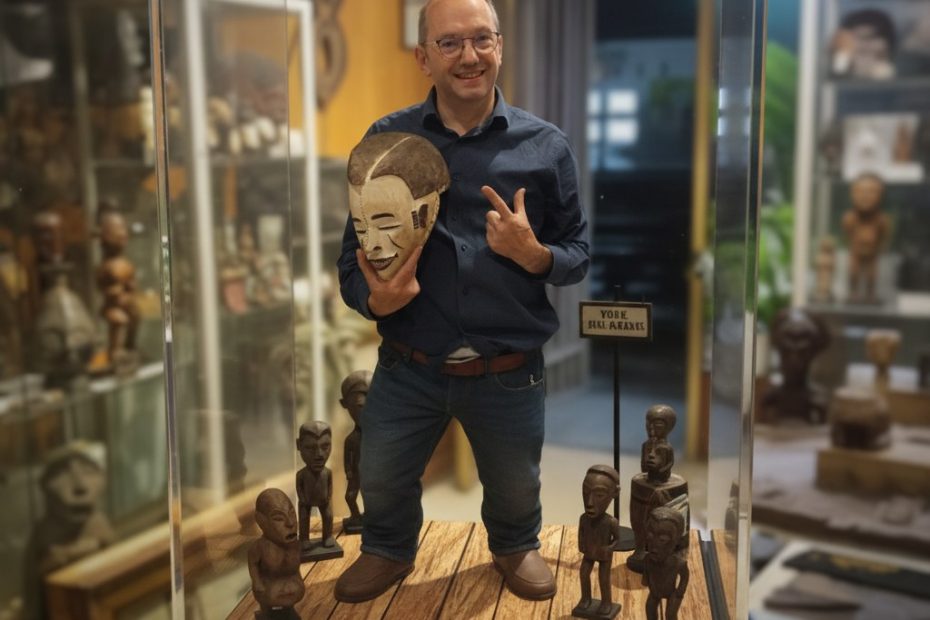
D.N. Aujourd’hui, j’achète principalement par le biais de ventes aux enchères en ligne. Et parfois, j’ai aussi un collectionneur qui a beaucoup de pièces et qui me dit
David, j’ai quelques pièces que je n’arrive plus à intégrer dans ma collection et tu as quelque chose que j’aimerais avoir. Pouvons-nous faire un échange, ou une partie en l’argent et de l’échange ? De cette façon, j’obtiens aussi mes pièces.
K.K. Ensuite, l’entretien de ces statues. Y consacrez-vous beaucoup de temps ou d’efforts ?
D.N. En fait, pas vraiment, mais ce qui est bien, c’est que si vous avez une belle pièce, elle peut occasionnellement faire l’objet d’une présentation… surtout… il faut parfois lui trouver un socle si elle ne tient pas droit et les mettre sur un piédestal. Pour les masques aussi, si on ne veut pas les accrocher au mur, on peut leur faire fabriquer un socle qui les présentera mieux. Je sais qu’il y a aussi des marchands qui travaillent avec des restaurateurs pour remplir les fentes et de temps en temps retailler ou completer les pièces pour les rendre plus attraillantes mais je ne m’occupe pas de cela. Je laisse généralement les pièces dans l’état où elles se trouvent lorsqu’elles arrivent. Les pièces les plus anciennes que j’ai, ont de temps en temps deux ou trois mille ans. Oui, j’ai une autre figurine qui a une histoire intéressante. Il s’agit d’une statue Teke qui vient du Congo et à l’époque certains missionnaires voulaient brûler les statues.
Teke figure Claude Lehuard 1930s height 24cm
Il s’agissait de “fétiches”, qui étaient supposés être des esprits maléfiques, et les Africains devaient devenir catholiques et devaient renoncer à leur religion.
Les missionnaires ont donc placé tous ces objets sur un grand bûcher. Un homme (Claude Lehuard) a réussi à sauver certaines de ces statues du bûcher. Et si vous regardez la statue, vous pouvez voir qu’il y a encore des traces du feu sur elle.
J’ai remarqué que je prenais un peu de poids avec l’âge et je me suis demandé : comment vais-je résoudre ce problème ? En faisant un peu plus d’activité physique. Mais personnellement, je ne ressens pas vraiment le besoin d’aller dans une salle de sport ou quoi que ce soit du genre. Alors j’ai pensé que je pourrais faire un peu de jardinage. Ma femme a donc acheté une maison en France où j’ai un grand potager de 500 mètres carrés, et je peux ainsi combiner cela avec mon magasin. Ainsi, en hiver, je laisse germer quelques graines sous une lumière artificielle. Au printemps, je les mets simplement dehors. Et quand je vais en France, je mets ces plantes qui ont un peu poussé dans la voiture pour les planter dans mon potager. C’est donc aussi mon passe-temps.
Et oui, j’ai une boutique ici qui n’est pas comme toutes les autres boutiques, car dans la plupart des boutiques d’art africain les marchands font ça très proprement,
un peu comme dans un musée. Et puis vous voyez cinq ou dix pièces et elles coûtent très cher. Mais ainsi vous ne vous adressez qu’à des personnes qui ont vraiment beaucoup d’argent et ce n’est pas vraiment mon intention ici, donc cela ne m’intéresse pas.
K.K. Et une de mes dernières questions est : pourquoi avez-vous choisi le nom « Primitive Art » comme nom de votre boutique ?
D.N. Oui, c’est un nom un peu controversé. Habituellement, je dirais juste l’art africain. Mais comme je suis un peu plus large et acquiert parfois aussi de l’art océanique ou esquimau (Inuit) ou de l’art non européen, j’ai d’abord choisi le terme ‘Art Primitif’, mais en fait chaque dénomination sera mauvaise, pour ainsi dire. À mon sens, il s’agit plutôt du sens original. Certain maintenant appellent cela aussi “Arts primaires”.
Mais finalement, il est difficile de toujours plaire à tout le monde avec un nom. En fait, cela ne dit pas grand-chose.
K.K. J’ai fait quelques recherches supplémentaires et il semble que quelques pays demandent le retour de leur art aux institutions et musées d’antiquités qui s’occupent d’art primaire ou aussi de « l’art primitif ». Quelle est votre opinion là-dessus ?
D.N. Oui, c’est effectivement une chose. En ce moment, nous remettons en fait en question l’histoire. Il y a donc de nombreux pays qui disent effectivement oui, vous nous avez volé notre art au fil du temps, parfois par la force et nous aimerions avoir ces objets d’art dans notre pays parce que c’est notre culture. Personnellement, je ne pense pas que ce soit correct à 100%. Pour moi, les objets sont davantage des ambassadeurs de la culture d’un pays, et cela garantit également que d’autres personnes découvrent la culture d’un pays et garantit en fait qu’ils restent informées de ce que ces personnes ont fait. De nombreuses pièces sont arrivées au XIXᵉ siècle. Je vois des pièces intéressantes chez des colons qui avaient une plantation au Congo et découvre ce qui se trouve dans le grenier des parents décédés. On m’appelle, il faut vider la maison. Êtes-vous intéressé à nous acheter ces pièces? OK, je les achète. Occasionnellement, il y a des documents qui sont inclus, mais souvent, je ne sais pas dans quelles circonstances les pièces se sont retrouvés là.
Donc tu ne peux pas déterminer tout cela. Que tout a été volé ou non. Non, il faut souvent nuancer un peu. Tout n’est pas noir ou blanc, bon ou mauvais. Il existe de nombreuses nuances de gris entre les deux.
We gingen langs bij David Norden, een gewaardeerde antiquair met een passie voor Afrikaanse kunst.
In drie dagen legde zij zijn verhaal vast, waarbij ze de focus legde op zijn persoonlijke leven als antiquair
en hoe hij zijn kennis heeft opgedaan.
“Mijn vader en grootvader hadden al een antiekwinkel. Zo is mijn kennis hierover gegroeid.”
Tijdens de documentaire komt zijn kijk op de kunstwereld naar boven en zijn passie voor waar hij in gelooft:
“Voor mij zijn kunstvoorwerpen een ambassadeurs van een cultuur van een land en zo blijven we
op de hoogte van wat die mensen hebben gedaan.”
Afrikaanse kunst Antwerpen
Video (c) door StampMedia onder creative commons, door Matias Ramos ter Maat en Kiza Kobé.
Tegenwoordig lijkt alles altijd zo druk te zijn. Iedereen is onderweg naar hun werk of aan het denken over hun toekomst.
Winkels staan vol en alles lijkt constant in beweging te zijn. Maar verborgen tussen al deze drukte vind je af en toe nog een winkel waar de tijd stil lijkt te staan.
“David Norden Primitieve Kunst”
D.N. Mijn naam is David Norden. Ik ben zestig jaar oud en in het dagelijkse leven ben ik een handelaar in Afrikaanse kunst.
Ja ik doe dat al een dertigtal jaren ongeveer. Ik heb al een handels register sinds 1988. Dan ben ik vijf jaar fotograag geweest, beroeps.
Ben ik overgeschakeld naarmeer Afrikaanse kunst en ik het begin deed ik ook wat algemeen antiek .
Shop Karel Israel Norden-Spui 164-Den Haag-1962
( Foto winkel van Israel Norden spui 164-Den Haag-1962 ).
En mijn vader en mijn grootvader ook hadden allemaal een antiek winkel.
En ja toen die mensen kwamen, ik was nog een kind. Ik moest toen helpen om de koffie te bedienen,
of een beetje de stukken uit de voorraad mooi op te stellen en dat deed ik graag.
( foto van Nadya Levi met Werner Gillon, oud curator van deBritish Museum)
Daarna ging ik met mijn moeder naar Engeland op veilingen en dan ja, zo is dat een beetje gegroeid, mijn kennis erover.
Maar toen ik kind was wou ik niet zo direct daar zelf handelaar in worden, ik heb een beetje biologie
gedaan op de universiteit. Maar ik heb dat niet afgerond en daarna ben ik verder met fotografie bezig geweest.
Afrikaanse kunst is gewoon zelfstudie, ik heb daar nooit specifieke studies voor gedaan. Maar het is niet dat ik
daar echt iets mee wou doen of zo. Ik kende het gewoon.
Het is pas later toen … ik fotograaf was, maar er waren veel mensen die me gewoon niet correct betaalden als fotograaf.
Het is een dienstesctor, en toen dacht ik toch wel eventjes aan iets anders te proberen.
K.K. – Hoe begin je daar eigenlijk aan ? Wat, hoe krijg je die beelden in de winkel ?
D.N. Vandaag koop ik vooral via online veilingen. En soms heb ik ook een verzamelaar die veel stukken heeft en die zegt
David ik heb hier een paar stukken die ik niet meer in mijn collectie passen en jij hebt iets dat ik graag zou hebben.
Kunen we ruilen of een deel geld en ruilen ? Dus op die manier geraak ok dan ook aan mijn stukken
K.K. Dan het onderhoud van zulke beelden. Besteedt u daar veel tijd aan of is er veel moeite?
D.N. In feite niet echt, maar wat wel leuk is: als je een mooi stuk hebt, kan soms wel presentatie iets toevoegen..soms moet je een
sokkel laten maken als ze niet recht houden.
Bij maskers ook, als je ze niet aan de muur wilt hangen dan kan je er een standje voor laten maken en dan presenteert dat beter.
Ik weet dat er ook handelaren zijn die met herstellers werken om gleuven te vullen en soms stukken bij te snijden of te herpatineren
maar daar hou ik mij niet mee bezig. Ik laat meestal de stukken in de staat dat ze zich bevinden, zoals ze binnenkomen.
De oudste stukken die ik heb, die kunnen soms twee, drieduizend jaar oud zijn.
Teke figure Claude Lehuard 1930s height 24cm
TEKE Beeld door Claude Lehuard uit de brandstappel gehaald in de jaren ’30.
Ja, ik heb nog een beeldje die een interessant verhaal heeft. Dit is een Teke beeld die uit Congo komt voor 1930 .
In die tijd wouden de missionarissen, die beelden verbranden. Dat waren “fetishes”, dat waren zogenaamd slechte geesten, en de Afrikanen moesten katholiek worden en in feite moesten ze hun religie afzweren. En dan zetten de missionarissen al die beelden op een grote brandstapel.
Die man ( Claude Lehuard) heeft toen in de tijd een paar van die beelden uit de brandstapel kunnen redden.
En als je naar het beeld kijkt, zie je dat er nog sporen van de brand erop zitten.
Ik merkte dat ik een beetje gewicht aan het nemen was met de jaren en dacht dan, hoe ga ik dat oplossen ? Door een beetje meer fysische activiteit te hebben. Maar ik heb persoonlijk niet echt de behoefte om naar een gymclub of zo te gaan. Dus heb ik gedacht ik zou best misschien een beetje tuinieren.
Mijn vrouw heeft dus een huis in Frankrijk gekocht waar ik een grote groentetuin van 500 vierkante meter heb, en dat kan ik in feite ook een beetje combineren met mijn winkel. Dus in de winter laat ik wat zaadjes kiemen met zo een kunst licht. In de zomer zet ik ze gewoon buiten. En als ik dan naar Frankrijk ga, dan zet ik die plantjes die wat gegroeid zijn gewoon in de auto om in mijn groententuin te planten. Dus dat is ook een beetje mijn hobby doen.
En ja, ik heb hier een winkel die ook niet zoals alle andere winkels is, want in de meeste Afrikaanse kunst winkels doen de handelaren dat heel clean,
een beetje zoals in een museum. En dan zie je vijf of tien stukken en die kosten dan enorm veel geld. Maar dan richt je je alleen maar tot mensen die echt enorm veel geld hebben en dat is niet echt mijn bedoeling hier, daar hou ik mij dus niet mee bezig.
K.K. En één van mijn laatste vraag is, zeg maar waarom u voor de naam “Primitieve Kunst” heeft gekozen als naam voor u winkel?
D.N. Ja da’s een naam dat een beetje controversieel is. Meestal zou ik beter zeggen gewoon Afrikaanse kunst. Maar aangezien ik toch ietsje breder ben
en soms ook oceanische kunst of Eskimo (Inuit) kunst of niet Europese kunst heb ik eerst gekozen voor Primitieve Kunst, maar in feite is elke
benaming verkeerd, zeg maar. In mijn betekenis is dat meer een oorspronkelijke betekenis. Maar nu hebben ze ook dat primaire kunsten genoemd.
Maar uiteindelijk is het moeilijk om iedereen altijd tevreden te stellen met de benaming. Het zegt ook weinig in feite allemaal.
K.K. Ik heb nog wat extra onderzoek gedaan en er blijkt dat er toch een paar landen zijn die toch wel hun kunst terug vragen van antiek instanties en musea die dan handelen in primaire of ja “Primitieve Kunst”. Wat is uw mening daarop ?
D.N. Ja, dat is in feite iets . Op dit moment stellen we dan in feite de geschiedenis in vraag. Dus er zijn veel landen die inderdaad zeggen ja, jullie hebben ons in de tijd onze kunst geroofd, soms met geweld en wij zouden graag die kunstvoorwerpen terug hebben in ons land omdat dat ons cultuur is. Nu persoonlijk vind ik niet dat dat 100 % terecht is. Voor mij zijn de kunstvoorwerpen meer ambassadeurs van een cultuur van een land, en die er ook ervoor zorgen dat andere mensen een cultuur van een land ontdekken en die ook ervoor zorgen dat andere mensen in feite, ja op de hoogte blijven van wat die mensen hebben gedaan. Veel stukken zijn binnen gekomen in de XIX-de eeuw. Ik zie dan maar iets bij kolonialen die een plantage hadden in Congo en dan staat dat op zolder bij die ouders die sterven. Ik word geroepen, het huis moet leeg. Hebt U belangstelling om die dingen van ons te kopen ?OK, ik koop ze. Soms zijn er documenten erbij, maar vaak weet ik ook niet in welke omstandigheden die stukken daar zijn terecht gekomen.
Je kan dat dus niet zeggen. Of het allemaal gestolen of niet. Neen vaak moet het een beetje genuanceerd worden. Het is niet allemaal zwart of wit, goed of slecht. Er zijn veel tinten grijs ertussen in .
K.K. Bedankt voor uw mening.
D.N. Ja, graag gedaan.
Sometimes you just need to start… I have photographed a selection of objects for my next online auction my next sale of African arts, some of them have prestigious provenance ~ Enjoy the preview~ Some objects are from my own collection, but I was also mandated by someone who stopped dealing to sell part of the collection. This is a short description of some of the items to come, click on the images to enlarge :
1. Ashanti Akuaba doll, Ghana H= 37 cm L=16 cm D= 5.5 cm
2. Important Yoruba Horse rider, Nigeria. H= 52 cm L=20 cm D=23 cm
3. Biwat Middle Sepik drum fragment. H= 74 cmL= 18 cm D= 19 cm
4. End Xixth Ashanti Akuaba doll. H= 24 cm L= 9 cm D = 3 cm
5. Ashanti Akuaba doll. H= 18.5 cm L= 6 cm D = 1.5 cm
6 A Madjapait head, Java 15th century
7. A Chokwe mask 22 cm X 17 cm X 7 cm
8. A Lega ivory, Congo DRC. 14,5 cm X 4 cm X 4 cm
9. An unusual Fali doll. Cameroon. 15cm X 10 cl X 14 cm
10 A Sepik bird hook. H= 50 cm L= 53 cm X D= 8 cm
And from a known Brussels dealer who closed the shop, discover a selection of fine masks and objects:
David Norden’s deep connection with the world of primitive art traces back to his childhood, shaped by the influence of his parents and his own personal experiences. Born into a family immersed in the appreciation of African art, Norden’s journey began at a young age, fostering a profound passion for these extraordinary cultural artifacts.
His mother, Nadya Levi, a sculptor and collector of African art, and his father, Herman Norden, an antique dealer with a dedicated room filled with African art, books, and preserved birds, created an environment rich in artistic expression. .
His grand-father Karel Israel Norden also had several antique shops in DenHaag, one them dedicated to Egyptian Art.
Shop Karel Israel Norden-Spui 164-Den Haag-1962
David Norden’s frequent trips to London auctions alongside his mother introduced him to captivating figures in the art world, such as Patricia Withofs and Gaston de Havenon. Additionally, encounters with influential individuals like Mrs. Huguette van Geluwe in Brussels and collectors like Willy Mestach, Simpson, Charles Raton, and Baron Rollin in Antwerp shaped his understanding of the art market.
Reflecting on his earliest connection to primitive art, Norden fondly recalls his mother’s collection of Bassa and Dan masks. Adorning the walls side by side, these masks held a special place in his heart and instilled in him an appreciation for the diversity and beauty of African art.
As Norden’s passion grew, he began his own journey as a collector and connoisseur of primitive art. His first purchase, a small miniature Etruscan stone tablet featuring a lion, marked the beginning of a lifelong pursuit of acquiring remarkable objects that captured his imagination.
Driven by an unquenchable thirst for discovery, Norden continuously seeks out new treasures. He possesses a particular desire to acquire a significant object once owned by Henry Pareyn, a pioneering collector and dealer in Antwerp during the early 20th century. Norden’s approach to collecting is rooted in the emotional connection he forms with each piece, emphasizing the personal value they evoke rather than solely considering beauty, antiquity, and provenance.
Throughout his journey, Norden has found inspiration in numerous figures within the primitive art field. He admires those who possess a deep passion for African art and recognize its significance in the broader context of humanity. The profound impact of African art on Western artistic movements following World War I further fuels his admiration for the art form and its artists.
Looking ahead, Norden’s enthusiasm for primitive art shows no signs of waning. With an ongoing book project awaiting completion, he is dedicated to sharing his extensive knowledge and experiences with a wider audience.
Considering the future of the primitive art market and African art in general, Norden acknowledges the challenges it faces. The African art market represents a small fraction of the overall antique market, with an abundance of counterfeit pieces. Determining authenticity remains a task reserved for a knowledgeable elite, while the market’s limited size contributes to its volatility. Despite these challenges, Norden sees opportunities for discerning collectors to make valuable acquisitions, especially with the increasing recognition of contemporary African art.
Norden places great importance on the role of museums and cultural institutions in recognizing and promoting the significance of African art and its associated cultures. He commends the Musée du quai Branly for its remarkable exhibitions, which attract new audiences and foster appreciation for African primitive art. Norden also expresses anticipation for the emergence of museums on the African continent, with the Museum of Black Civilizations in Dakar serving as a beacon of hope.
David Norden’s lifelong dedication to primitive art has solidified his position as a respected figure in the field. His unwavering passion, discerning eye, and commitment to preserving the legacy of African art continue to shape his remarkable journey. As he eagerly shares his knowledge and explores new horizons, Norden’s contributions play an invaluable role in promoting the beauty and significance of primitive art to a global audience.
David Norden, a dealer who can help collector’s, museums and art enthousiast, exploring and appreciating the beauty of these ancient cultural treasures.
Some pictures inside David Norden’s shop in Antwerpen
If you have any question or want more pictures click here to mail David Norden -Sint Katelijnevest 27 – B2000 Antwerpen. Tel +32 3 227.35.40
To view a small selection of available pieces visit the online African art shop:
Please subscribe to this free newsletter . Stay in the loop of the African art world as 10,000 African Art lovers and discover the world of David Norden who is dealing since more than 30 years in African Art in Antwerp Belgium, you will get news on auctions and learn more about the African Art world and other related events.
We of course respect the privacy of your email address and will never sell or rent your details.
Sen us an email to stay in the loop, and tell us a bit more about what interest you.
Nadya Levi, a sculptor with a passion for African Art.
Born in 1929 in Bucarest, Nadya Levi left Roumania for Antwerp in 1929 where she studied sculpture at the Antwerp Academy.
In the early 1960s, Nadya Levi started collecting African art, and also became a dealer. The Dutch dealer in African and Oceanic art Loed Van Bussel, introduced her to Herman Norden who would become her husband. Herman followed Nadya to Antwerp where he would open his antique shop.
While expanding her career as a dealer in African art, Nadya also continued her work as a sculptor – her monumental soldered metal sculptures were shown in several cultural centers – and became the mother of three sons.
In her grand Antwerp townhouse, she received visits from the major dealers of the time such as Patricia Withofs, Henry Kamer and Christine Valluet, Paolo Morigi, Tishman, the baron Rolin, Simpson, Charles Ratton, Ladislas Segy, and many others. Traveling between Antwerp, London, Paris, and New York she skimmed auction houses and galleries and used these extensive travels to visit her clients, who would, in turn, come to visit her in Antwerp.
The artistic lineage of Nadya Levi was passed on to her sons. Jacob Norden became an antique dealer specialized in musical instruments, while David Norden followed more closely in his parents’ steps, becoming a dealer of African art himself, and Oliver (Olivier) Norden is a painter and performer.
Nadya Levi lived until her final days in the Antwerp townhouse where she enjoyed her beautiful garden.
At age 92 she passed away, having lived a full life. Native auctions has been entrusted with a number of objects that were part of her life and dreams. We wish that these keenly collected pieces will keep her legacy alive in collections all over the world.
Object of the day. This very fine staff was once in the collection of my mother Nadya Levi , she sold it in 1967 to Henry Kamer who sold it to Tishmann , who sold it to Walt Disney who sold it to the Smithsonian, who exhibited it at the Met. While Kongo leaders generally adopted the leopard as emblematic of leadership, the stylized mane depicted may refer to that of a lion, an animal not indigenous to the Lower Congo but introduced instead by way of European heraldic imagery. https://www.metmuseum.org/art/collection/search/321190
Let yourself be surprised and enticed by Antwerp’s extensive shopping offerings.
Ranging from major fashion houses to trendy boutiques, and from small and independent shops like David Norden’s African Art shop to groundbreaking concept stores.
Every first Sunday of the month, a large selection of shops are open in the center of Antwerp. Come shop and combine it with a visit to the numerous restaurants & cafés; museums, markets, and points of interest.
Because shopping in Antwerp is …
Knowing where you begin but not where you will end up.
Bassa passport mask, wood, H= 16 cm, 23 cm on metal stand.
provenance Nadya Levi, Paolo Morigi.
– Small Baule shrine figure. Wood, remains of offerings encrusted. H = 18 cm
Ogboni mask, Nigeria. Wood, white kaolin, red Tokula powder, black carbon. H= 28 cm. 40cm on the stand.
Provenance Millon French collection
-Passport Bassa mask. Wood. H= 13cm, 21cm on stand.
Provenance= Bob Germ.
Akan commemorative statue. Terracotta, H= 25 cm. Hands on knees for terracotta, a rare depiction of female wisdom in Akan votive pieces. When the arms are along the body it is virtue. Ivory Coast.
Provenance: Charles Lapicque (1898-1988)
Ibeji. Ilorin Oyo. Yoruba, Nigeria. Wood. H = 25cm.
Provenance: Ursula Voorhuis.
Salampasu mask in two colors. Height of the wood mask = 19 cm. H= 46 cm on stand.
Provenance: Nadya Levi.
In the online African Art shop I am regularly adding objects from my inventory. But if you want to see everything, you should visit me in Antwerp. If for any reason you have troubles buying through the shop, drop me a line at david.norden@telenet.be
Online kunt U enkele voorwerpen uit mijn collectie zien, maar U bent ook welkom hier in Antwerpen. Indien het U niet lukt om via de webshop te bestellen kunt U mailen naar david.norden@telenet.be
Sur mon site pour pouvez acquérir certaines de mes pièces d’Art Africain , mais pour les voir toutes il faudra vous rendre à Anvers. Si vous avez des diffucultés pour acheter dans le webshop, vous pouvez aussi simplement envoyer un courriel à david.norden@telenet.be.
The Dogon people are an ethnic group in Mali, West Africa, known for their unique art, including their masks. The Dogon masks are believed to have spiritual significance and are used in various traditional ceremonies and rituals.
There are several types of Dogon masks, each with its own meaning and purpose. More than eighty types of African Dogon masks have been identified.
Here are some of the most common types of Dogon masks:
Kanaga Mask: The Kanaga mask is one of the most well-known Dogon masks. These masks are characterized by a wooden superstructure in the form of a double-barred cross with short vertical elements projecting from the tips of each horizontal bar. Kanaga masks are worn at rituals called dama, whose goal is to transport the souls of deceased family members away from the village and to enhance the prestige of the deceased It was first believed that mask represents a bird, the Dogon’s mythical ancestor, but Griaule the french anthropologist discovered the deeper meaning of the kanaga mask apparently pertains both to God, the crossbars being his arms and legs, and to the arrangement of the universe, with the upper crossbar representing the sky and the lower one the earth. . The mask is believed to have the power to connect the living with the spiritual world.
Satimbe Mask: The Satimbe mask is a female mask that represents the spirit of agriculture and fertility.Dogon Satimbe masks are surmounted by female figures, commemorating a mythological woman who first discovered and wore a mask. According to myth, her husband stole this mask, and from that time on Dogon women have been prohibited from wearing or coming close in contact with masks.
Dama Mask: dama is a collective funerary rite for Dogon men. The Dama mask is used in funeral ceremonies to honor the deceased. It is a tall, narrow mask that represents the spirit of the deceased and is believed to help guide them to the afterlife.
Conversations With Ogotemmeli: An Introduction to Dogon Religious Ideas
The society of the masks is a picture of the whole world. For all men, all activities, all crafts, all ages, all foreigners, all animals can be carved as masks or woven into hoods.
Sigui Mask: The Sigui mask is used in a ceremony that last 7 years and that celebrates the end of a 60-year cycle in the Dogon calendar. The Great Sigui Mask is carved from a single piece of wood and measures several meters in length. It looks like a plank with a mask sculpted at its lower end. It is not meant to be worn. The mask is made up of several different parts, each representing different elements of Dogon cosmology.
Sirige Mask: The Sirige mask is used in a ceremony that honors the spirit of the ancestors. It is a wooden helmet-like mask with a small, circular face, and is believed to have the power to protect the living from evil spirits.
Samana Dogon Warrior Mask: Also named ‘the hunter mask’ this mask would hold the nyama of the deceased ancestor.
Each of these masks is unique and has its own meaning and significance in Dogon culture. They are highly respected and are an important part of the Dogon people’s cultural heritage.
Samo Dogon mask: A Dogon dancing mask, representing a Samo, a member of a neighboring ethnic group with a reputation for aggressive, warlike behavior.
A Dogon Samana mask from David Norden’s collection
Each of these masks is unique and has its own meaning and significance in Dogon culture. They are highly respected and are an important part of the Dogon people’s cultural heritage.
If you live in Belgium, you probably already know that Antwerp has shopping Sundays: on the first Sunday of each month, a lot of shops and galleries are open all Sunday!
So please drop by and visit my Shop on the Sint Katelijnevest 27. B2000 Antwerpen Belgium the next first sunday of the month. I am usually there, but you can always give me a phone call to be 100% sure +32 3 227.35.40.
Antwerp has dozens of Amazing museums, notably the Mas (that holds the Janssens collection of precolumbian art and it’s gold jewelry, as well as outstanding tribal collections like Malraux Hemba figure from his imaginary museum), the recently reopened KMSKA museum (a lot of Rubens, and James Ensor, mixed with ugly contemporary art, amongst much else)
The Mayer van den Bergh museum hosting the Dulle Griet, and around the corner from my shop you can find the Snijders & Rockoxhuis…there is something to suit everyone!
You will also be able to examine and handle this spectacular Punu mask and hundreds of other things from my own collections!
And just in case some treasure catches your eye, there is a “Special Sunday” deal that must not be missed!
Did you know David Norden started his online magazine about the Arts of Africa and his first website about African art already in 1998 and is dealing in genuine African Art for more than 30 year now.
9000 collectors are reading actually his newsletter. He sold to museums, dealers, and collectors worldwide. His shop is in Antwerp.
David Norden also was one of the first to start online discussions about the authenticity of traditional African Art.
More or less regularly he is also doing online auction and handles the delivery to your front door in house, to avoid you the unecessary costs from expedition companies. He also participated in Art fairs, from Paris to Lisboa, and from New York to Netherland.
Please subscribe to our African Art Newsletter to stay in the loop…
African Art Newsletter
Signup for the latest African Art news, auctions, museum exhibitions, books, fairs and more African Art information !
Today I will show you some African art objects with an interesting provenance.
I found recently this 28 cm high sweet little Dengese figure . The small Dengese tribe north of the Kuba kingdom, across the Sankuru River, produced some of the most refined art .
It has a honey patina and is coming from the Carlo Bold collection
and a Janus double head Fang helmet mask coming from Ludwig Bretschneider collection.
Both objects are on view in my shop in Antwerp, where you are welcome. But I also ship worldwide..
The shop in Antwerp is a real treasure trove filled with a hundred authentic items waiting for a new caring family to adopt them.
Still going on a continuation of my previous auction from a week ago, that somehow got some technical troubles and delays at , so a second chance for those interested
in acquiring the below beauties. Until next Tuesday at 7 p.m. you can pre-bid on the following items, before the auction goes live.
This early XXth Bassa mask below was from Paolo Morigi who sold it to my mother Nadya Levi in the 1970’s.
Once Upon a time, a long time ago, there was a shop in Antwerp where time stood still.
Once you walked in the door, your eyes would be dazzled by hundred of ancient gods, of masks, of curiosities from Africa and all over the world, looking down from the shelves.
It was like walking into a different world, a different time.. like a Victorian cabinet of curiosities still alive and well in this busy world.
…and the wonful thing is… It’s still there.
All you have to do to find it is ask the owner to be added to his free newsletter, and tell him what you collect.
Once you do this he will be in touch and tell you everything you need to know.. and you can even go and find the virtual African Art Shop Online , or visit it yourself in Antwerp and lose yourself among the shelves, and benefit from all thirthy years of David Norden experience collecting, owning and selling some of the world’s most beautiful and refined tribal and non-western art.
Right now there is a mask or a figure standing on a shelf in Antwerp that has been waiting for you all its life.
David Norden is happy to show you 2 masks and two figures he recently added to his extensive collection that can be viewed in Antwerp or discovered in his online shop
To determine the age and authenticity of African art sculptures there are many techniques that can be used, but nothing will replace having seen tens of thousands of objects during the past thirty years of buying and selling African art through auctions, visits of collections, museums, fairs, and studying African art through books and online research, and last but not… Read More »
SOLD This impressive Dogon figure is coming from the Meulendijk collection. The Meulendijk collection was sold at Christie’s, London, October 1980.
This figure was also Exhibited in Rotterdam in 1967-68 and published and illustrated in the catalog Afrikaanse Sculpturen uit de Collectie C.P. Meulendijk, Museum voor land en Volkenkunde, 1967-68, curator J.Hurwitz, M.A., introduction by C. op ‘t Land.
The Bassa mask from Liberia is the senior entertainment mask of the men’s No association. When danced it emphasizes desirable traits for women to emulate.
Although smaller than life size, the wood mask was attached to an open basket like construction that was concealed as part of a larger costume that fully covered the dancer’s face.
Bassa wood mask in a concave oval shape with pointed chin, while those from their Dan neighbors are convex.
Incised row hairstyle . Two bone teeth are visible in the protruding mouth from the Bassa mask on the right.
The two big mask are coming from the estate collection of my mother Nadya Levi a sculptor and collector of African Art in Antwerp who recently passed away at age 92.
She got them from Paolo Morigi who collected them in situ during the Biafra wars. The small miniature passport mask is coming from collection S. an old colonial Belgian family.
You can place your bids until Sunday evening the 19th September 2021.
3 Fine and old Pende Miniature masks Ikhokho’s ( before 1947 )
The Central Pende from the Democratic Republic of the Congo replicate masks in miniature form.
Wooden versions produced by healing specialists are prescribed by diviners as remedies.
In contrast, their ivory counterparts, ikhokho, are made by professional sculptors to be worn as decorative pendants to protect.
While its texture and resistance to cracking make elephant ivory the material of choice, the thighbones of hippopotamuses allow artists to achieve comparable effects.
Bodily contact through wear alters the whiteness of the pendants. Although this effect is prized by Western collectors, the Pende themselves scrub the ornament’s surface daily with water and abrasive sand in order to maintained its original color, process which blurs the features over time.
Date: Those 3 Pende Pendants are all first half XXth century before 1947.
African masks have become part of life in the west just as they have in Africa. Originally they served as the literal face of justice, or representations of ceremonial beings, deities, or departed ancestors. They were used for education, for entertainment, and to tell the many-splendoured story of African history. their diverse function is reflected in their extraordinarily varied appearance, as well as the contexts in which they were used.
In the west, African masks first became part of the avant garde’s artistic resources, then gradually entered the western consciousness to such an extent that they are among the most valued African art items; a rare Luba mask recently sold at auction for 7.2 million euros.
Africa is an extremely prolific centre for innovative and traditional works, that can suit any budget. Decorative masks exist at the lower end of the market, while connoisseurial attention is naturally focused on what are considered to be ‘genuine’ pieces – those that were designed, made and used for their original role, typically before extensive western influence put an end to traditional religions and ceremonial practice. It can be difficult to identify these rare gems, and also to fully understand the pomp, ceremony and social context in which they were used. To this end, David Norden African Antiques has spent 30 years sourcing, describing and contextualising African masks, and integrating them into new collections with specialist advice and information.
The bidding platform can be found HERE, where you can manage your bids, orders and personal information. A proxy bidding system is in place – enter your maximum bid, and the system will bid only as much of it as is necessary to win the lot. Commission rates are low – 12% – and postage is also managed in house to ensure reasonable costs: free to Belgium, 40 Euros to the rest of Europe, 80 Euros to the USA and 100 Euros to the rest of the world.
The auction starts Friday the 10th September at 11am, and end on the evening of Sunday the 12th at 8pm (Belgian time), but I will keep adding tribal masks on the bidding platform until Sunday the 12th..
David Norden stated dealing 30 years ago. His shop is in Antwerp and he is part of a family dealing in Antiques for three generations.
His grand-father Israel Norden had five shops in Den Haag ( Netherland) in the 1950’s-60’s, and his father Herman Norden had his Antique Shop in Antwerp in the 1960’s-80’s.
His mother Nadya Levi a sculptor, also collected African Art privately, some of here items will soon be offered on this site.
Start creating your collection by buying carefully curated items from David Norden’s African Art auctions at attractive prices.
We sold thousands of objects and are proud to say we have only happy clients .
99% Customer Satisfaction
5 Star Reviews
How Buying at our Auction Works
Visitors need to register with the website to place bids in the auction.
After having registered your account and choose your username and password you can start bidding.
User can view the photos and description of the product and can send private message for any queries and Request Additional Info.
Timed Bidding
If you are bidding in an timed auction, you can place a maximum bid and the system will bid on your behalf based on our bidding increments below at the lowest competitive price. Pricing increases (up to – but not beyond – your maximum bid) as other users bid on the work. Please note that maximum bid amounts are only executed if there is a competing bidder up to that amount, otherwise you will win the auction at a lower price..
Proxy Bidding (also known as Automatic Bidding) – Our automatic bidding system makes bidding convenient so you don’t have to keep coming back to re-bid every time someone places another bid. When you place a bid, you enter the maximum amount you’re willing to pay for the item. The seller and other bidders don’t know your maximum bid. We’ll place bids on your behalf using the automatic bid increment amount, which is based on the current high bid. We’ll bid only as much as necessary to make sure that you remain the high bidder, or to meet the reserve price, up to your maximum amount. This happens in an automatic way, so it will often happen you pay less than what yo where willing to pay.
Win
The auction costs are only 12 %, while at other places you usually pay around 30 % costs. We can do this because we have a small structure with not to high costs.
All winning bidders will get a winning notification and product will be added to their checkout page. Winners can enter their billing address and pay for item.
We do not collect credit card numbers in advance but any auction bid is final, failing to pay will ban you from our system.
Your won items will be carefully packed and send in house with tracking number door to door.
You will find inside your package a written description with picture from your authentic items as described, with David Norden’s private opinion.
The bidding platform can be found HERE, where you can manage your bids, orders and personal information. A proxy bidding system is in place – enter your maximum bid, and the system will bid only as much of it as is necessary to win the lot. Commission rates are low – 12% – and postage is also managed in house to ensure reasonable costs: free to Belgium, 40 Euros to the rest of Europe, 80 Euros to the USA and 100 Euros to the rest of the world.
To determine the age and authenticity of African art sculptures there are many techniques that can be used but nothing will replace having seen tens of thousands objects during the past thirty years of buying and selling African art through auctions , visits of collections, museums, fairs, and studying African art through books and online research, and last but not least living among the objects.. .
A stool From the Luba Benji substyle.
HAS THE AFRICAN ART BE USED IN A RITUAL OR DANCED ? What was it used for, has it been handled ?
There are many types of wood, and not all have been used for the same purposes. Some African sculptures where made to be put outside and the used with needed to be resistant to the weather conditions, those where often made in a very heavy and dense wood, while masks made to be danced, and neckrests needed to be transported all day long, where made in a light wood. An inteesting book for that matter that listed “31 Wood Conditions,” to be analysed to determine it’s function where mentioned in the book “Surfaces”, but it is hard to find today at decent price.
Of course using common sense when looking at the wood conditions allow to determine and recognise those masks , figures and objects with a look artificially produced to make it look older than it really is .
Clear signs of fakery are :
UNNATURAL AND OVERDONE PATINA
By rubbing the objects in the wrong places, wrong directions, in an exaggerated or to big area, in an uniform way on the different parts of the item and in an uniform manner to influence the appearance. The result is an unnatural patina.
THE BACK, INSIDE OF A MASK TELLS MORE THAN THE FRONT
Old masks often are just have the light color of the wood on the back. More recent masks made for the decoration market or to fool the starting collectors are first colored on the back and given a palm oil treatment to simulate human sweat from the dancers. Often the mask is broken and restored with thick raffia, or put on a termite hole and then under the ground to similate aging and insect damages, making it appear older than it really is. Also the patination are done often in a repetitive and not layered with a time build up. Also often the fakers are using the wrong tools that where not in use in the old times. The fakers also can not imitate very well the patination due to the effects of time and the oxidation of the wood, so characteristic for those having seen a lot of historical masks. The sun’s UV also are occasioning the fading of applied pigments. The artificial patina made by a repetitive motion of man’s hand rather than by the accidental, varied, time-
EROSIONS DONE WRONG
It is not so difficult to create an impression of erosions on masks and statues artificially, drilling holes to imitate insects, using chemicals abrasives to damage the surface. Putting the objects in the ground, or keeping them in the garden for a few months . Or on the top of a termite to produce a quick old -aged impression . The fakers use contemporary pigments and even oil paints, but those can’t replace the real aspect of UV damaged, laundry blue, white kaolin, and red Tokula powders turned brown or gray. BEETLES
A small pin hole made artificially on the surface is not the same as the remains of powder from beetle borings. Sometimes fakers use old woods and recarve them, but those insects usually do there holes beneath the surface and not on the surface, making it easy for the trained eye to spot the difference. Using patination machines to rub the wood makes the artificially patinated object looking quite unifom, and lacking the richness of a time build patina. from a layered surface. These variations can be determined using a microscope.
NO SMELLING PLEASE
When the masks and figures where made they often where darkened using the firing of the wood and greasing it, but this makes the wood to smell for at least 30 years, so when you smell nothing it’s a good sign. Also old wood becomes oxidised, so when you look at the cracks in the wood it should not be white but the wood should become colored you the cracks filled with dust and dirt.
Signs of Aging in a Western environment.
A long time ago , westerners who lived in Africa used to wax and even varnish on the items they bought to protect them against bugs and mushrooms. For most collectors it is important to have an object that has stayed for a long time in Europe, giving it more guarantees of being genuine and not to made for the decoration market. But it depends also on the tribe and the cultural evolution. eg. in the culture from Gabon, exercicing rites related to the Fang N’gil was prohibited since the end XIXth century, making all object made after that date quite divergent from the traditional styles, and not deemed so worthful by collectors. Same for objects from Benin, .., S it is important to know if the sculpture just come out of Africa or if it has a Western provenance history, some signs making it possible to recognise the qualities of having been resting in an out of Africa environment? – ( does it have an old base, are there painted numbers or etiquettes on the piece, are cracks in the wood showing fresh wood or accumulation of Western dust, does the sculpture or mask have restoration and how where they done and by who, has the original patinaa been cleaned, a lack of odor is a good sign, style comparison with similar items in books and museums, etc, etc.) A fake decorative object doesn’t have the same look and feel than the original since nature and man have two different handwritings, and those sculptors who are copying objects from books make mistakes in size , proportions, and patina. It is even often possible to recognise the workshop worked on a particular piece because of man’s “handwriting” style that is different from the originals, often details are forgotten, or other details have been added to enhance the “attractivity” and the techniques used are often different than the originals and more contemporary tools and materials used giving it another “feel” the experts often recognise quite fast. Other observations that can be made are the carving qualities, the logic of a piece’s form, the function, etc. That is all needed to establish African art authentication and valuation, a field that is quite difficult seen the hundreds of different tribes and also the large scale of collectors, and experts that not always agree with each others. But the internet and the various groups for even the more obscure collecting areas are available to ask opinions and help to establish the authenticity of any object.
VALUATION AND APPRAISING OF AFRICAN SCULPTURES AND MASKS.
It is very important to compare the appearance of similar pieces in the African Art literature, museum, dealers and auction catalogues, if a similar piece has been exhibited, a known hand, book material on such pieces and on rare occasions it can even happen that you recognise that piece itself, provenance which can double or even triple it’s value, auction results of similar pieces, rarity, original invoices, etc, etc. This can all help to establish an evaluation, but also to appraise a mask or sculpture the expert prefers to see the piece in person to make a more secure judgment on the age, presence and authenticity of the sculpture. But today it can become more tricky, because some carvers have made it a skill to copy some rare types of masks , when you 5 examples of the same rare type of mask all looking the same with the rubs on the same spots, you know there is something suspicious about it. Carvers from the Ivory Coast are making beautiful and quite convincing Baule masks, and carvers from Gabon make quite convincing copies from the Mahongwe’s, but often they add to much unlogical patina, and make the figures somewhat bigger than the genuine ones to make it look more “important”, knowing the genuine ones can often sell for six numbers . To valuate and authenticate African art is still an “instinctive” reaction by most experts and collectors of African art, and rare are those who can give you a hundred procent guarantee but it is believed that by viewing a lot of objects, and studying the books and catalogues, applying stylistic comparisons, and types of woods from each tribe, and the aging characteristics it can come close to a “science” .
But don’t expect to become an expert yourself in a few weeks, it takes many years and the help of good friends to be able to uncover all the richness of African art.
If you need a second opinion or help in building a collection, or cleaning up an old one, you can always contact me.