Category: African Masks

  • Two African Pieces on the Table

    Two African Pieces on the Table

    This morning, before opening the shop, I placed these two next to each other.

    Not because they belong to the same tradition. They clearly do not.

    But sometimes objects begin to speak differently when they share the same space for a while.

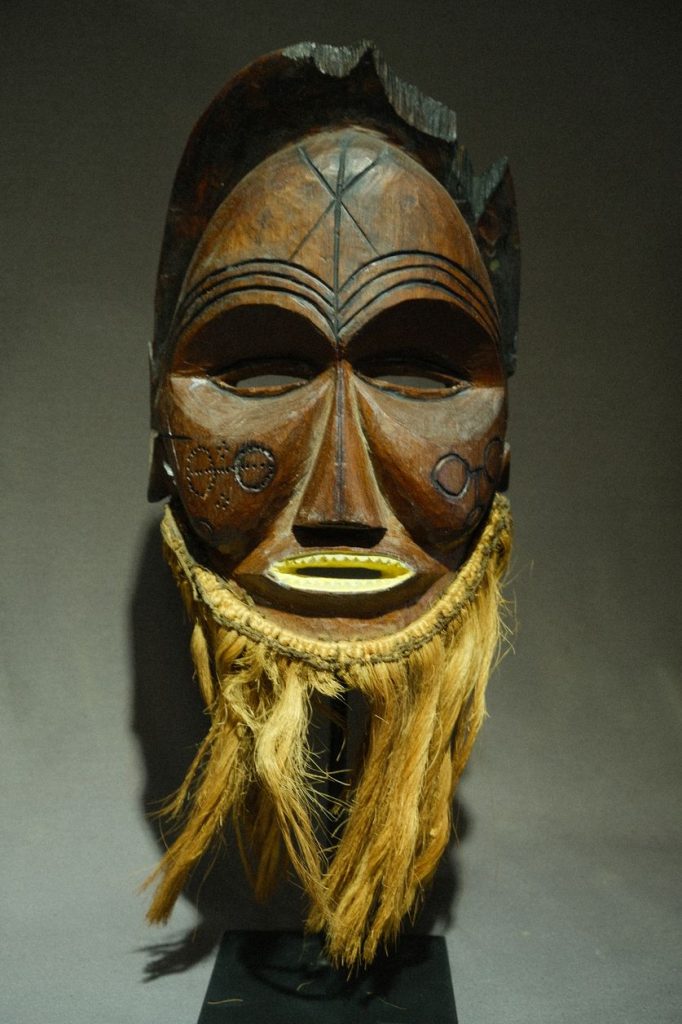
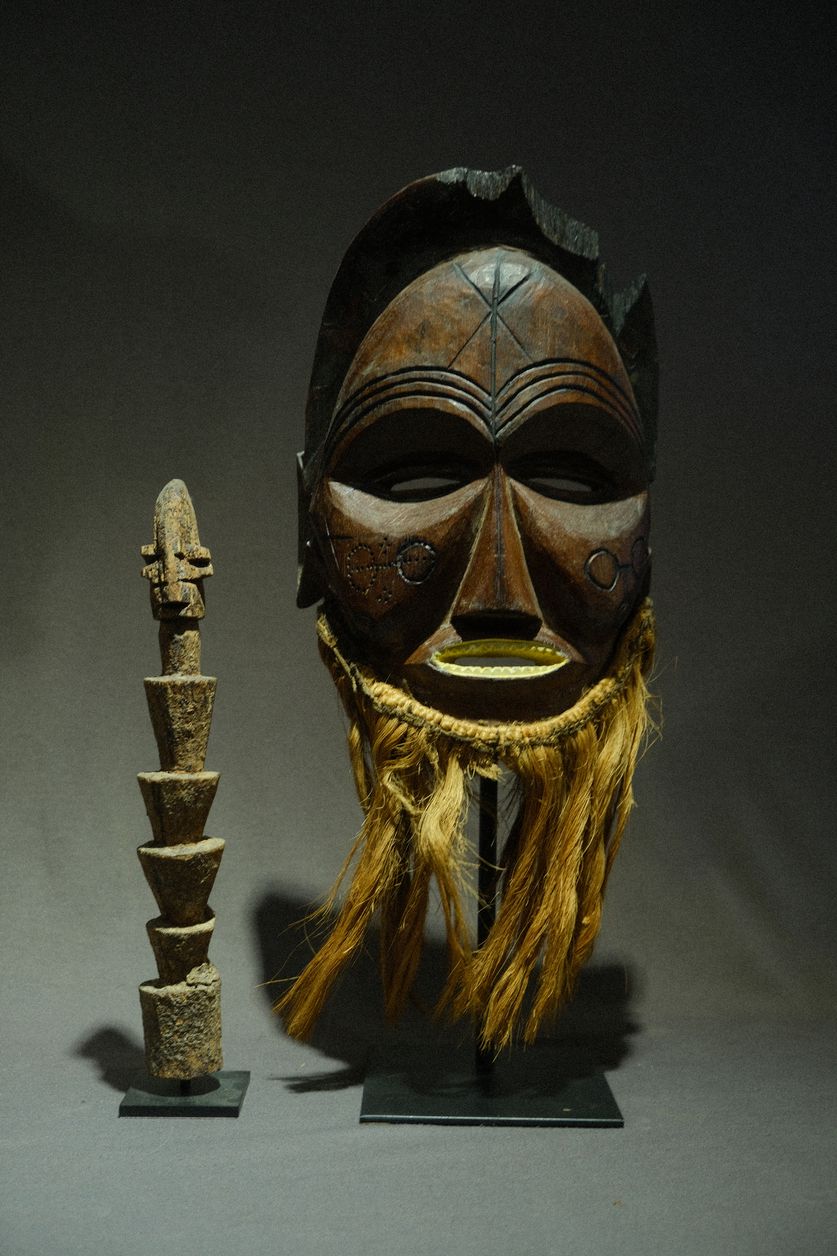
    One is a mask from Zambia, in the Mbunda style.
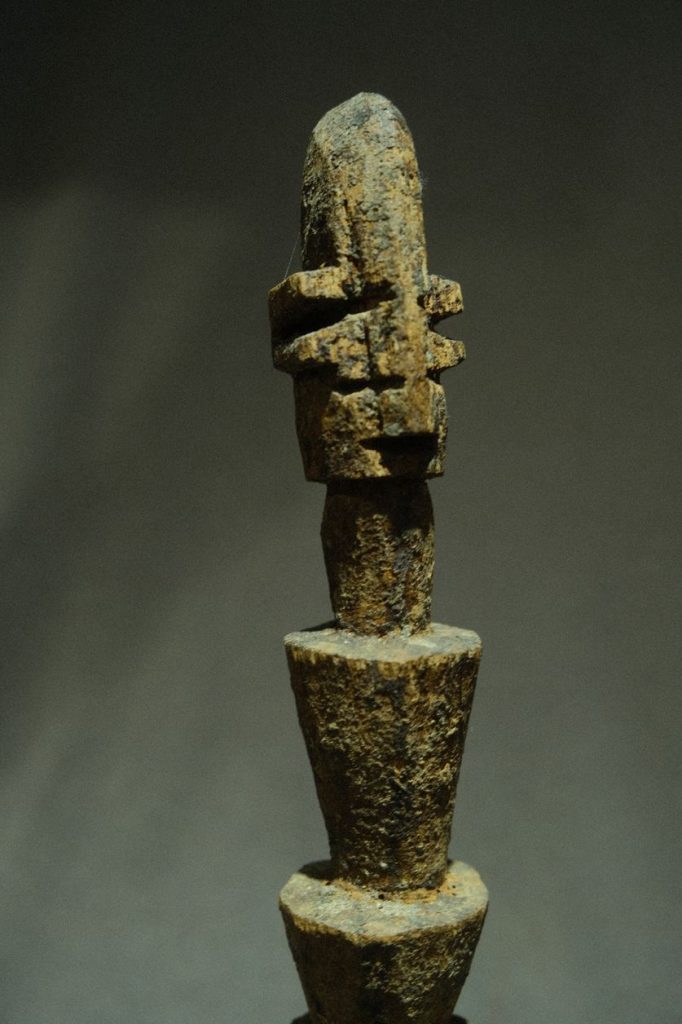
    The other, a small Lobi figure from Burkina Faso and Ivory Coast.

    The mask immediately takes control of the table.

    FXE49780African Art

    Its construction is unusually deliberate. The repeated lines above the eyes almost feel architectural, as if the face was assembled rather than carved. It reminded me of older Mbunda masks I had seen years ago — those powerful faces balancing authority and restraint.

    But what interested me most here was not the attribution.

    It was the tension.

    The mask feels calm, but not passive. The symmetry is controlled, though never rigid. Even the surface has settled in a convincing way, without the heavy-handed restoration or artificial aging one so often encounters today.

    You can view the mask here:
    Mask in the Mbunda Style — Zambia

    The small Lobi figure reacted differently.

    FXE49773African Art

    At first glance, it almost disappears next to the mask.

    But after some time, it became the piece I kept looking back at.

    The composition is extremely reduced — almost like a narrow ladder with a head placed on top. Very little is described. And yet the figure holds together remarkably well.

    There are traces of sacrificial material still attached to the surface, forming a dense encrusted patina that gives the object its physical weight and history.

    It is not a spectacular piece.

    Which may be exactly why it works.

    You can view the Lobi figure here:
    Lobi Figure — Burkina Faso / Ivory Coast

    After thirty years of handling African objects, I increasingly notice that the pieces which stay with me are not always the loudest ones.

    Often they are simply objects that continue to hold the eye after the first impression has passed.

    These two did.

    Dogon figure — Mali

    Mask in the Mbunda Style — Zambia


    Share and Enjoy !

    Shares
  • Kifwebe masks explained

    Kifwebe masks explained

    Unmasking the Kifwebe

    There are objects that one first encounters as forms, and only later understands as systems.

    The Songye Kifwebe mask belongs to this category.

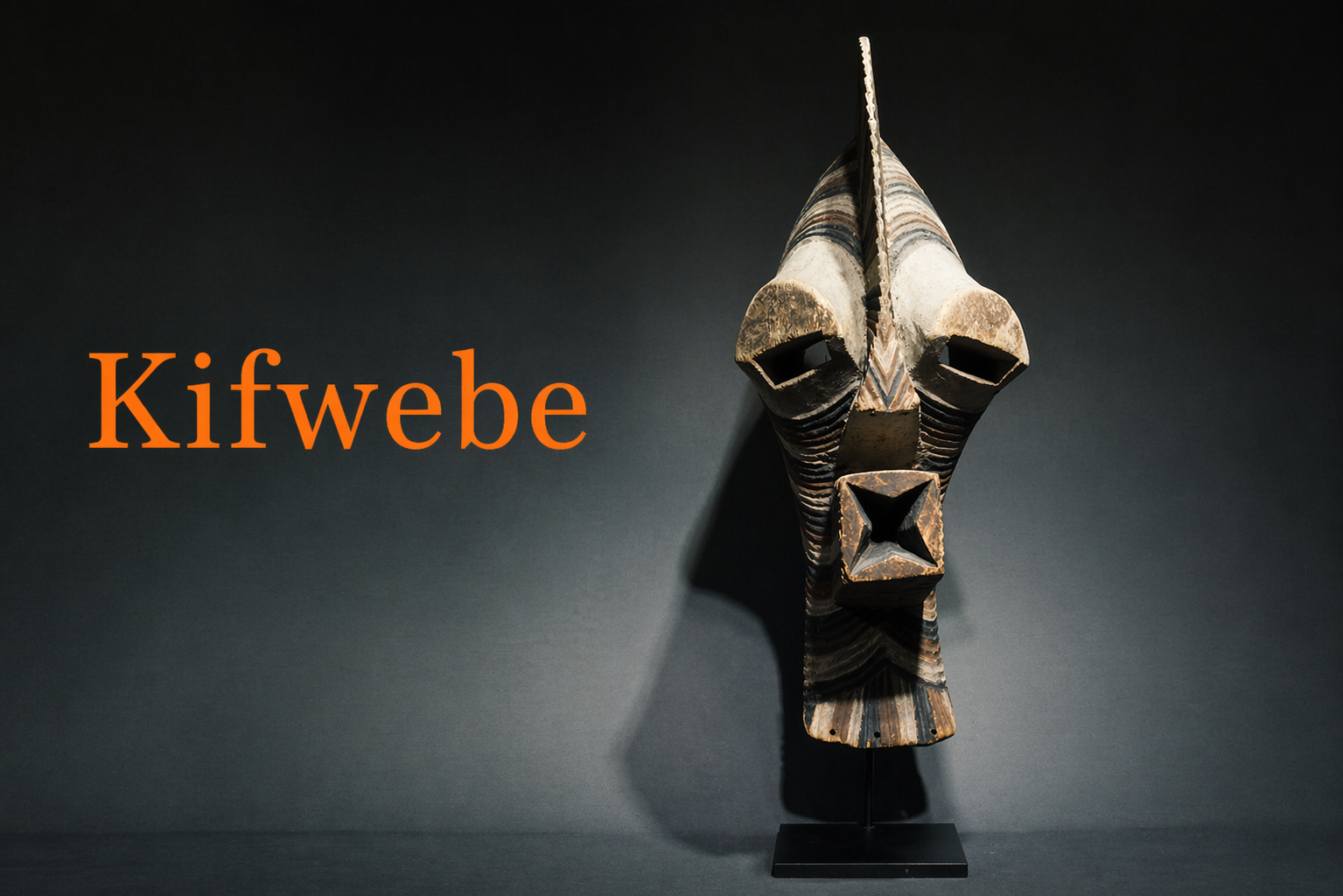
    At first glance, it is defined by its structure: a face reduced to essential volumes, covered with rhythmic striations, interrupted by projecting eyes and a mouth that breaks the plane. The geometry is direct, almost abrupt. It is easy to understand why such forms would later resonate with Cubism.

    But this clarity is not aesthetic invention. It comes from function.


    An Object of Authority

    Kifwebe masks were created within the Bwadi Bwa Kifwebe society, a powerful institution among the Songye. These were not decorative objects, but instruments used to regulate social order, enforce authority, and accompany important rituals.

    They appeared in moments of tension: initiation, illness, funerals, or the presence of power. Their role was active, not symbolic.

    Early observers already noted the dual nature of these masks—at once controlled and unsettling. A balance between order and distortion, beauty and force.


    Structure Before Style

    What defines a Kifwebe mask is not its decoration, but its construction.

    The surface is organized through incised striations, often enhanced with pigments—white, red, or black. These are not ornamental. They structure the face, guiding the eye, creating rhythm and tension across the volume.

    The central crest indicates a male mask, associated with authority. White masks, often considered female, form the basis from which other variations developed.

    Over time, the style evolved:

    • earlier examples show more restrained, curvilinear forms
    • later masks become more geometric, more exaggerated
    • by the mid-20th century, some forms reach a near abstract intensity

    This evolution is not linear, but it shows a constant exploration of structure.
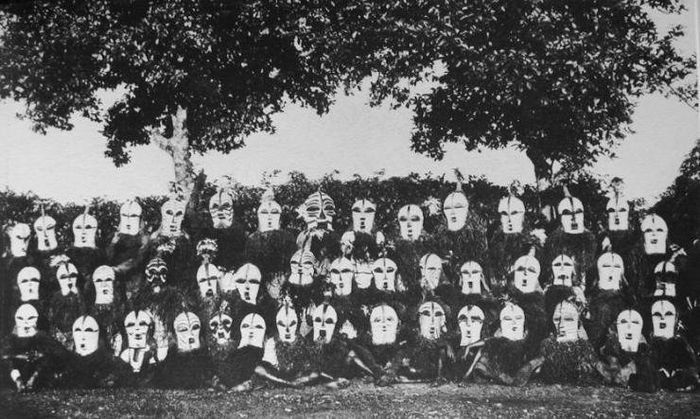

    Kifwebe Songye bifwebe masquerade photographed in the Congo in 1934

    Kifwebe Songye bifwebe masquerade photographed in the Congo in 1934

    Early Encounters

    The first documented Kifwebe masks entered Western collections at the end of the 19th century.

    Explorers, colonial officers, and early ethnographers collected them—often without fully understanding their meaning. The German ethnologist Leo Frobenius, during his expedition of 1905–1906, gathered several examples and recorded fragments of their context.

    What emerges from these early accounts is a sense of distance:

    • the masks were difficult to obtain
    • their meaning was only partially revealed
    • and their use remained, in many ways, deliberately obscured

    Even at that time, they were already considered powerful objects.


    From Ritual to Collection

    Today, these masks exist in a different context.

    Removed from their original function, they have entered collections—private and institutional. Their role has shifted. No longer active within a social system, they are now observed, studied, and lived with.

    And yet, something remains.

    The structure still holds. The tension is still present. The object does not collapse into decoration.

    This is perhaps why Kifwebe masks have had such a lasting impact. Not only within African art, but also in the way Western artists began to rethink the human face—breaking it down into planes, volumes, and essential forms.


    Experienced Eye
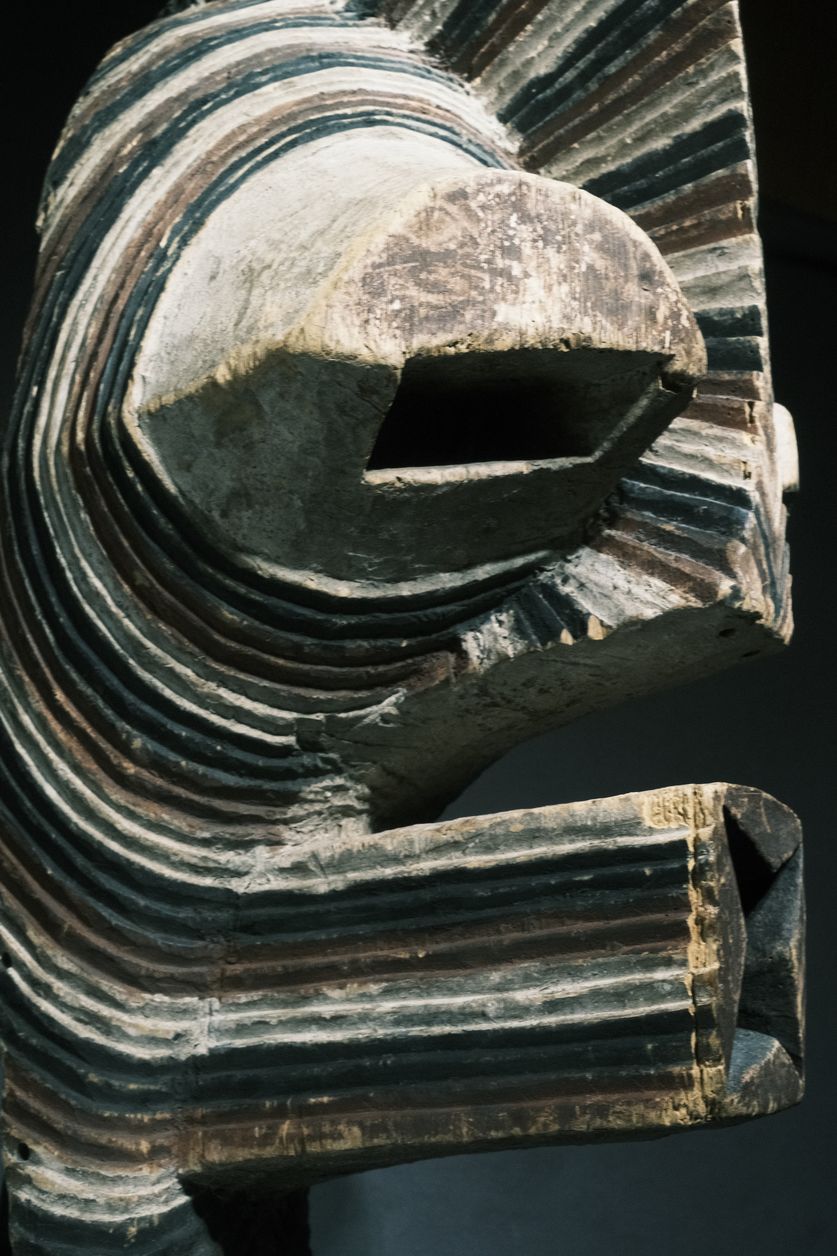
    Kifwebe mask

    When looking at a Kifwebe mask, it is useful to step away from the idea of “mask” as an object, and to see it instead as a construction of forces.

    The lines are not drawn—they are carved to control movement.
    The volumes are not shaped—they are positioned to assert presence.

    This is what gives certain examples their strength.

    And this is also why, once placed within a collection, some of these masks do not simply sit among others—they tend to organise the space around them.


    From Kifwebe to Verstockt — a shared language of structure

    Not long after acquiring this mask, I discovered an additional layer to its history.

    On the reverse, a label identified it as having been part of the collection of Mark Verstockt (1930–2014), the Antwerp-based artist whose work focused on geometry, repetition, and structure.

    What interested me was not only the provenance, but the connection.

    Verstockt’s work often reduces form to its essential elements—lines, rhythm, and controlled variation. Looking again at the mask, one begins to see a similar logic at play. The striations are not decorative; they organize the surface. The face is not modeled, but constructed.

    Two very different worlds, yet a shared way of thinking through form.

    I had, in fact, worked with Verstockt years ago, as a photographer, on the book Het teken Mens, centered on Chinese calligraphy. At the time, the connection to African sculpture was not something I considered.

    Only later, with this mask in front of me, the parallel became clear.


    Closing

    The Kifwebe mask is often approached through its striking appearance.

    But its true interest lies elsewhere.

    Not in what it represents,
    but in how it is built.

    You can view the Songye Kifwebe mask here →

    Songye Kifwebe Mask
    Share and Enjoy !

    Shares
  • Navigating the World of Authentic African Masks: Lessons From 30 Years in the Field

    Navigating the World of Authentic African Masks: Lessons From 30 Years in the Field

    Photo: A fine Suku Mask fom David Norden’s collection.

    Over the past weeks, several collectors have told me how difficult it is to navigate the world of African masks online.
    Too many choices, too many claims of “authenticity,” and far too many pieces that were never used in ritual at all.

    I understand the frustration.
    When I began 30 years ago, I made my share of mistakes too. Today, I’ve handled thousands of traditional masks, and I’ve seen the entire spectrum—from sacred instruments of ceremony to tourist replicas built to deceive.

    That experience is exactly why I wrote my latest article: to help you feel confident, informed, and inspired when you add a mask to your collection.

    What New and Experienced Collectors Should Know

    In simple terms, here are a few key points I cover:

    ✔️ Why authentic masks are meaningful

    Real masks were not created for decoration. They were made to serve the community—whether to honor ancestors, guide initiates, invoke protection, or embody spirits. This gives them a presence that modern copies simply cannot reproduce.

    ✔️ Which types are most heavily reproduced today

    Masks from popular ethnic groups—Baule, Dan, Songye, and Fang—are often copied because of demand. The reproductions might look pleasing at first glance, but they lack the subtle traits of long use: wear from handling, smoke absorption, repairs, ritual additions, and layers of history.

    ✔️ Regions that offer safer pathways for new collectors

    Certain areas of Central and West Africa still retain strong traditions and offer well-documented masks on the market. Understanding regional practices can help you recognize which pieces are more likely to be genuine.

    ✔️ What true age, patina, and use really look like

    Authentic masks show earned surface details—not artificially rubbed, sanded, or chemically aged textures. A true layered patina tells a story of sweat, dust, ritual substances, smoke, and human hands. It doesn’t feel “designed”; it feels lived.

    ✔️ Why provenance matters more than people think

    Provenance is not a luxury—it is protection. Knowing who collected the mask, when, where, and under what circumstances is essential. As a dealer, I expect the same proof I would demand if I were the buyer myself. And remember, provenances can also be faked, so use your sellers wisely.

    If you haven’t seen real masks in museums or international vetted fairs, I think you’ll enjoy my African Art Shop. Descriptions are clear, honest, and based on decades of working with real traditional pieces, not workshop replicas.


    The Personal Side: Why I Continue Searching

    Many people believe African masks are mainly decorative.
    But once you hold an authentic one—one that has danced, protected, instructed, or comforted its community—you feel the difference immediately.

    These are not just objects.
    They carry memory, presence, and dignity.

    This is the reason I continue to search for them, study them, and bring them to collectors who honor their origins. Finding a mask that has served its community is a privilege. Preserving it is a responsibility.


    Explore Authentic Masks

    If you’re thinking about adding a mask to your collection—or if you simply want to see what authentic examples look like—feel free to explore the selection on my webshop.

    👉 Browse authentic African masks and more: BuyAfricanAntiques.com/shop

    Every mask I offer is carefully chosen, described in detail, and accompanied by the provenance I would expect myself as a collector.

    If you ever have questions—need a second opinion, want guidance, or simply want to discuss a piece—reach out.
    I’m always happy to help.

    Warm regards,
    David Norden
    30 years of dealing in authentic African art
    Antwerp — BuyAfricanAntiques.com

    Share and Enjoy !

    Shares