Tag: west african art

  • The Yoruba Horseman: A Legend of the Rider

    The Yoruba Horseman: A Legend of the Rider

    A short tale inspired by the Yoruba tradition of the horse rider — a symbol of leadership, prestige and authority in West African art.

    Photo collage: Yoruba horseman in the Osun Sacred Grove, Arch of the Flying Tortoise.
    Landscape photograph by Adolphus Opara. Horseman sculpture photographed by David Norden.

    A long time ago, when the kingdoms of the Yoruba were young, the people said that a great rider sometimes appeared at the edge of the town.

    No one knew exactly where he came from.

    At dawn he would emerge from the red earth roads, seated proudly on his horse, holding a lance that caught the first light of the rising sun. Children would run to the paths to see him pass, while the elders watched in silence.

    Some said he was a warrior returning from distant lands. Others whispered that he was a messenger of the gods.

    In those days horses were rare in the forest regions of southern Nigeria. They came from the northern savannas and were precious animals, associated with kings, chiefs and powerful warriors. To ride a horse was to show authority and prestige.

    Over time the image of the mounted rider became one of the most powerful symbols in Yoruba art. Sculptors carved figures known as elesin—horsemen who embodied leadership, courage and the ability to command.

    The rider was often larger than the horse, because Yoruba artists did not aim for realism. Importance was expressed through proportion. The horse carried the rider, but the rider carried the meaning.

    Some of these figures were placed in shrines or royal spaces. Others commemorated great leaders or ancestors whose presence was believed to protect the community.

    Scholars have long noted the importance of this imagery in Yoruba culture. A beautiful example in ivory from the Dallas Museum of Art illustrates how deeply rooted the motif of the mounted rider is in the region:


    Dallas Museum of Art – Yoruba Horse and Rider

    Even earlier, archaeological discoveries such as a tenth-century bronze object from Igbo-Ukwu showing a horse and rider remind us that equestrian symbolism has deep historical roots in southern Nigeria. You can see this remarkable object, once exhibited in the Smithsonian exhibition Caravans of Gold, here:


    Igbo-Ukwu Horse and Rider – Caravans of Gold

    And perhaps that is why these sculptures still feel so alive today.

    They do not simply show a man on a horse.

    They show authority, presence, and the memory of a rider who once appeared on the road at dawn.

    Sometimes such Yoruba riders exist only in stories. And sometimes one quietly survives in wood.

    One such rider eventually found his way to my collection.

    Yoruba Horseman (Elesin), Ekiti Master Tradition

    Share and Enjoy !

    Shares
  • A Large Encrusted Lobi Figure: Why Some African Ritual Objects Are Not Easy to Sell

    A Large Encrusted Lobi Figure: Why Some African Ritual Objects Are Not Easy to Sell

    Not everything is easy to sell.
    I hesitated.

    I’ve kept this Lobi figure for many years.

    At first, very simply, because it is big.
    Eighty-one centimeters high, heavy, not easy to handle. For my in-house expeditions, it was never a convenient object. It always required more space, more care, more effort.

    But that was not the real reason.

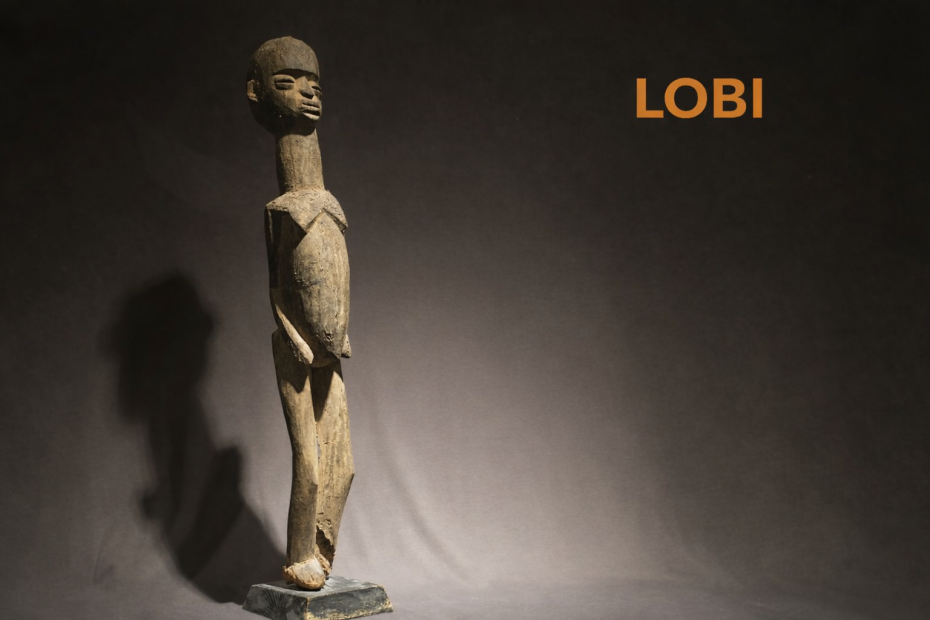
    Large encrusted Lobi shrine figure, Burkina Faso, front view

    There is an elegance in its rudeness that gave me pleasure from the beginning.
    The expression is not pleasing. The arms and legs are very thin, almost fragile, while the belly is bulging and heavy. The proportions are not meant to comfort the eye. They create tension.

    It is not an object that tries to seduce.

    Lobi African Art

    Lobi figures like this one were kept in shrine houses, usually placed slightly aside from the village. Their role was protection. These shrine houses are not clean or ordered places. They are often messy. You can feel the traces of offerings — chicken blood, residue, layers of use accumulated over time.

    This figure carries that history quietly.

    Lobi belly African Art

    I also kept it because of its authenticity.
    Because nothing here has been softened or corrected.
    Because it has not been made easier to live with.

    And yes — because living with it gave me pleasure. Not decorative pleasure, but the pleasure of presence. Of an object that resists you a little, and asks for time.

    Lobi head-African Art

    After many years, I decided it was time to let it go.

    If this Lobi figure speaks to you, you can find a link to the sales page below.
    If you prefer a more detailed approach, you can also contact me directly and I will send you a PDF with a complete description, additional images, and provenance information.

    Not everything is easy to sell.
    Some objects ask you to hesitate first.

    David Norden

    A Large Encrusted Lobi Figure

    Large Encrusted Lobi Shrine Figure

    Share and Enjoy !

    Shares
  • Navigating the World of Authentic African Masks: Lessons From 30 Years in the Field

    Navigating the World of Authentic African Masks: Lessons From 30 Years in the Field

    Photo: A fine Suku Mask fom David Norden’s collection.

    Over the past weeks, several collectors have told me how difficult it is to navigate the world of African masks online.
    Too many choices, too many claims of “authenticity,” and far too many pieces that were never used in ritual at all.

    I understand the frustration.
    When I began 30 years ago, I made my share of mistakes too. Today, I’ve handled thousands of traditional masks, and I’ve seen the entire spectrum—from sacred instruments of ceremony to tourist replicas built to deceive.

    That experience is exactly why I wrote my latest article: to help you feel confident, informed, and inspired when you add a mask to your collection.

    What New and Experienced Collectors Should Know

    In simple terms, here are a few key points I cover:

    ✔️ Why authentic masks are meaningful

    Real masks were not created for decoration. They were made to serve the community—whether to honor ancestors, guide initiates, invoke protection, or embody spirits. This gives them a presence that modern copies simply cannot reproduce.

    ✔️ Which types are most heavily reproduced today

    Masks from popular ethnic groups—Baule, Dan, Songye, and Fang—are often copied because of demand. The reproductions might look pleasing at first glance, but they lack the subtle traits of long use: wear from handling, smoke absorption, repairs, ritual additions, and layers of history.

    ✔️ Regions that offer safer pathways for new collectors

    Certain areas of Central and West Africa still retain strong traditions and offer well-documented masks on the market. Understanding regional practices can help you recognize which pieces are more likely to be genuine.

    ✔️ What true age, patina, and use really look like

    Authentic masks show earned surface details—not artificially rubbed, sanded, or chemically aged textures. A true layered patina tells a story of sweat, dust, ritual substances, smoke, and human hands. It doesn’t feel “designed”; it feels lived.

    ✔️ Why provenance matters more than people think

    Provenance is not a luxury—it is protection. Knowing who collected the mask, when, where, and under what circumstances is essential. As a dealer, I expect the same proof I would demand if I were the buyer myself. And remember, provenances can also be faked, so use your sellers wisely.

    If you haven’t seen real masks in museums or international vetted fairs, I think you’ll enjoy my African Art Shop. Descriptions are clear, honest, and based on decades of working with real traditional pieces, not workshop replicas.


    The Personal Side: Why I Continue Searching

    Many people believe African masks are mainly decorative.
    But once you hold an authentic one—one that has danced, protected, instructed, or comforted its community—you feel the difference immediately.

    These are not just objects.
    They carry memory, presence, and dignity.

    This is the reason I continue to search for them, study them, and bring them to collectors who honor their origins. Finding a mask that has served its community is a privilege. Preserving it is a responsibility.


    Explore Authentic Masks

    If you’re thinking about adding a mask to your collection—or if you simply want to see what authentic examples look like—feel free to explore the selection on my webshop.

    👉 Browse authentic African masks and more: BuyAfricanAntiques.com/shop

    Every mask I offer is carefully chosen, described in detail, and accompanied by the provenance I would expect myself as a collector.

    If you ever have questions—need a second opinion, want guidance, or simply want to discuss a piece—reach out.
    I’m always happy to help.

    Warm regards,
    David Norden
    30 years of dealing in authentic African art
    Antwerp — BuyAfricanAntiques.com

    Share and Enjoy !

    Shares