Tag: tribal sculpture

  • The Mask That Smiled Back

    The Mask That Smiled Back

    There is an old story I once heard from a collector who spent years traveling through mountain villages between Nepal and Tibet.

    He told me that certain masks should never be looked at too quickly.

    “At first,” he said, “they are only wood.”

    But then, after some time, the face begins to change.

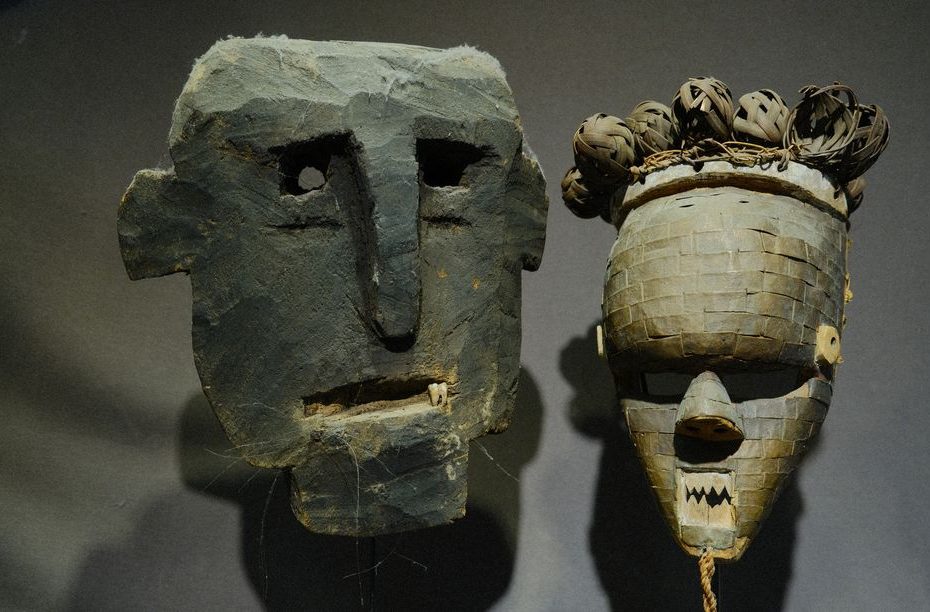
    One evening, while arranging objects in my gallery, I placed two masks beside each other almost accidentally. A Nepalese shamanic mask and a Salampasu mask from Congo.

    Different continents. Different beliefs. Different peoples.

    And yet, the room suddenly became strangely quiet.

    The Nepalese mask was the first to emerge from the darkness. Its face was dry and ancient, with deep shadows around the eyes and mouth. At first glance, it seemed almost humorous — a crooked grin, exaggerated teeth, a theatrical expression.

    Then I noticed the tooth.

    Not carved.

    Human.

    The collector’s story returned immediately.

    In Himalayan ritual traditions, masks were never merely decorations. They were instruments used by shamans during ceremonies of healing, protection, and exorcism. Some antique examples even incorporated real human or animal teeth into the carving itself, strengthening the presence of the spirit inhabiting the mask.

    The mouth was not symbolic.

    It was active.

    FXE41546African Masks

    Nearby, the Salampasu mask watched silently.

    Its mouth was entirely different — rectangular, aggressive, armed with rows of sharpened teeth beneath a massive domed forehead covered in metal strips. The woven beard ended in a tightly braided sphere like a final punctuation mark.

    The Salampasu people of Congo were known as hunters and warriors. Their masks belonged to initiation societies reserved for men, appearing during ceremonies marking passage into adulthood. Among the Salampasu, the sharpening of human teeth formed part of identity itself. The body became an extension of ritual force, much like the masks they carved.

    And suddenly the two objects no longer seemed far apart.

    One carried an actual human tooth.
    The other transformed human teeth into sculpture.

    Salampasu teeth

    Both understood something ancient:

    The mouth is power.

    The mouth speaks. Threatens. Invokes. Breathes life into chants and names. It is where invisible force leaves the body and enters the world.

    Perhaps this is why ritual masks remain so compelling even after leaving their original cultures. Long after the ceremonies disappear, something still survives inside the sculpture itself.

    Not literally perhaps.

    But enough to make us look twice.

    Later that evening, before turning off the lights, I glanced once more toward the wall.

    For a brief moment, the Nepalese mask almost appeared to smile.

    Happy and curious,

    David Norden

    Salampasu Mukinka Mask — D.R. Congo

    Raw Shamanic Himalayan Mask with Human Tooth


    Share and Enjoy !

    Shares
  • Two African Pieces on the Table

    Two African Pieces on the Table

    This morning, before opening the shop, I placed these two next to each other.

    Not because they belong to the same tradition. They clearly do not.

    But sometimes objects begin to speak differently when they share the same space for a while.

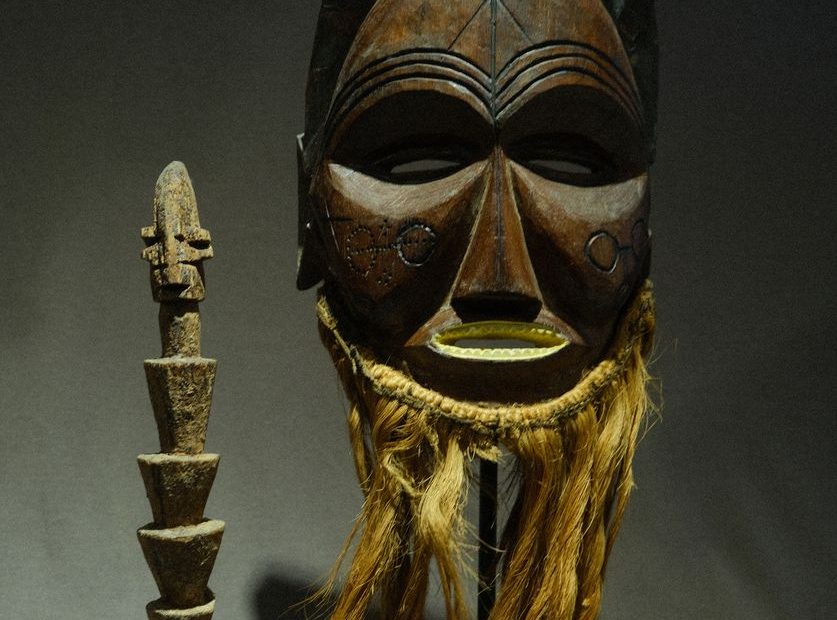
    One is a mask from Zambia, in the Mbunda style.
    The other, a small Lobi figure from Burkina Faso and Ivory Coast.

    The mask immediately takes control of the table.

    FXE49780African Art

    Its construction is unusually deliberate. The repeated lines above the eyes almost feel architectural, as if the face was assembled rather than carved. It reminded me of older Mbunda masks I had seen years ago — those powerful faces balancing authority and restraint.

    But what interested me most here was not the attribution.

    It was the tension.

    The mask feels calm, but not passive. The symmetry is controlled, though never rigid. Even the surface has settled in a convincing way, without the heavy-handed restoration or artificial aging one so often encounters today.

    You can view the mask here:
    Mask in the Mbunda Style — Zambia

    The small Lobi figure reacted differently.

    FXE49773African Art

    At first glance, it almost disappears next to the mask.

    But after some time, it became the piece I kept looking back at.

    The composition is extremely reduced — almost like a narrow ladder with a head placed on top. Very little is described. And yet the figure holds together remarkably well.

    There are traces of sacrificial material still attached to the surface, forming a dense encrusted patina that gives the object its physical weight and history.

    It is not a spectacular piece.

    Which may be exactly why it works.

    You can view the Lobi figure here:
    Lobi Figure — Burkina Faso / Ivory Coast

    After thirty years of handling African objects, I increasingly notice that the pieces which stay with me are not always the loudest ones.

    Often they are simply objects that continue to hold the eye after the first impression has passed.

    These two did.

    Dogon figure — Mali

    Mask in the Mbunda Style — Zambia


    Share and Enjoy !

    Shares