And there are those who live with objects for a long time before letting them go.
Not long ago, an anthropologist came to see a Dogon figure.
He didn’t come alone.
He came with his wife, and they spent time with the piece — quietly, without deciding.
Nothing happened that day.
Which, in hindsight, was already meaningful.
Two weeks later, he returned.
This time, not to negotiate.
But with a different kind of proposal.
He was ready to let go of pieces he had lived with for years, in order to take one with him.
An anthropologist looks differently.
Not in terms of categories or completeness.
But in terms of use.
How an object has been handled. Returned to. Integrated into a life.
And over time, that changes what is kept.
The group that came from this exchange was not assembled.
It had already taken shape, slowly, over years.
African, but not only African.
Objects that lived alongside Oceanic works, Pre-Columbian pieces, and traces of archaeology.
Not separated, but understood in relation.
That kind of collecting leaves marks.
Not always visible at first.
But present in the surface. In the choices. In what was not discarded.
Some pieces reveal themselves immediately.
Others take longer.
Those are often the ones that remain.
Looking back, the exchange was simple.
Not a transaction.
But a moment where two ways of seeing aligned — just long enough for objects to change hands.
Below are some of the pieces that came from that moment. (click on the images to enlarge)
Mossi Mossi figure — ex New York collection, Bonhams New York Mossi — a bit older than usual with a balance that doesn’t need explanation. Height 47 cm
Boki Boki figure — ex Ursula Heijs Voorhuis collection Boki — strong hands the rest follows slowly. Height 38 cm
Dan mask Dan mask — French collection, later Netherlands Dan — almost dreaming not fully awake. Height 22 cm (32 cm on stand)
Dan divination figure Dan divination figure — French collection Dan — a form that calls the spirits the forest still responds. Height 35 cm
Igbo (Ikenga) Igbo figure (Ikenga) — collection Nancy & John Hyde DeVoe, New York (1950s–70s) Igbo — Ikenga a figure of strength, held over time — and across the ocean. Height 57 cm
Ibibio Ibibio panel — Danish collection Ibibio — quiet construction with a presence that builds slowly. Height 27 cm
Pende Pende mask — ex Hans Schoute, The Hague Pende — light in appearance but not without structure. Height 23 cm
If one of these speaks to you, feel free to get in touch.
I’ll be happy to share more images, provenance, or details.
At the old border between Benin and Togo, the landscape changes little, but belief changes everything. The line we know today—704 kilometers of straight segments, river bends and coastal lagoons—was not drawn by the Fon priests who worked with spirits. It was the product of 19th-century European treaties between France and Germany, and a precise delimitation in 1912. The boundary endured, even after the Great War stripped Germany of Togoland. In 1960, when Benin and Togo became independent, they inherited the line that had already cut through an older, shared spiritual territory.
It is in this region—the Dahomean heartland of Vodun—that the figure I present today was born.
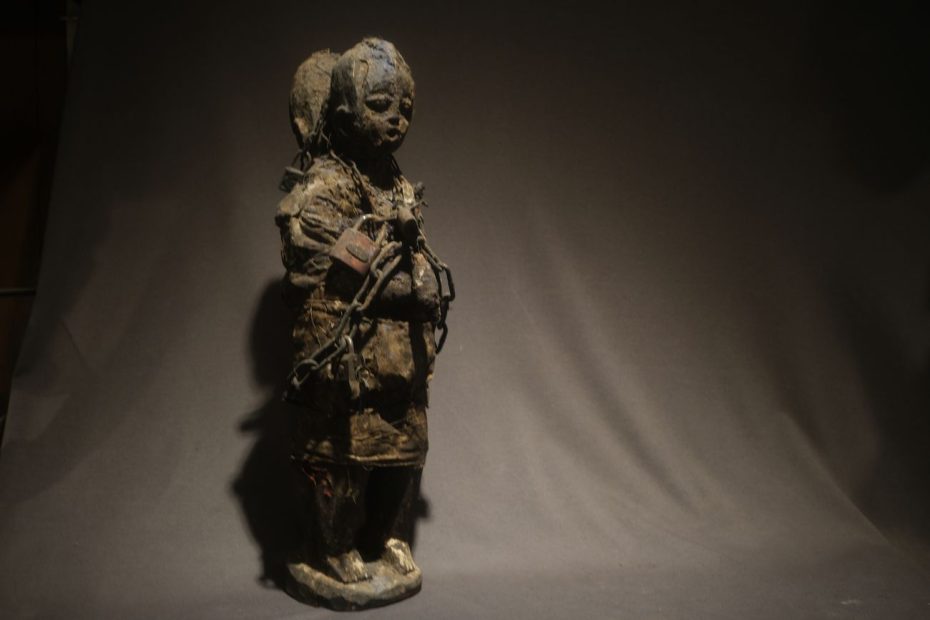
Unlike the small, easily portable boccio often commissioned for domestic protection, this example belongs to a stronger tradition: a commanding Bo—a ritual mechanism of power. Standing 53 cm high, wrapped in layers of cloth, fiber, and sacrificial matter, this double-headed figure bears the unmistakable signs of long activation. The Fon do not “decorate” their sculptures. They feed them. They bind them. They coax or force invisible entities to work on behalf of the living.
One head appears male, the other female. This polarity is purposeful. In Fon cosmology, a single perspective protects only part of the self. A second head grants more than vision—it grants balance, complementarity, and symmetry of spiritual forces. What one side cannot see or endure, the other can guard or absorb.
The surface of the figure is a vocabulary of ritual history:
Slots and cavities cut into the torso and heads—made for the insertion of medicines, fetish charges, and pharmaco-magical matter.
Feathers and residue of offerings—mute records of sacrifices that nourished the spirit within.
Blue discoloration, rare and telling—blue is a cooling, pacifying color in Vodun. It tempers anger, diminishes sorcery, and calms destructive spirits.
Iron chain, aged and oxidized—iron is the realm of Ogun, a binding metal that traps intrusion, neutralizes malediction, and seals contracts with spirits.
Objects like this are never simply “carved.” They are negotiated into existence by a Vodun priest—often a Fa diviner—who mediates between human need and the spirits’ price. They begin as wood, and only become sacred when charged with what the Fon call bo—the active ingredient of agency. Once animated, they are not touched casually. They are installed, fed, and consulted like an elder or an ally.
Unlike the more portable single-bodied boccio, this work is constructed as two separate human bodies tied together, positioned back to back, each with its own pair of legs. The duality is intentional and operational: the two bodies embody complementary forces and vigilance in opposing directions. They are not a single two-headed persona, but two cooperating entities, bound to address threats arising from multiple fronts.
This figure comes from a South French private collection, far from the shrines or communal spaces where it once stood. Its textile wrappings have hardened into a second skin, and the patina of offerings remains untouched. Nothing about it was made for tourists, salons, or the polite art market. It existed to act.
Collectors who gravitate toward the elegant refinement of Baule figure or the sculptural serenity of Luba figures often pause before a Bo like this one. It asks something different of us. It does not beautify life—it defends it. It does not commemorate the dead—it confronts the living challenges of jealousy, illness, conflict, or injustice.
In the Dahomean world, art and spirit are inseparable. A Boccio or Bo is not a statue with a story; it is the story—an object that has already worked, already taken risks, already absorbed blows meant for its owner.
If you would like to explore this figure further, Please discover more details and images in the webshop: