Tag: Congo art

  • The Mask That Smiled Back

    The Mask That Smiled Back

    There is an old story I once heard from a collector who spent years traveling through mountain villages between Nepal and Tibet.

    He told me that certain masks should never be looked at too quickly.

    “At first,” he said, “they are only wood.”

    But then, after some time, the face begins to change.

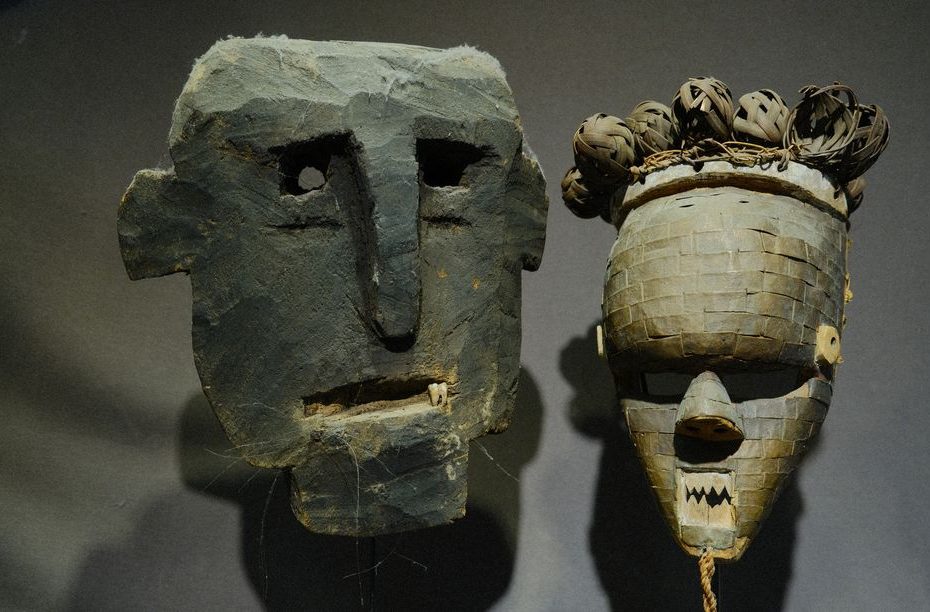
    One evening, while arranging objects in my gallery, I placed two masks beside each other almost accidentally. A Nepalese shamanic mask and a Salampasu mask from Congo.

    Different continents. Different beliefs. Different peoples.

    And yet, the room suddenly became strangely quiet.

    The Nepalese mask was the first to emerge from the darkness. Its face was dry and ancient, with deep shadows around the eyes and mouth. At first glance, it seemed almost humorous — a crooked grin, exaggerated teeth, a theatrical expression.

    Then I noticed the tooth.

    Not carved.

    Human.

    The collector’s story returned immediately.

    In Himalayan ritual traditions, masks were never merely decorations. They were instruments used by shamans during ceremonies of healing, protection, and exorcism. Some antique examples even incorporated real human or animal teeth into the carving itself, strengthening the presence of the spirit inhabiting the mask.

    The mouth was not symbolic.

    It was active.

    FXE41546African Masks

    Nearby, the Salampasu mask watched silently.

    Its mouth was entirely different — rectangular, aggressive, armed with rows of sharpened teeth beneath a massive domed forehead covered in metal strips. The woven beard ended in a tightly braided sphere like a final punctuation mark.

    The Salampasu people of Congo were known as hunters and warriors. Their masks belonged to initiation societies reserved for men, appearing during ceremonies marking passage into adulthood. Among the Salampasu, the sharpening of human teeth formed part of identity itself. The body became an extension of ritual force, much like the masks they carved.

    And suddenly the two objects no longer seemed far apart.

    One carried an actual human tooth.
    The other transformed human teeth into sculpture.

    Salampasu teeth

    Both understood something ancient:

    The mouth is power.

    The mouth speaks. Threatens. Invokes. Breathes life into chants and names. It is where invisible force leaves the body and enters the world.

    Perhaps this is why ritual masks remain so compelling even after leaving their original cultures. Long after the ceremonies disappear, something still survives inside the sculpture itself.

    Not literally perhaps.

    But enough to make us look twice.

    Later that evening, before turning off the lights, I glanced once more toward the wall.

    For a brief moment, the Nepalese mask almost appeared to smile.

    Happy and curious,

    David Norden

    Salampasu Mukinka Mask — D.R. Congo

    Raw Shamanic Himalayan Mask with Human Tooth


    Share and Enjoy !

    Shares
  • African Art Authenticity, Colonial Postcards, and the Problem of “Made for the Market” Objects

    African Art Authenticity, Colonial Postcards, and the Problem of “Made for the Market” Objects

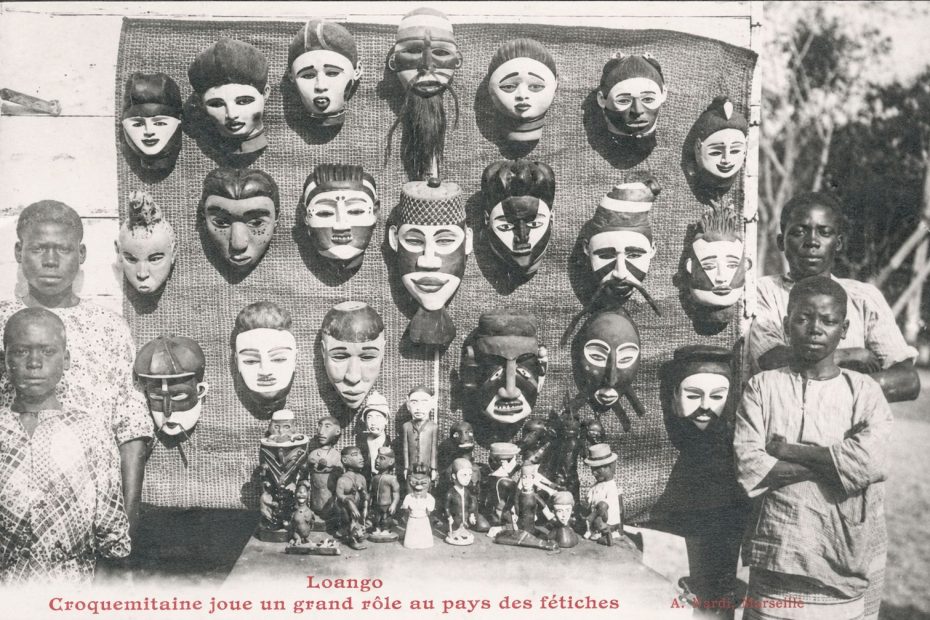
    Recently I revisited a fascinating postcard from the Loango coast, dating from around 1910. At first sight, it appears to confirm exactly what many collectors hope to see: African masks and figures photographed “in the field,” offered in an open-air market during the colonial period.

    For many collectors, such early documentation immediately creates reassurance. The older the publication or photograph, the more authentic the objects are assumed to be.

    But when one looks carefully at the postcard, the situation becomes far more interesting — and far more complex.

    Some masks seem clearly inspired by Kongo traditions, yet several also appear simplified, repetitive, or intentionally carved for trade. In other words, this postcard may already document an early tourist and export market. This should not surprise us. Along the Loango coast, artists had already been producing works for European traders, sailors, and colonials since the 19th century, alongside objects made for local use.

    And yet here lies the paradox: some of the masks shown in this postcard resemble works that later entered museum collections — and it is entirely possible that some of these very masks eventually did so themselves.

    That uncomfortable reality challenges many simplistic ideas about authenticity.

    Today, objects are often divided into rigid categories:

    • authentic or commercial
    • ritual or tourist
    • traditional or made for the market

    But history was rarely so clean.

    The postcard shows an African world already deeply connected to trade, foreign demand, colonial presence, and artistic adaptation. African artists were not passive creators frozen in an untouched past. They responded intelligently to changing realities around them.

    Colon Figures and a Forgotten Category

    One detail particularly caught my attention: at the level of the bellies of the two men standing on either side of the image, several small colon figures representing Europeans can be seen, probably displayed on a table placed in front of the masks.

    These figures are fascinating witnesses to a changing society where African artists were already observing and interpreting colonial presence.

    One example from my own collection can be seen here:

    Colon figure african art

    Bakongo Colon Figure – Congo

    What is interesting is that colon figures still occupy a somewhat uncertain position in the market today. Compared to more classical ritual sculpture from the same period, they often remain surprisingly affordable. Many collectors still hesitate on how to classify them:

    • ethnographic curiosity
    • colonial souvenir
    • transitional object
    • or serious sculptural work

    And perhaps this uncertainty explains why they remain intellectually undervalued within African art history.

    Yet these figures are historically important. They show African artists observing Europeans, reacting to colonial society, and adapting their visual language to a rapidly changing world. They are not outside African art history — they are part of it.

    The Colonial Gaze

    The inscription on the postcard is equally revealing:

    “Croquemitaines joue un grand rôle au pays des fétiches.”

    The term croque-mitaine refers to the bogeyman used to frighten children. The masks are therefore presented not as sophisticated cultural creations, but as exotic and frightening curiosities for a European audience.

    The postcard tells us not only about African art, but also about the colonial imagination looking at it.

    A collector friend formulated it very well during an online discussion:

    “This postcard is less an ethnographic record than a visual statement of early 20th-century colonial perception.”

    That observation is important. The word fétiche itself says more about European misunderstanding than about the cultures that produced these objects.

    What were once living objects — used in ritual, performance, initiation, healing, and social structure — became transformed into exotic curiosities for outsiders.

    And yet, despite this colonial framing, the objects still speak.

    Even through the limitations of the postcard, one can still sense:

    • the diversity of styles
    • the individuality of forms
    • the sculptural intelligence behind certain pieces
    • and the artistic strength that later attracted museums and collectors.

    “Made for the Market”

    When I posted this image online, reactions were surprisingly divided.

    Some collectors immediately dismissed the objects as “made for the market.” Others argued that these works should finally be recognized as a legitimate category of African art history in their own right.

    One comment struck me particularly:

    “These pieces can very well be antiques and art.”

    Exactly.

    The existence of a market context does not automatically destroy artistic value. Artists have always adapted to patrons, markets, and changing societies. This was true in Europe, in Asia, and equally in Africa.

    At the same time, it is also true that many objects visible in the postcard appear freshly carved and intended for trade. Both realities can exist simultaneously.

    That is precisely why the postcard is so interesting.

    It forces us to move beyond simplistic categories and confront the historical complexity of African art itself.

    Museums, Provenance, and the Eye

    Interestingly, several masks illustrated in museum publications and research on Loango and Kongo material show striking formal similarities to examples visible in the postcard, further complicating simplistic distinctions between “museum art” and “market production.”

    For readers interested in exploring this further, the following research publication from the AfricaMuseum (in French) is worth consulting:

    AfricaMuseum research publication by Julien Volper (French PDF)

    At the same time, age alone can never be enough to guarantee authenticity or quality.

    An old postcard, an old label, or an early publication may strengthen an object and change its perception and value — but they can never replace the eye.

    Museums and postcards do not only preserve history or certainty.
    Sometimes they preserve historical complexity.

    You cannot change the past — but you can change the way you look at it.

    Happy and curious,

    David Norden

    African Antiques From Antwerp — One Eye, 30 Years of Selection
    For collectors building a serious collection: buy fewer, but better.

    Share and Enjoy !

    Shares