Tag: African sculptures

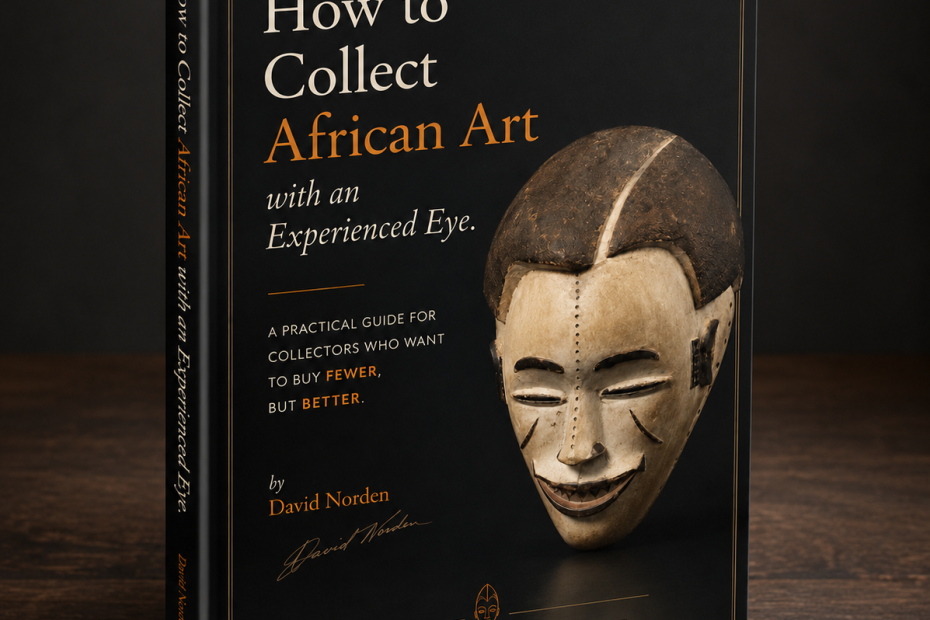
  • How to Collect African Art with an Experienced Eye – David Norden
    How to Collect African Art with an Experienced Eye – David Norden

    Welcome To the African Art World.

    How to collect African Art with an experienced Eye

    Most people begin collecting African art by asking the wrong questions.

    They ask about the tribe, the age, the provenance, or the price. Those things certainly matter, but they are not where true connoisseurship begins.

    The first question should always be: Is this a good piece of sculpture?

    After more than thirty years of handling thousands of African objects, visiting museums across Europe, studying important collections, and making both good and bad buying decisions, I have learned that exceptional works reveal themselves in ways that photographs, labels, and certificates alone never can. Quality lives in proportion, balance, surface, craftsmanship, expression, and the subtle presence that only the finest objects possess.

    An experienced eye is not a gift. It is something that can be developed through careful observation, comparison, and patience.

    That is the purpose of this experienced eye book.

    Rather than presenting a catalogue of ethnic groups or historical facts, this guide focuses on how to see. You will learn practical methods for judging craftsmanship, recognizing authentic age and patina, understanding what separates an ordinary object from an exceptional one, and avoiding many of the mistakes that beginning collectors often make.

    One of the most valuable ways to train your eye is by studying the very best examples. Throughout this guide we therefore examine masterpieces from major museum collections, including remarkable Fang, Baule, Djennenké, Kota, Bangwa, Kongo, Songye, and Yoruba sculptures. These objects are not included simply because they are famous, but because they demonstrate the qualities that collectors should learn to recognize wherever they encounter African art.

    Whether you are considering your very first mask or building a serious collection, the principles remain the same. The goal is not to buy more objects, but to buy better ones—pieces that continue to reward careful study for years to come.

    This is an Early Edition of How to Collect African Art with an Experienced Eye. At present it contains 45 illustrated pages, but it is intended to grow into a much more comprehensive guide. New chapters, museum case studies, photographs, and collecting insights will be added regularly as the project develops. As the content expands, the retail price will gradually increase, while everyone who already owns a copy will receive all future updates free of charge.

    My hope is that this book becomes more than an illustrated collector’s guide. I hope it helps you cultivate the most valuable tool any collector can possess: an experienced eye.

    David Norden

    African Art Dealer, Antwerp

    Since 1992

    How to collect African Art with an experienced Eye

    Share and Enjoy !

    Shares
  • African Art Gallery — Step Inside the David Norden Cavern

    African Art Gallery — Step Inside the David Norden Cavern

    African Art Gallery — Step Inside the David Norden Cavern

    When people search for an African art gallery, they are often looking for beauty.
    But seasoned collectors are looking for something else entirely: truth, age, rarity, and presence.

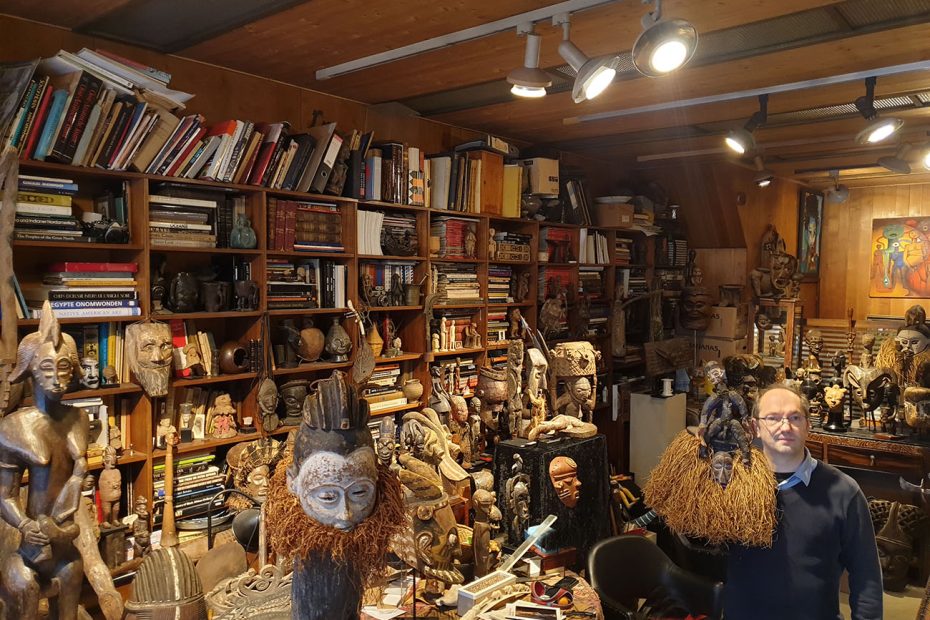
    The other day, something happened in my Antwerp gallery that made me smile.

    The director of the African Art department at the Musée du quai Branly in Paris walked in.
    He looked around, paused, and said:

    “This is amazing, it looks like the Alibaba cavern.”

    I told him:
    “No, this is the David Norden cavern.”

    And in a way, that says everything.

    The Difference Between Display and Selection

    Many galleries present African art.
    Few truly select it.

    An experienced eye does not start with aesthetics.
    It starts with questions:

    • Has this object lived a life before arriving here?
    • Does the surface show real use, or artificial aging?
    • Is the form consistent with known hands and traditions?
    • Does it hold presence when you stand in front of it?

    These are not things you can fake convincingly.
    And they are not things you can always explain quickly either.

    A Cavern, Not a Showroom

    A true African art gallery is not always minimal, white, and silent.

    Sometimes, it is layered.
    Dense.
    Full of discoveries.

    You don’t take it in at once—you enter it.
    It took me 33 years to build it.

    That is how I have always built my space:
    not as a showroom, but as a place where objects live together until the right collector finds them.

    Yes, it may feel like a cavern.
    But every piece in it has been chosen, one by one, over 33 years.

    Not only private collectors buy from me—museums do as well.

    For example, I sold a fine Mende statue, together with a related textile and a painting representing one of the first American female anthropologists working in the region in the 1950s, to the African Art gallery’s from Yale   https://artgallery.yale.edu/research-and-learning/curatorial-areas/african-art

    Discover David Norden’s African Art Gallery Collection

    If you want to explore a small selection, you can start here:
    👉 https://www.buyAfricanAntiques.com/shop

    What you see there is a carefully selected group of pieces.

    But the full collection is something else entirely.

    Many objects never make it online.
    They are part of a deeper selection—available to those who take the time to ask, to look, and to engage.

    If something speaks to you, the best way is simple:

    • Send me a message to ask for more information or arrange a wire transfer
    • Use the online shop to purchase directly
    • Or arrange an appointment to see it in Antwerp

    The gallery is often open without one—
    but the real experience is always better when there is time and attention.

    Buying African Art Is Buying an Eye

    Collectors sometimes think they are buying an object.
    But over time, they realize they are buying something else:

    They are buying someone else’s judgment, refined over decades.

    That is what turns an African art gallery into something worth returning to.

    Not just what is there—
    but how it got there.

    A Quiet Suggestion for Collectors

    If you are building a collection, don’t rush.

    Visit African art galleries.
    Visit museums.
    Buy books.

    Look, compare, and then return again.

    Over time, try to understand what you are really seeing:
    Is the object alive, or does it feel empty?
    Does it create a strong emotional response, or is it just a pale copy—made quickly, without depth?

    Ask yourself:
    Did the artist take the time to bring this piece to life?
    Or was it simply produced?

    Because in African art, the difference is not subtle.
    A true piece carries presence.
    A lesser one only imitates it.


    African Antiques From Antwerp — One Eye, 30 Years of Selection
    Not an inventory. A perspective. Collected slowly, chosen carefully, offered with certainty.

    Happy and curious,
    David Norden

    Share and Enjoy !

    Shares
  • How to Train Your Eye in African Art: 3 Practical Tips for Collectors

    How to Train Your Eye in African Art: 3 Practical Tips for Collectors

    Chibinda Ilunga figure, Chokwe, Angola — Museum RietbergThis article is based on a recent newsletter I sent to collectors. 


    Over the years, I’ve noticed that most collectors are not lacking interest — they are lacking orientation.

    Where do you look?
    What do you trust?
    And how do you train your eye?

    In this guide, I share three practical directions that I personally use — and that can quietly transform the way you see African art.


    1. Train Your Eye: Use Museum Collections

    Figure of the culture hero Chibinda Ilunga, Workshop of the Chokwe region, Angola, around 1850 Wood, Museum Rietberg, 2007.1, Gift acquired through Novartis 5 2007.1

    If there is one habit I would recommend to any collector, it is this: spend time with museum collections.

    Not only in person — but also online.

    Today, many major institutions offer access to thousands of documented objects. You can study proportions, surfaces, patina, and even small details that rarely appear in books.

    In the guide below, you’ll find direct and active links to museum databases, along with a selection of objects that I personally find particularly interesting.

    Over time, something shifts — you begin to recognise what feels right… and what doesn’t.

    → Explore museum collections

    Collector insight:
    The more time you spend with strong, documented objects, the more confident your decisions become when a good piece appears.


    2. Understand What You Are Really Looking At

    One of the most common mistakes I see is confusion between authentic objects and decorative pieces.

    The difference is not always obvious — especially at the beginning.

    But authentic objects tend to have a certain internal coherence:
    the proportions make sense, the wear follows use, the surface has depth, and the object carries a presence that is difficult to imitate.

    In the article below, I explain how I approach this distinction in practice:

    → Read the article on authenticity

    Collector insight:
    Once you have seen enough authentic pieces, decorative ones start to feel strangely empty — even when they look convincing at first glance.


    Ibibio chanel mask

    Ibibio “Chanel” mask — Nigeria

    A Piece That Caught My Eye

    While writing this, I was reminded of a mask I have kept in the collection for some time — an Ibibio “Chanel” mask.

    At first glance, it may seem unusual or even playful. But if you take a closer look, you begin to see the coherence in the carving, the balance in the proportions, and the way the surface has evolved through handling and use.

    It is also a good example of how African artists could absorb and reinterpret external influences, while remaining rooted in their own visual language.

    This is exactly the kind of object where experience matters — not because it is obvious, but because it reveals itself over time.

    → View the Ibibio mask


    3. Be Careful with Labels

    African art is often simplified — sometimes too much.

    Certain names are used so loosely that they can become misleading.

    Take the Kuba, for example.

    Behind this single label lies a complex network of workshops, styles, and neighbouring cultures. Not everything labelled “Kuba” is what you might expect — and understanding that can completely change how you evaluate an object.

    In the article, I also touch on the figure traditionally associated with the founding of the Kuba Kingdom, and why that history still matters when looking at objects today.

    If you want to look beyond the label and discover the story behind it:

    → Read the Kuba article

    Collector insight:
    Collectors who rely too much on names often miss good objects — or overpay for average ones.


    A Final Thought

    Collecting is not about owning many objects.

    It is about learning to recognise the right ones — and having the confidence to act when you see them.

    Even after 30 years, I still return to museum collections, compare objects, and refine my eye.

    If you would like to explore pieces selected through that same process:


    Happy and curious,
    David Norden

    African Antiques From Antwerp — One Eye, 30 Years of Selection
    Personally chosen with curiosity and experience — so you can collect with confidence.

    Share and Enjoy !

    Shares