Tag: african art history

  • African Art Authenticity, Colonial Postcards, and the Problem of “Made for the Market” Objects

    African Art Authenticity, Colonial Postcards, and the Problem of “Made for the Market” Objects

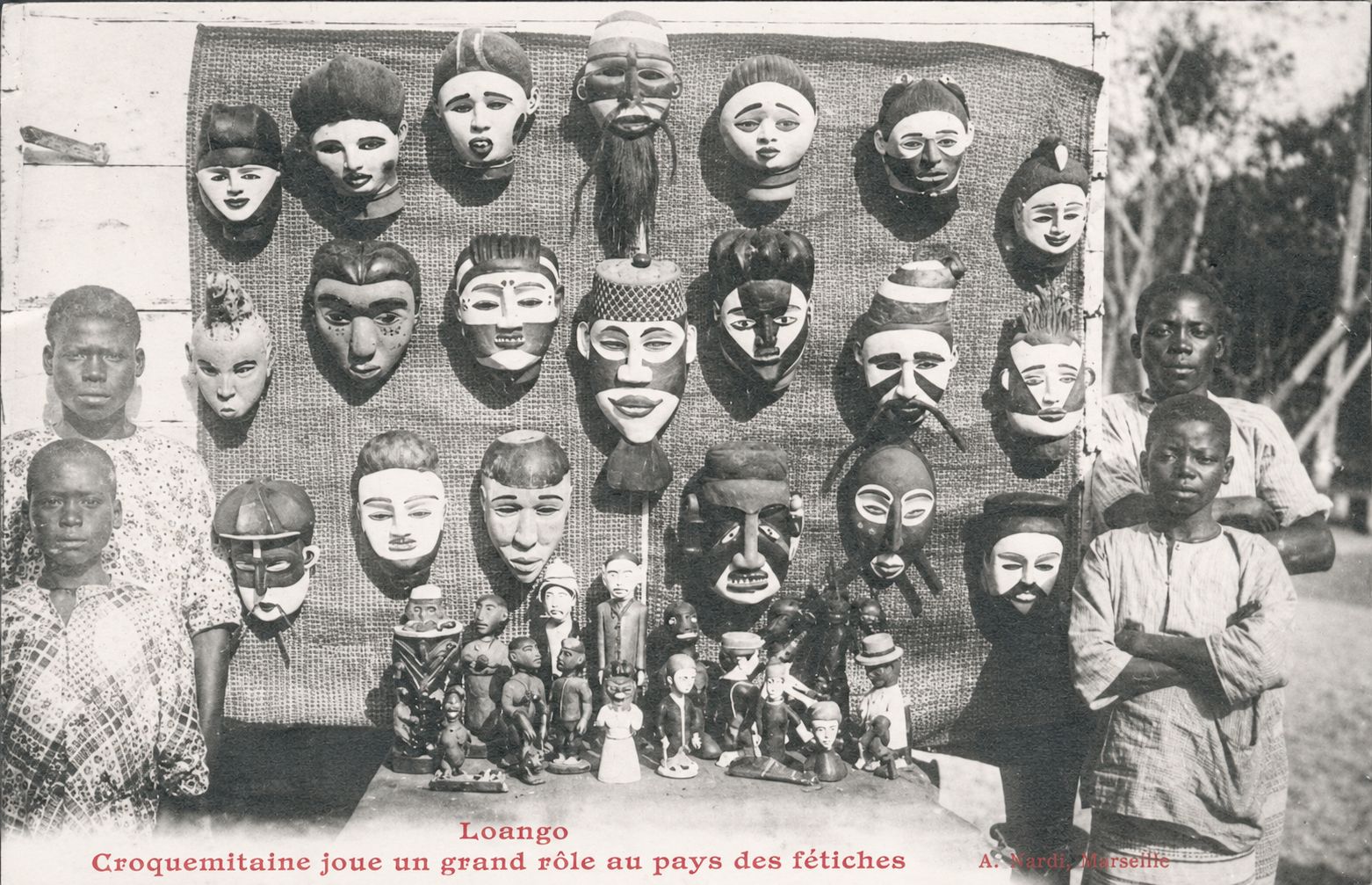
    Recently I revisited a fascinating postcard from the Loango coast, dating from around 1910. At first sight, it appears to confirm exactly what many collectors hope to see: African masks and figures photographed “in the field,” offered in an open-air market during the colonial period.

    For many collectors, such early documentation immediately creates reassurance. The older the publication or photograph, the more authentic the objects are assumed to be.

    But when one looks carefully at the postcard, the situation becomes far more interesting — and far more complex.

    Some masks seem clearly inspired by Kongo traditions, yet several also appear simplified, repetitive, or intentionally carved for trade. In other words, this postcard may already document an early tourist and export market. This should not surprise us. Along the Loango coast, artists had already been producing works for European traders, sailors, and colonials since the 19th century, alongside objects made for local use.

    And yet here lies the paradox: some of the masks shown in this postcard resemble works that later entered museum collections — and it is entirely possible that some of these very masks eventually did so themselves.

    That uncomfortable reality challenges many simplistic ideas about authenticity.

    Today, objects are often divided into rigid categories:

    • authentic or commercial
    • ritual or tourist
    • traditional or made for the market

    But history was rarely so clean.

    The postcard shows an African world already deeply connected to trade, foreign demand, colonial presence, and artistic adaptation. African artists were not passive creators frozen in an untouched past. They responded intelligently to changing realities around them.

    Colon Figures and a Forgotten Category

    One detail particularly caught my attention: at the level of the bellies of the two men standing on either side of the image, several small colon figures representing Europeans can be seen, probably displayed on a table placed in front of the masks.

    These figures are fascinating witnesses to a changing society where African artists were already observing and interpreting colonial presence.

    One example from my own collection can be seen here:
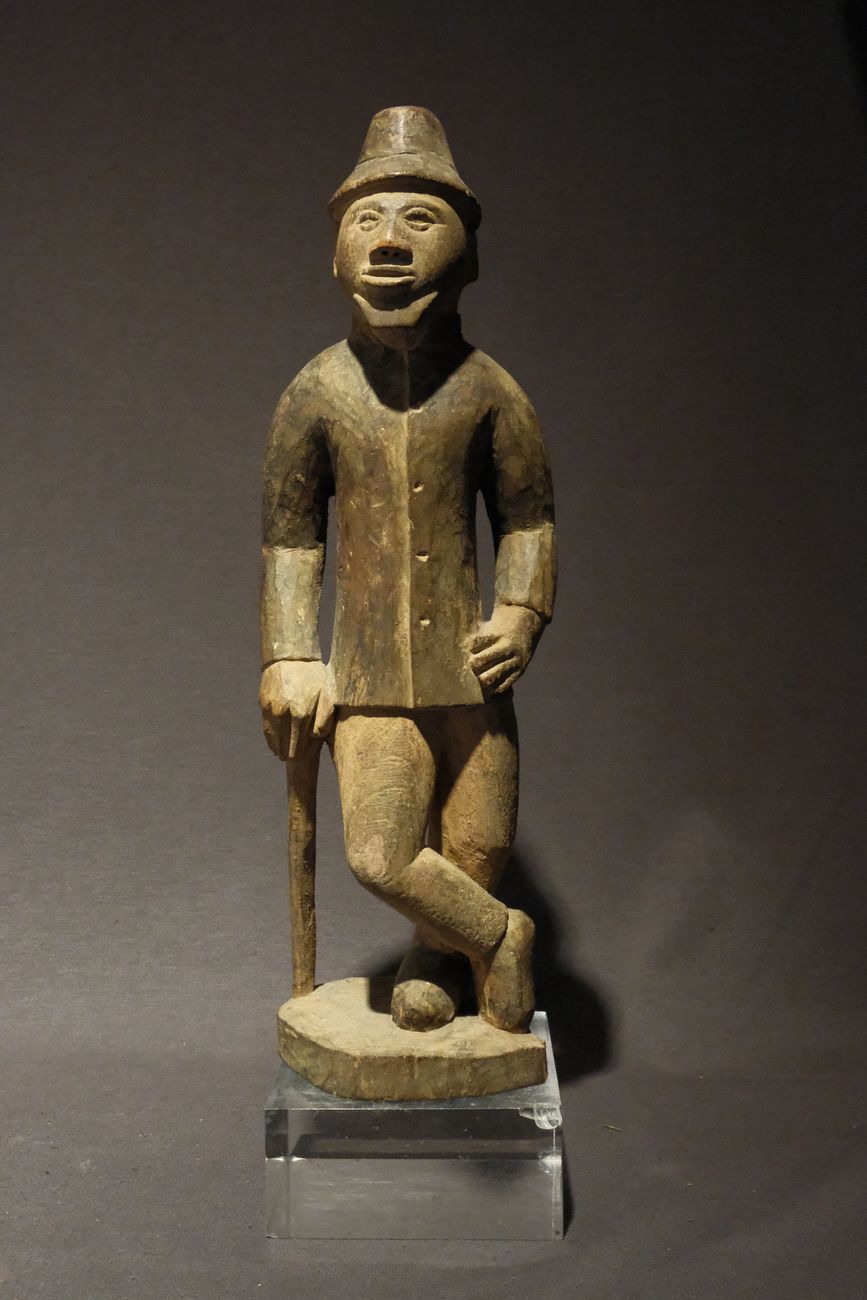
    Colon figure african art

    Bakongo Colon Figure – Congo

    What is interesting is that colon figures still occupy a somewhat uncertain position in the market today. Compared to more classical ritual sculpture from the same period, they often remain surprisingly affordable. Many collectors still hesitate on how to classify them:

    • ethnographic curiosity
    • colonial souvenir
    • transitional object
    • or serious sculptural work

    And perhaps this uncertainty explains why they remain intellectually undervalued within African art history.

    Yet these figures are historically important. They show African artists observing Europeans, reacting to colonial society, and adapting their visual language to a rapidly changing world. They are not outside African art history — they are part of it.

    The Colonial Gaze

    The inscription on the postcard is equally revealing:

    “Croquemitaines joue un grand rôle au pays des fétiches.”

    The term croque-mitaine refers to the bogeyman used to frighten children. The masks are therefore presented not as sophisticated cultural creations, but as exotic and frightening curiosities for a European audience.

    The postcard tells us not only about African art, but also about the colonial imagination looking at it.

    A collector friend formulated it very well during an online discussion:

    “This postcard is less an ethnographic record than a visual statement of early 20th-century colonial perception.”

    That observation is important. The word fétiche itself says more about European misunderstanding than about the cultures that produced these objects.

    What were once living objects — used in ritual, performance, initiation, healing, and social structure — became transformed into exotic curiosities for outsiders.

    And yet, despite this colonial framing, the objects still speak.

    Even through the limitations of the postcard, one can still sense:

    • the diversity of styles
    • the individuality of forms
    • the sculptural intelligence behind certain pieces
    • and the artistic strength that later attracted museums and collectors.

    “Made for the Market”

    When I posted this image online, reactions were surprisingly divided.

    Some collectors immediately dismissed the objects as “made for the market.” Others argued that these works should finally be recognized as a legitimate category of African art history in their own right.

    One comment struck me particularly:

    “These pieces can very well be antiques and art.”

    Exactly.

    The existence of a market context does not automatically destroy artistic value. Artists have always adapted to patrons, markets, and changing societies. This was true in Europe, in Asia, and equally in Africa.

    At the same time, it is also true that many objects visible in the postcard appear freshly carved and intended for trade. Both realities can exist simultaneously.

    That is precisely why the postcard is so interesting.

    It forces us to move beyond simplistic categories and confront the historical complexity of African art itself.

    Museums, Provenance, and the Eye

    Interestingly, several masks illustrated in museum publications and research on Loango and Kongo material show striking formal similarities to examples visible in the postcard, further complicating simplistic distinctions between “museum art” and “market production.”

    For readers interested in exploring this further, the following research publication from the AfricaMuseum (in French) is worth consulting:

    AfricaMuseum research publication by Julien Volper (French PDF)

    At the same time, age alone can never be enough to guarantee authenticity or quality.

    An old postcard, an old label, or an early publication may strengthen an object and change its perception and value — but they can never replace the eye.

    Museums and postcards do not only preserve history or certainty.
    Sometimes they preserve historical complexity.

    You cannot change the past — but you can change the way you look at it.

    Happy and curious,

    David Norden

    African Antiques From Antwerp — One Eye, 30 Years of Selection
    For collectors building a serious collection: buy fewer, but better.

    Share and Enjoy !

    Shares
  • How to Train Your Eye in African Art: 3 Practical Tips for Collectors

    How to Train Your Eye in African Art: 3 Practical Tips for Collectors

    Chibinda Ilunga figure, Chokwe, Angola — Museum RietbergThis article is based on a recent newsletter I sent to collectors. 


    Over the years, I’ve noticed that most collectors are not lacking interest — they are lacking orientation.

    Where do you look?
    What do you trust?
    And how do you train your eye?

    In this guide, I share three practical directions that I personally use — and that can quietly transform the way you see African art.


    1. Train Your Eye: Use Museum Collections

    Figure of the culture hero Chibinda Ilunga, Workshop of the Chokwe region, Angola, around 1850 Wood, Museum Rietberg, 2007.1, Gift acquired through Novartis 5 2007.1

    If there is one habit I would recommend to any collector, it is this: spend time with museum collections.

    Not only in person — but also online.

    Today, many major institutions offer access to thousands of documented objects. You can study proportions, surfaces, patina, and even small details that rarely appear in books.

    In the guide below, you’ll find direct and active links to museum databases, along with a selection of objects that I personally find particularly interesting.

    Over time, something shifts — you begin to recognise what feels right… and what doesn’t.

    → Explore museum collections

    Collector insight:
    The more time you spend with strong, documented objects, the more confident your decisions become when a good piece appears.


    2. Understand What You Are Really Looking At

    One of the most common mistakes I see is confusion between authentic objects and decorative pieces.

    The difference is not always obvious — especially at the beginning.

    But authentic objects tend to have a certain internal coherence:
    the proportions make sense, the wear follows use, the surface has depth, and the object carries a presence that is difficult to imitate.

    In the article below, I explain how I approach this distinction in practice:

    → Read the article on authenticity

    Collector insight:
    Once you have seen enough authentic pieces, decorative ones start to feel strangely empty — even when they look convincing at first glance.


    Ibibio chanel mask

    Ibibio “Chanel” mask — Nigeria

    A Piece That Caught My Eye

    While writing this, I was reminded of a mask I have kept in the collection for some time — an Ibibio “Chanel” mask.

    At first glance, it may seem unusual or even playful. But if you take a closer look, you begin to see the coherence in the carving, the balance in the proportions, and the way the surface has evolved through handling and use.

    It is also a good example of how African artists could absorb and reinterpret external influences, while remaining rooted in their own visual language.

    This is exactly the kind of object where experience matters — not because it is obvious, but because it reveals itself over time.

    → View the Ibibio mask


    3. Be Careful with Labels

    African art is often simplified — sometimes too much.

    Certain names are used so loosely that they can become misleading.

    Take the Kuba, for example.

    Behind this single label lies a complex network of workshops, styles, and neighbouring cultures. Not everything labelled “Kuba” is what you might expect — and understanding that can completely change how you evaluate an object.

    In the article, I also touch on the figure traditionally associated with the founding of the Kuba Kingdom, and why that history still matters when looking at objects today.

    If you want to look beyond the label and discover the story behind it:

    → Read the Kuba article

    Collector insight:
    Collectors who rely too much on names often miss good objects — or overpay for average ones.


    A Final Thought

    Collecting is not about owning many objects.

    It is about learning to recognise the right ones — and having the confidence to act when you see them.

    Even after 30 years, I still return to museum collections, compare objects, and refine my eye.

    If you would like to explore pieces selected through that same process:


    Happy and curious,
    David Norden

    African Antiques From Antwerp — One Eye, 30 Years of Selection
    Personally chosen with curiosity and experience — so you can collect with confidence.

    Share and Enjoy !

    Shares
  • The Yoruba Horseman: A Legend of the Rider

    The Yoruba Horseman: A Legend of the Rider

    A short tale inspired by the Yoruba tradition of the horse rider — a symbol of leadership, prestige and authority in West African art.

    Photo collage: Yoruba horseman in the Osun Sacred Grove, Arch of the Flying Tortoise.
    Landscape photograph by Adolphus Opara. Horseman sculpture photographed by David Norden.

    A long time ago, when the kingdoms of the Yoruba were young, the people said that a great rider sometimes appeared at the edge of the town.

    No one knew exactly where he came from.

    At dawn he would emerge from the red earth roads, seated proudly on his horse, holding a lance that caught the first light of the rising sun. Children would run to the paths to see him pass, while the elders watched in silence.

    Some said he was a warrior returning from distant lands. Others whispered that he was a messenger of the gods.

    In those days horses were rare in the forest regions of southern Nigeria. They came from the northern savannas and were precious animals, associated with kings, chiefs and powerful warriors. To ride a horse was to show authority and prestige.

    Over time the image of the mounted rider became one of the most powerful symbols in Yoruba art. Sculptors carved figures known as elesin—horsemen who embodied leadership, courage and the ability to command.

    The rider was often larger than the horse, because Yoruba artists did not aim for realism. Importance was expressed through proportion. The horse carried the rider, but the rider carried the meaning.

    Some of these figures were placed in shrines or royal spaces. Others commemorated great leaders or ancestors whose presence was believed to protect the community.

    Scholars have long noted the importance of this imagery in Yoruba culture. A beautiful example in ivory from the Dallas Museum of Art illustrates how deeply rooted the motif of the mounted rider is in the region:


    Dallas Museum of Art – Yoruba Horse and Rider

    Even earlier, archaeological discoveries such as a tenth-century bronze object from Igbo-Ukwu showing a horse and rider remind us that equestrian symbolism has deep historical roots in southern Nigeria. You can see this remarkable object, once exhibited in the Smithsonian exhibition Caravans of Gold, here:


    Igbo-Ukwu Horse and Rider – Caravans of Gold

    And perhaps that is why these sculptures still feel so alive today.

    They do not simply show a man on a horse.

    They show authority, presence, and the memory of a rider who once appeared on the road at dawn.

    Sometimes such Yoruba riders exist only in stories. And sometimes one quietly survives in wood.

    One such rider eventually found his way to my collection.

    Yoruba Horseman (Elesin), Ekiti Master Tradition

    Share and Enjoy !

    Shares