Category: African tale

  • The Bellows That Fed the Fire

    The Bellows That Fed the Fire

    When I first brought this old Kuba Lele blacksmith’s bellows into my Antwerp shop, it did not look like a sculpture waiting for a pedestal. It looked like something that had worked hard for a very long time. Dust still rested deep inside the chambers, the wood smelled faintly of smoke, and the black surface carried the soft sheen that only repeated human touch can create. I turned it over several times before placing it on a stand. The head was what stopped me. Those closed eyes did not seem carved for decoration; they seemed carved to remember.

    African Art Kuba Lele Blacksmiths Bellows

    In the Kasai region of the Democratic Republic of Congo, among the peoples linked to the Kuba kingdom and its related groups such as the Lele, blacksmiths occupied a place that was never entirely ordinary. They were the men who could persuade earth to become iron and iron to become useful. A hoe that opened the soil, a knife that cut meat, a spear that protected a village, a bracelet worn by a chief—all began with fire, breath, and metal. The forge was therefore not merely a workshop; it was a place of transformation.

    The Kuba kingdom developed one of the most sophisticated court cultures of Central Africa. Its rulers encouraged weaving, carving, music, ceremonial life, and the crafts that gave the kingdom both wealth and prestige. Among the remembered rulers stands Shamba Bolongongo, celebrated in Kuba tradition as a wise and peace-loving king associated with refinement, order, and the flourishing of the arts. The Lele, who lived within the broader Kuba cultural sphere, shared certain artistic ideas with their Kuba neighbors while preserving a more austere sculptural language of powerful silhouettes and restrained geometry.

    Old Central African traditions often speak of the world as something animated by hidden forces. Trees, rivers, animals, and ancestors could possess presence and intention. A blacksmith worked at the boundary between these visible and invisible worlds. He took ore from the ground, fed it to fire, and drew from it a new form. It is not difficult to understand why such work attracted stories.

    An elder from the Kasai might have told a tale like this.

    Long ago, in the time when the great Kuba kings were still remembered by name, a young hunter called Shamba wandered beyond the cultivated fields and entered the deep forest at dusk. He had grown up hearing stories of Shamba Bolongongo, the ruler who valued peace more than war and who protected the craftsmen whose work sustained the kingdom.

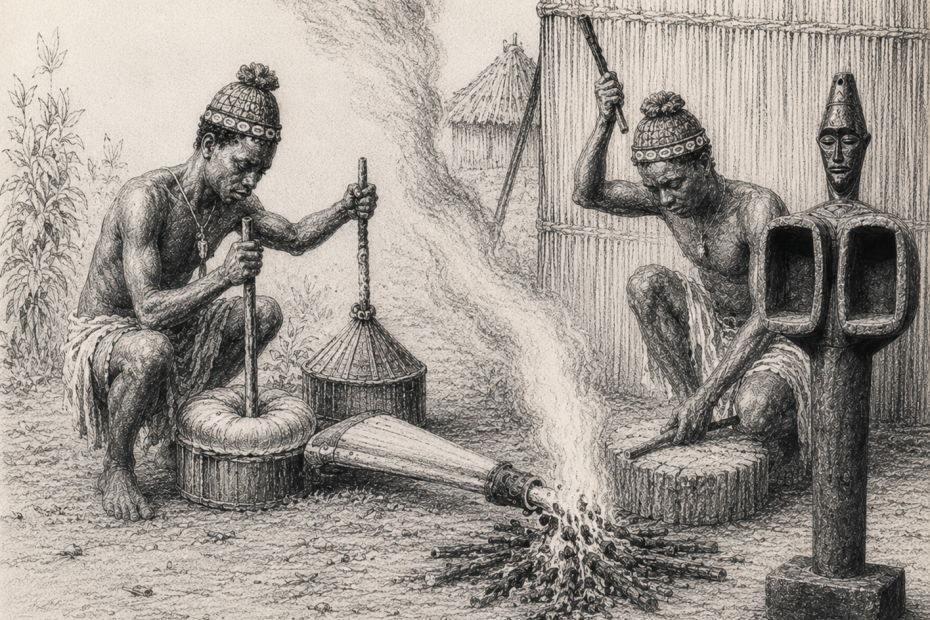
    As night fell, the hunter heard a strange sound—slow, rhythmic breathing, as if the forest itself were asleep. He followed the sound to a clearing where a fire glowed beneath a mound of clay. Beside it stood a tall figure with a face dark as charcoal and eyes half closed. The stranger worked a pair of wooden bellows. Each time he pressed them, the fire brightened; each time he released them, the flames sank back into shadow.

    Shamba asked, “Who keeps a fire alive in the middle of the forest?”

    The stranger replied, “I keep the breath that awakens iron.”

    He showed the hunter stones hidden along the riverbank and taught him how to build a furnace of clay. He taught him that fire grows weak when it is denied breath, and that breath must move in rhythm, like the heartbeat of a living being. Before dawn the stranger disappeared into the smoke, leaving the bellows beside the dying embers.

    Shamba returned to his village and shared what he had learned. Iron tools appeared where there had once been only stone and wood, and the people prospered. Yet he repeated one warning throughout his life: “Never mock the breath of the bellows. It is the breath that turns darkness into usefulness.”

    Whether such a tale was ever told exactly in this form matters less than the truth it carries. Across much of Central Africa, tools were not entirely separated from spirit, labor was not entirely separated from ritual, and breath itself was understood as a force that gives life. Looking at this bellows, I can easily imagine generations of hands pressing those chambers in steady rhythm while sparks rose into the night.

    Collectors sometimes ask me whether I prefer masks, figures, or utilitarian objects. I usually deal in masks and statues, and I confess that figurative sculpture remains what moves me most deeply. A powerful face, a charged posture, a figure shaped by ritual use—these are the objects that first drew me into African art more than thirty years ago. Bellows, stools, or other utilitarian pieces are less common in my collection and often much harder to find in convincing old condition.

    Perhaps that is why this bellows stayed with me. Although it was made to work rather than to be admired, it possesses an unmistakably figurative presence. The elongated head, the calm closed eyes, the pierced crest, and the broad twin chambers give it the authority of a standing figure. It stands today as sculpture, yet it was born as a tool, and that tension between usefulness and beauty is exactly what makes it memorable.

    FXE41968African Art Kuba Lele Blacksmiths Bellows

    This exceptional Kuba Lele blacksmith’s bellows, standing 85 cm high (92 cm including its display base), is now available in my collection.

    View the complete object, detailed photographs, condition report, and acquisition information in the African Art webshop.

    Kuba Lele Blacksmith’s Bellows – Democratic Republic of Congo

    Share and Enjoy !

    Shares
  • The Yoruba Horseman: A Legend of the Rider

    The Yoruba Horseman: A Legend of the Rider

    A short tale inspired by the Yoruba tradition of the horse rider — a symbol of leadership, prestige and authority in West African art.

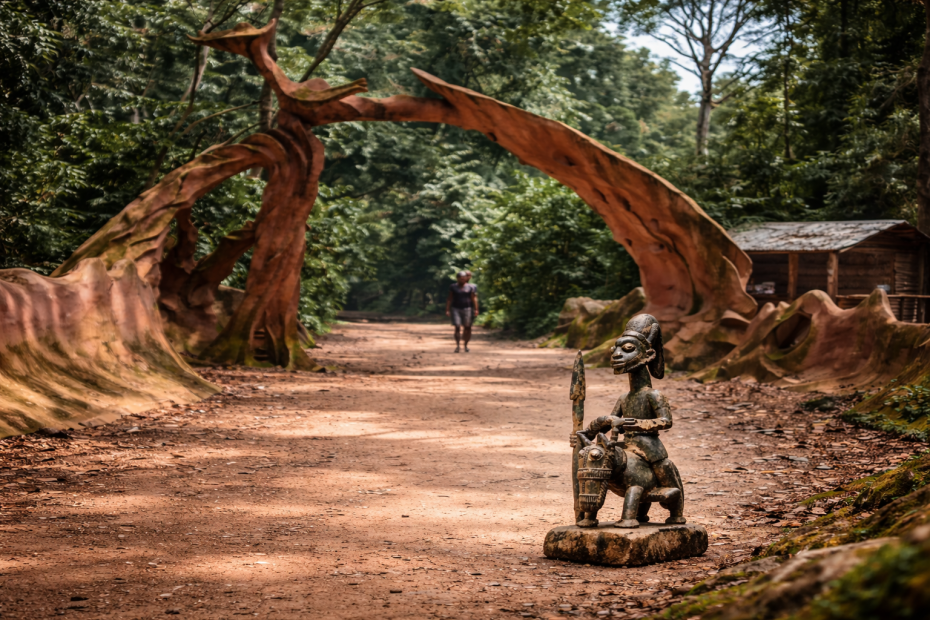
    Photo collage: Yoruba horseman in the Osun Sacred Grove, Arch of the Flying Tortoise.
    Landscape photograph by Adolphus Opara. Horseman sculpture photographed by David Norden.

    A long time ago, when the kingdoms of the Yoruba were young, the people said that a great rider sometimes appeared at the edge of the town.

    No one knew exactly where he came from.

    At dawn he would emerge from the red earth roads, seated proudly on his horse, holding a lance that caught the first light of the rising sun. Children would run to the paths to see him pass, while the elders watched in silence.

    Some said he was a warrior returning from distant lands. Others whispered that he was a messenger of the gods.

    In those days horses were rare in the forest regions of southern Nigeria. They came from the northern savannas and were precious animals, associated with kings, chiefs and powerful warriors. To ride a horse was to show authority and prestige.

    Over time the image of the mounted rider became one of the most powerful symbols in Yoruba art. Sculptors carved figures known as elesin—horsemen who embodied leadership, courage and the ability to command.

    The rider was often larger than the horse, because Yoruba artists did not aim for realism. Importance was expressed through proportion. The horse carried the rider, but the rider carried the meaning.

    Some of these figures were placed in shrines or royal spaces. Others commemorated great leaders or ancestors whose presence was believed to protect the community.

    Scholars have long noted the importance of this imagery in Yoruba culture. A beautiful example in ivory from the Dallas Museum of Art illustrates how deeply rooted the motif of the mounted rider is in the region:


    Dallas Museum of Art – Yoruba Horse and Rider

    Even earlier, archaeological discoveries such as a tenth-century bronze object from Igbo-Ukwu showing a horse and rider remind us that equestrian symbolism has deep historical roots in southern Nigeria. You can see this remarkable object, once exhibited in the Smithsonian exhibition Caravans of Gold, here:


    Igbo-Ukwu Horse and Rider – Caravans of Gold

    And perhaps that is why these sculptures still feel so alive today.

    They do not simply show a man on a horse.

    They show authority, presence, and the memory of a rider who once appeared on the road at dawn.

    Sometimes such Yoruba riders exist only in stories. And sometimes one quietly survives in wood.

    One such rider eventually found his way to my collection.

    Yoruba Horseman (Elesin), Ekiti Master Tradition

    Share and Enjoy !

    Shares