Month: June 2026

  • What Is a Fake in African Art?

    What Is a Fake in African Art?

    One of the questions I am most frequently asked is how one can distinguish an authentic African object from a fake. After more than thirty years spent handling traditional sculpture, I have come to believe that before speaking about fakes, one must first understand what authenticity itself means. Surprisingly often, the answer is less straightforward than many collectors imagine.

    In its strictest sense, an authentic object is one that was created according to tradition for the use of the society that produced it and that fulfilled the purpose for which it was intended. Yet reality is often more nuanced. Some objects were collected before they ever entered service and therefore never acquired the traces of use associated with ritual life. Others were made as replacements or were carved for neighbouring communities according to established conventions. Such pieces may lack the evidence of prolonged use that collectors often seek, but they nevertheless belong fully within the traditional world from which they emerged.

    History also reminds us that African art never developed in complete isolation. Artistic traditions have always absorbed influences and adapted to changing circumstances. Long before the colonial period, one finds exchanges with Europeans and with neighbouring peoples. The Sapi ivories, the Benin plaques, certain Kongo figures and even some Yombe maternity figures reveal that outside influences were not incompatible with authentic artistic expression. What mattered was not the source of inspiration, but whether the object retained its place within a living tradition.

    Objects made for trade are by no means a modern phenomenon. They existed centuries ago and became increasingly common during the first decades of the twentieth century. Some of these pieces, originally intended for sale rather than ritual use, have themselves become part of the history of collecting. The real problem begins when the object is conceived not as an expression of tradition or craftsmanship, but with the deliberate intention of deceiving.

    By the late twentieth century, entire workshops had appeared whose purpose was to satisfy the growing demand for old African art. Patinas were artificially aged, surfaces manipulated and signs of use carefully imitated. Some of these productions are crude and easily recognised. Others are considerably more sophisticated. In fact, some of the most deceptive objects are carved by talented hands and subsequently given an artificial history.

    Over the years, I have learned that no single criterion can determine authenticity. Scientific analyses can provide useful information and occasionally confirm or challenge assumptions, but neither carbon dating nor thermoluminescence can replace observation. In the end, the object itself remains the principal witness.

    Perhaps the greatest teacher is comparison. Looking at one object in isolation is rarely sufficient. By studying groups of related works, by comparing examples in museums, old collections and publications, one gradually develops an understanding of recurring forms and proportions. Traditional artists rarely signed their work, but each sculptor possessed his own way of treating volumes, eyes, mouths and surfaces. The hand of an accomplished artist leaves traces that are difficult to define and even more difficult to imitate.

    Patina is another aspect that reveals itself slowly. Collectors sometimes think of patina merely as a dark colour or an indication of age, whereas genuine surfaces are the result of decades of life. Smoke from village houses, repeated handling, sacrificial materials, pigments and countless gestures have all contributed to their formation. Certain old surfaces possess a depth and complexity that is difficult to describe. They seem less applied than absorbed by the object itself.

    Artificial patinas can occasionally be convincing, especially when they are applied to sculptures carved by talented artists. Nevertheless, they often reveal themselves through a certain uniformity or by an excess that appears intended to impress. The faussaire frequently exaggerates. Features become stronger, expressions more dramatic and surfaces heavier. By contrast, authentic objects are often quieter and more restrained. Their beauty does not always reveal itself immediately.

    The inside of a mask can sometimes be as instructive as the front. The attention of the copyist is naturally directed towards the visible appearance, whereas the interior frequently preserves evidence of use, construction and wear that receives less consideration. Some of the most revealing details are therefore hidden from immediate view.

    Provenance, too, should be approached with a certain nuance. A documented history is always desirable and an object known before the great wave of reproductions that appeared in the second half of the twentieth century inspires confidence. Yet provenance alone does not authenticate a sculpture. It places the object within time, but ultimately it remains the sculpture itself that must convince.

    From time to time I receive messages from people who believe they own a valuable collection of African art. The details vary, but the underlying story is often remarkably similar. The objects are presented as ancient, rare or exceptionally important. There may be certificates, written appraisals or stories involving museums, experts or interested buyers who, for one reason or another, never completed a purchase.

    What has always struck me is that the people making these enquiries are rarely collectors. More often they are individuals who were persuaded that they had discovered an opportunity. At some point, someone convinced them that a relatively modest investment could lead to a substantial financial return. The attraction is understandable. The dream of finding an overlooked treasure has fascinated people for centuries.

    Yet after more than thirty years in this field, I have found that the most interesting collections are seldom built in this way. Their owners were first attracted by the sculpture itself, by its craftsmanship, its history and its aesthetic qualities. They spent time looking, comparing and learning. Gradually they developed confidence and, more importantly, judgment. If their collections later acquired significant value, this was usually the consequence of years of thoughtful collecting rather than the original objective.

    This difference between the collector and the speculator is perhaps more important than it first appears. The speculator begins with the hope of discovering value and then searches for arguments that support that hope. The collector begins with curiosity. He studies, questions, compares and slowly develops an eye for quality. One approach is guided primarily by expectation, the other by observation.

    Sadly, many supposed treasures are the result not merely of misunderstanding but of organised scams. Fear of missing out and the hope of easy profit are powerful emotions, and unscrupulous individuals have long understood how to exploit them. In that respect, the world of African art is no different from many other areas of collecting.

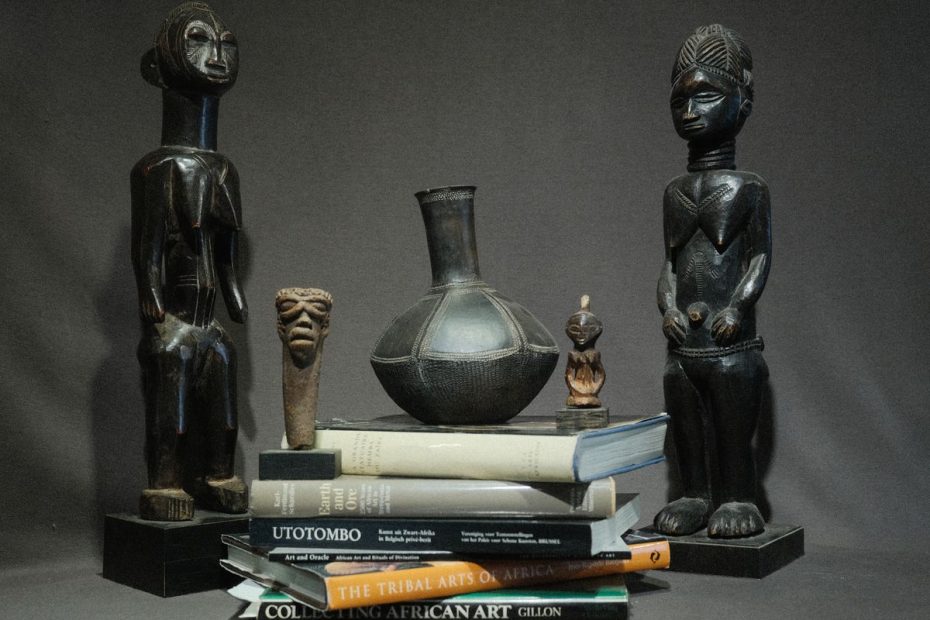
    There are, in my opinion, no real shortcuts in African art. Museums remain indispensable because they allow one to compare and to study. Books preserve the memory of old collections and old publications often contain information that has since disappeared. Conversations with fellow collectors, with dealers and with specialists are equally important. Much can also be learned by visiting fairs and exhibitions and simply by spending time with objects.

    Perhaps the most common mistake made by beginners is to buy too quickly. Enthusiasm is valuable, but patience is even more so. A collection is built over decades and not over months. The first dealer with whom one establishes a relationship often plays an important role, because a good dealer does more than sell objects. He helps to educate the eye, encourages curiosity and assists the collector in building a coherent collection rather than simply accumulating pieces.

    Looking back, I sometimes think that collecting African art is not really a race to acquire objects. It is a long process of learning to see. Even after thirty years, I still find that every object teaches something new, and perhaps that is one of the enduring pleasures of this field.

    Hidden treasures do occasionally exist, but the most rewarding collections are usually built slowly, guided by knowledge, patience and genuine curiosity. In the end, an educated eye is worth far more than the promise of easy profit.

    Share and Enjoy !

    Shares
  • Close Encounters with African Sculpture

    Close Encounters with African Sculpture

    Not long ago, a client entered my gallery and paused in front of a small group of figures from northeastern Nigeria. After looking at them for a while, he smiled and said:

    “They remind me of Japanese robots.”

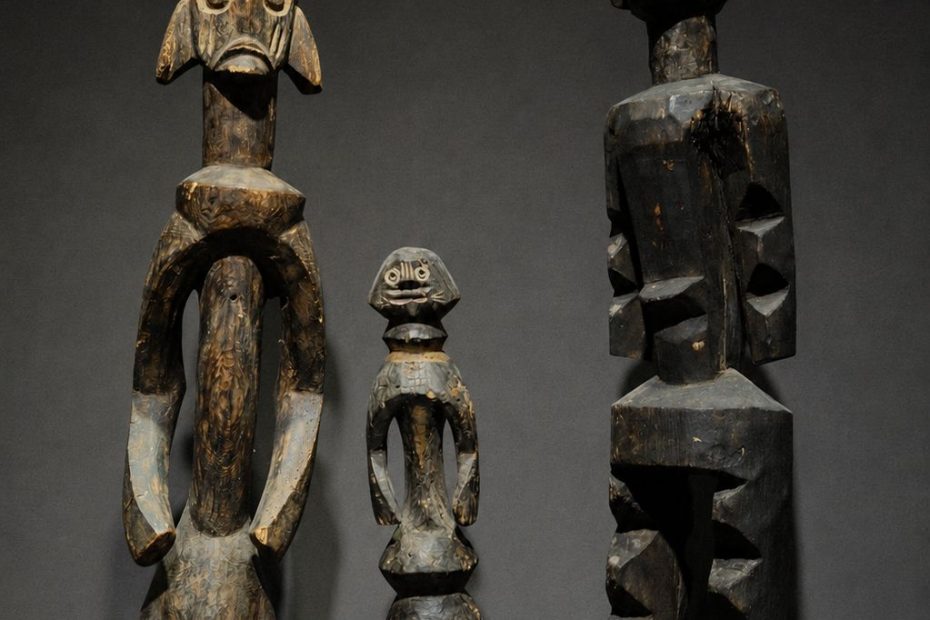
    It was not the first time I had heard such a remark. Over the years, visitors have compared certain Mumuye figures to robots, science-fiction characters, and occasionally even scenes from Star Wars. Looking at their elongated bodies, angular forms and almost articulated limbs, one understands why.

    Yet perhaps the opposite is closer to the truth.  Our robots and imaginary worlds sometimes look like African sculpture.

    African art is not merely an ethnographic curiosity. Its forms influenced twentieth-century modernism and continue to resonate in contemporary visual culture. The same qualities that fascinated Picasso and Modigliani — abstraction, geometry and expressive power — still speak to us today through cinema, science fiction and design.

    In 1984, a journalist writing for The New York Times suggested that one celebrated Mumuye figure may have inspired the helmeted head of Darth Vader. George Lucas himself later explained that the famous helmet was based on Japanese samurai armour, but the comparison remains interesting. Even if there was no direct influence, the visual similarities are striking.

    The Mumuye and Their Sculptures

    The Mumuye are an agricultural people living in the rocky hills south of the Benue River in northeastern Nigeria. Comprising several related groups sharing a common language and traditions, they remained relatively isolated until the middle of the twentieth century.

    Their sculptures were not created as decorative objects. Most were associated with medicine, divination and protection. They belonged to healers, diviners, rainmakers, blacksmiths and other influential individuals. Some were kept in sanctuaries known as tsafi, where initiation ceremonies also took place.

    Anthropologist Mette Bovin recorded that certain figures, known as janari — “figures that speak” — could be used to restore harmony, ward off epidemics, identify thieves and help maintain social order. A single sculpture might serve different purposes during its existence, making it difficult to assign one fixed function to a particular figure.

    One of the more intriguing interpretations concerns the angular arms and stepped zigzag legs found on many examples. According to Bovin, these forms may symbolize lightning and the swift action of spiritual forces. The sculptures were conceived as vigilant beings, ready to intervene on behalf of their owners. White kaolin circles around the eyes emphasized their ability to perceive what ordinary people could not.

    Why Collectors Continue to Appreciate Mumuye Sculpture

    When Western collectors first encountered Mumuye sculpture in the 1950s and 1960s, they were struck by its originality. Unlike many sculptural traditions with strongly codified forms, Mumuye artists explored an astonishing variety of proportions and compositions.

    Some figures are compact and powerful, others slender and elongated. Helmet-like coiffures alternate with openwork ears. No two figures are exactly alike. What collectors have long appreciated is this sense of freedom and individuality.

    More than half a century after their discovery by Western collectors, Mumuye figures remain among the most distinctive sculptural traditions of Africa. Their originality still feels fresh.

    An Experienced Eye

    When visitors tell me that a Mumuye figure reminds them of a robot, I always find the comparison interesting.

    Not because these sculptors were anticipating science fiction, but because our visual world has changed. During the twentieth century, artists, designers and filmmakers became increasingly comfortable with abstraction and simplified forms. The qualities that attracted Picasso and Modigliani to African sculpture are now familiar to all of us.

    Perhaps that explains why a visitor entering an antique shop in Antwerp in 2026 can look at a sculpture made in northeastern Nigeria generations ago and think of Japanese robots or Star Wars.

    For me, such reactions are another reminder that African sculpture deserves to be approached not only as ethnographic material, but also as art.

    Mumuye

    Three Close Encounters

    The three figures illustrated below have been living together in my gallery for some time. Seen side by side, their personalities become immediately apparent.

    The figure on the left, with its large circular eyes and elongated body, possesses a quiet elegance and simplicity. The smaller central figure has a more playful character, while the larger figure on the right — probably Montol rather than Mumuye — has a more architectural quality, with powerful geometric volumes and deeply carved forms.

    Looking closely at their faces, one begins to understand why visitors occasionally think of robots or science-fiction characters. Yet these works were created by artists from northeastern Nigeria generations before the age of cinema.

    FXE41605Mumuye

    Mumuye figure, Nigeria
    Height: 45 cm
    Price: €1,450

    Mumuye 34cm

    Mumuye figure, Nigeria
    Height: 34 cm
    Price: €950

    Mumuye 54cm

    Montol figure, Nigeria (?)
    Height: 54 cm
    Price: €1,950

    Happy and curious,

    David Norden

    African Antiques From Antwerp — One Eye, 30 Years of Selection

    For collectors building a serious collection: buy fewer, but better.

    Share and Enjoy !

    Shares