Tag: central african art

  • The Bellows That Fed the Fire

    The Bellows That Fed the Fire

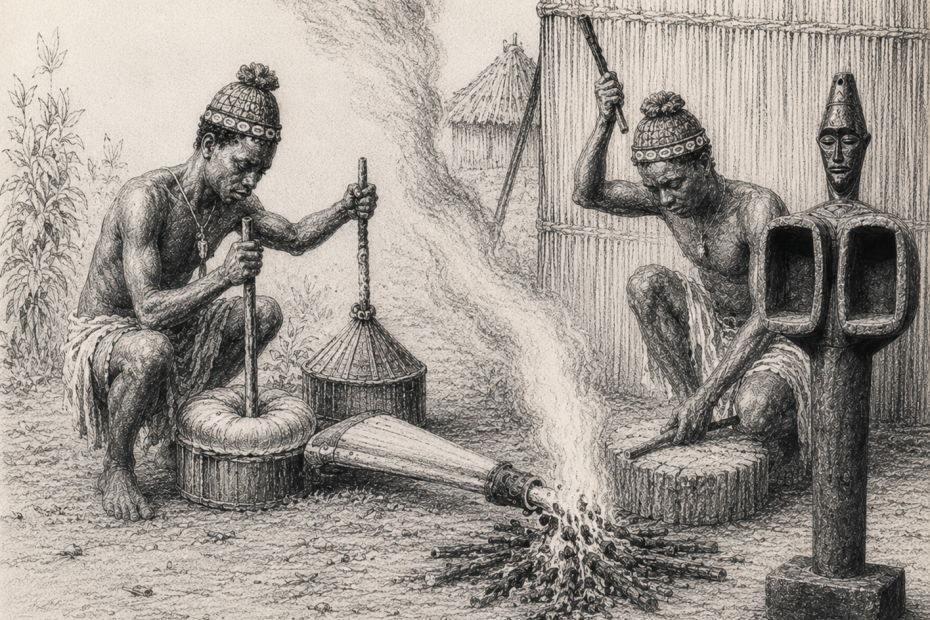
    When I first brought this old Kuba Lele blacksmith’s bellows into my Antwerp shop, it did not look like a sculpture waiting for a pedestal. It looked like something that had worked hard for a very long time. Dust still rested deep inside the chambers, the wood smelled faintly of smoke, and the black surface carried the soft sheen that only repeated human touch can create. I turned it over several times before placing it on a stand. The head was what stopped me. Those closed eyes did not seem carved for decoration; they seemed carved to remember.

    African Art Kuba Lele Blacksmiths Bellows

    In the Kasai region of the Democratic Republic of Congo, among the peoples linked to the Kuba kingdom and its related groups such as the Lele, blacksmiths occupied a place that was never entirely ordinary. They were the men who could persuade earth to become iron and iron to become useful. A hoe that opened the soil, a knife that cut meat, a spear that protected a village, a bracelet worn by a chief—all began with fire, breath, and metal. The forge was therefore not merely a workshop; it was a place of transformation.

    The Kuba kingdom developed one of the most sophisticated court cultures of Central Africa. Its rulers encouraged weaving, carving, music, ceremonial life, and the crafts that gave the kingdom both wealth and prestige. Among the remembered rulers stands Shamba Bolongongo, celebrated in Kuba tradition as a wise and peace-loving king associated with refinement, order, and the flourishing of the arts. The Lele, who lived within the broader Kuba cultural sphere, shared certain artistic ideas with their Kuba neighbors while preserving a more austere sculptural language of powerful silhouettes and restrained geometry.

    Old Central African traditions often speak of the world as something animated by hidden forces. Trees, rivers, animals, and ancestors could possess presence and intention. A blacksmith worked at the boundary between these visible and invisible worlds. He took ore from the ground, fed it to fire, and drew from it a new form. It is not difficult to understand why such work attracted stories.

    An elder from the Kasai might have told a tale like this.

    Long ago, in the time when the great Kuba kings were still remembered by name, a young hunter called Shamba wandered beyond the cultivated fields and entered the deep forest at dusk. He had grown up hearing stories of Shamba Bolongongo, the ruler who valued peace more than war and who protected the craftsmen whose work sustained the kingdom.

    As night fell, the hunter heard a strange sound—slow, rhythmic breathing, as if the forest itself were asleep. He followed the sound to a clearing where a fire glowed beneath a mound of clay. Beside it stood a tall figure with a face dark as charcoal and eyes half closed. The stranger worked a pair of wooden bellows. Each time he pressed them, the fire brightened; each time he released them, the flames sank back into shadow.

    Shamba asked, “Who keeps a fire alive in the middle of the forest?”

    The stranger replied, “I keep the breath that awakens iron.”

    He showed the hunter stones hidden along the riverbank and taught him how to build a furnace of clay. He taught him that fire grows weak when it is denied breath, and that breath must move in rhythm, like the heartbeat of a living being. Before dawn the stranger disappeared into the smoke, leaving the bellows beside the dying embers.

    Shamba returned to his village and shared what he had learned. Iron tools appeared where there had once been only stone and wood, and the people prospered. Yet he repeated one warning throughout his life: “Never mock the breath of the bellows. It is the breath that turns darkness into usefulness.”

    Whether such a tale was ever told exactly in this form matters less than the truth it carries. Across much of Central Africa, tools were not entirely separated from spirit, labor was not entirely separated from ritual, and breath itself was understood as a force that gives life. Looking at this bellows, I can easily imagine generations of hands pressing those chambers in steady rhythm while sparks rose into the night.

    Collectors sometimes ask me whether I prefer masks, figures, or utilitarian objects. I usually deal in masks and statues, and I confess that figurative sculpture remains what moves me most deeply. A powerful face, a charged posture, a figure shaped by ritual use—these are the objects that first drew me into African art more than thirty years ago. Bellows, stools, or other utilitarian pieces are less common in my collection and often much harder to find in convincing old condition.

    Perhaps that is why this bellows stayed with me. Although it was made to work rather than to be admired, it possesses an unmistakably figurative presence. The elongated head, the calm closed eyes, the pierced crest, and the broad twin chambers give it the authority of a standing figure. It stands today as sculpture, yet it was born as a tool, and that tension between usefulness and beauty is exactly what makes it memorable.

    FXE41968African Art Kuba Lele Blacksmiths Bellows

    This exceptional Kuba Lele blacksmith’s bellows, standing 85 cm high (92 cm including its display base), is now available in my collection.

    View the complete object, detailed photographs, condition report, and acquisition information in the African Art webshop.

    Kuba Lele Blacksmith’s Bellows – Democratic Republic of Congo

    Share and Enjoy !

    Shares
  • Navigating the World of Authentic African Masks: Lessons From 30 Years in the Field

    Navigating the World of Authentic African Masks: Lessons From 30 Years in the Field

    Photo: A fine Suku Mask fom David Norden’s collection.

    Over the past weeks, several collectors have told me how difficult it is to navigate the world of African masks online.
    Too many choices, too many claims of “authenticity,” and far too many pieces that were never used in ritual at all.

    I understand the frustration.
    When I began 30 years ago, I made my share of mistakes too. Today, I’ve handled thousands of traditional masks, and I’ve seen the entire spectrum—from sacred instruments of ceremony to tourist replicas built to deceive.

    That experience is exactly why I wrote my latest article: to help you feel confident, informed, and inspired when you add a mask to your collection.

    What New and Experienced Collectors Should Know

    In simple terms, here are a few key points I cover:

    ✔️ Why authentic masks are meaningful

    Real masks were not created for decoration. They were made to serve the community—whether to honor ancestors, guide initiates, invoke protection, or embody spirits. This gives them a presence that modern copies simply cannot reproduce.

    ✔️ Which types are most heavily reproduced today

    Masks from popular ethnic groups—Baule, Dan, Songye, and Fang—are often copied because of demand. The reproductions might look pleasing at first glance, but they lack the subtle traits of long use: wear from handling, smoke absorption, repairs, ritual additions, and layers of history.

    ✔️ Regions that offer safer pathways for new collectors

    Certain areas of Central and West Africa still retain strong traditions and offer well-documented masks on the market. Understanding regional practices can help you recognize which pieces are more likely to be genuine.

    ✔️ What true age, patina, and use really look like

    Authentic masks show earned surface details—not artificially rubbed, sanded, or chemically aged textures. A true layered patina tells a story of sweat, dust, ritual substances, smoke, and human hands. It doesn’t feel “designed”; it feels lived.

    ✔️ Why provenance matters more than people think

    Provenance is not a luxury—it is protection. Knowing who collected the mask, when, where, and under what circumstances is essential. As a dealer, I expect the same proof I would demand if I were the buyer myself. And remember, provenances can also be faked, so use your sellers wisely.

    If you haven’t seen real masks in museums or international vetted fairs, I think you’ll enjoy my African Art Shop. Descriptions are clear, honest, and based on decades of working with real traditional pieces, not workshop replicas.


    The Personal Side: Why I Continue Searching

    Many people believe African masks are mainly decorative.
    But once you hold an authentic one—one that has danced, protected, instructed, or comforted its community—you feel the difference immediately.

    These are not just objects.
    They carry memory, presence, and dignity.

    This is the reason I continue to search for them, study them, and bring them to collectors who honor their origins. Finding a mask that has served its community is a privilege. Preserving it is a responsibility.


    Explore Authentic Masks

    If you’re thinking about adding a mask to your collection—or if you simply want to see what authentic examples look like—feel free to explore the selection on my webshop.

    👉 Browse authentic African masks and more: BuyAfricanAntiques.com/shop

    Every mask I offer is carefully chosen, described in detail, and accompanied by the provenance I would expect myself as a collector.

    If you ever have questions—need a second opinion, want guidance, or simply want to discuss a piece—reach out.
    I’m always happy to help.

    Warm regards,
    David Norden
    30 years of dealing in authentic African art
    Antwerp — BuyAfricanAntiques.com

    Share and Enjoy !

    Shares