
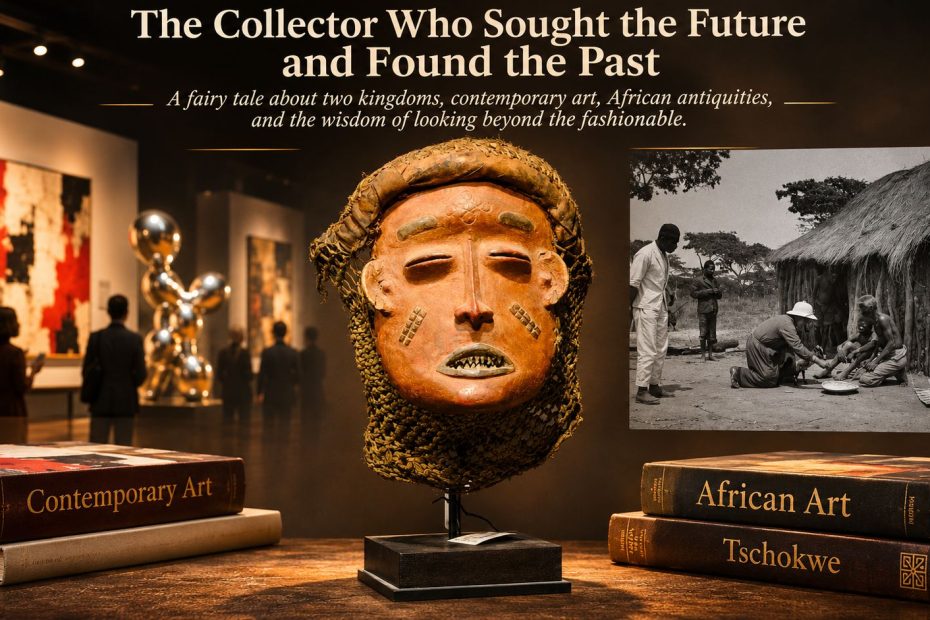
A fairy tale about two kingdoms, contemporary art, African antiquities, and the wisdom of looking beyond the fashionable.
Once upon a time, in a kingdom not so far from our own, there lived a wealthy collector who dreamed of building a great art collection.
He had heard that the finest treasures were to be found in the kingdom of Contemporary Art, where young artists were celebrated by powerful galleries, praised by influential critics, and displayed at glittering fairs. The collector was told that if he bought the right paintings today, their value might multiply tenfold tomorrow. Some artists, he was assured, would become the great masters of the next century.
So he travelled to the kingdom and began to buy.
He acquired paintings with unusual colours, sculptures made from unexpected materials, and installations that required lengthy explanations. Each purchase came with a story about the artist’s vision, the importance of the work, and the extraordinary future that awaited it. The collector was pleased. His collection grew, and his friends admired his courage to spend tens of thousands of euros.
Yet, one evening, as he wandered through his private gallery, he wondered:
Will anyone remember these artists in fifty years? – Nobody could answer.
One day, he found an old magazine featuring artists who had been praised thirty years earlier. He discovered that most of them had been forgotten. Perhaps ten percent had become celebrated. Many others had disappeared into the mist of forgotten exhibitions, their names surviving only in old catalogues. Auction houses were no longer interested in selling their works because they were considered passé. The collector was disappointed. He was no longer sure that he had invested his money wisely. He began to lose faith in the uncertain prophecies of the art market, even though he still enjoyed the works he had selected.
Then, one autumn morning, an old traveller arrived at his door, hoping to visit his collection.
They began discussing their shared passion for art and collecting over a glass of wine.
“I would like to show you something,” said the traveller. He carried a wooden Tschokwe mask, its reddish colour slightly darkened by time, with a face of remarkable dignity. Its half-closed almond-shaped eyes, delicately modelled nose, sharpened teeth and serene expression seemed to possess a quiet authority.
The collector examined the mask.
Its forehead and cheeks were adorned with fine scarification patterns. Its original woven fibre hood and padded coiffure had survived the passage of time. The reddish-brown patina accentuated the refined modelling of the face. Although modest in size, the mask possessed a remarkable sculptural presence.
“Where did you find this?” asked the collector.
“It comes from a Belgian private collection,” replied the traveller. “The reverse of the mask and its display stand retain their original Sotheby’s inventory labels.”
“Who was the artist?” asked the collector.
“We may never know,” said the traveller. “The Tschokwe carvers worked within traditions passed down through generations. This mask represents Mwana Pwo, the idealized beauty of a woman and the revered spirit of a female ancestor. It was worn by initiated male dancers during ceremonies celebrating fertility, social harmony and the continuity of the community.”
“And who was the first owner?”
“That remains a mystery. We know more about its recent history than its earliest beginnings.”
The collector looked puzzled. “But then how can I know its value?”
The traveller smiled. “Look at it. Study its form. Consider the hands that shaped it, the generations that preserved it, and the culture that gave it meaning. Look at the skill of the carver, who understood the traditions of his people and created this work with knowledge and care. Then ask yourself whether it needs the name of a famous artist to deserve your admiration.
“And if you want to understand its market value, study the results of comparable auctions. Exceptional masks can achieve tens of thousands of euros. But remember: price and artistic quality are not always the same thing.”
The collector decided to travel to Angola, hoping to discover the world from which the mask had come and perhaps some treasure in the villages.
He imagined finding villages unchanged by time, where ancient traditions continued exactly as they had centuries before, and where precious masks and statues were still kept as they had been in the past. But the world he encountered was more complicated.
He met people whose lives were shaped by modern realities, by economic hardship and the long consequences of colonial rule. In Luanda, he saw a striking contrast between the expensive lifestyles of wealthy residents and expatriates, supported by the oil economy, and the difficult circumstances of much of the population.
He also discovered that the people he met were not merely guardians of a vanished past. They were living communities with their own hopes, struggles and futures.
Travelling through eastern and northeastern Angola, regions renowned for their woodcarving traditions, he encountered communities where Mwana Pwo traditions continued to live. Yet the masks he saw were often different from the refined examples that had fascinated him in European collections. The traditions had survived, but they had also evolved, shaped by new materials, changing circumstances and Western influences.
The collector returned home with no great treasure in his luggage, but with something more valuable than he had expected: a deeper understanding of the distance between romantic imagination and historical reality.
He realised that the treasures he sought were not simply waiting to be rediscovered in the villages of Africa. Many had travelled far from their places of origin, carried by traders, collectors and colonial histories. They could be found in the galleries of Antwerp, Brussels and Paris, and at respected art fairs where collectors gathered to study and acquire them.
They could also be found in the great museums of the world: the Musée du quai Branly in Paris, the Metropolitan Museum of Art in New York, the British Museum in London, and the Royal Museum for Central Africa in Tervuren.
There, he encountered African sculptures that had survived centuries, works whose artistic power had outlasted the names of their makers and the circumstances of their creation.
And he began to understand something. In the kingdom of Contemporary Art, he had often been asked to believe in the future value of an artist.
In the kingdom of African Antiquities, he could encounter the enduring artistic achievements of generations past.
This did not mean that every old mask was a masterpiece, nor that every contemporary artist would be forgotten. There were treasures in both kingdoms, and disappointments in both. Some African works spoke to one another across cultures and centuries. Others possessed such distinctive forms that they seemed to belong to a world entirely their own.
The collector had learned to ask a different question.
Instead of asking, “What might this be worth in ten years?” he began asking, “What makes this object worth preserving for another hundred years?”
He became more patient. He bought fewer objects, but studied them more carefully. He learned that age alone was not quality, that provenance mattered, and that a convincing patina could not replace genuine artistic merit. And when he finally found an exceptional African figure, he did not feel that he had merely purchased an investment. He enjoyed it every day. He gradually forgot what he had paid for it, but never forgot its quality. He carefully documented its provenance, its history, and the stories of its use and meaning.
He felt that he had become the temporary guardian of something that had already survived the rise and fall of kingdoms, the changing tastes of collectors, and the passing of generations.
The collector grew old and some of the contemporary artists he had once admired became famous. Many others were forgotten. The market rose and fell, as markets always do. But the African figure remained in his collection, its presence as compelling as the day he first saw it.
And when his grandchildren gathered around it, he told them:
“Do not collect merely what the world tells you will become valuable. Learn to recognize what is already valuable. The future may change its mind about an artist, but a work of genuine artistic power has already earned its place in history. “And if you collect African art, preserve its documentation, its provenance, and whatever you can learn about its past stories, use and meaning. These are part of the treasure, too.”
And so the collector’s greatest treasure was not the fortune he had made or lost.
It was the eye he had learned to trust.
The moral of the story: The wisest collector does not try to predict which artists the future will remember or what tribe will be in fashion. He learns to recognize the works that have already stood the test of time and make a coherent collection.
African Antiques From Antwerp — One Eye, 30 Years of Selection
For collectors building a serious collection: buy fewer, but better.
A mask from the story
The antique Tschokwe Mwana Pwo mask that inspired this tale is available in my collection.
Discover the Tschokwe Mwana Pwo mask with Sotheby’s provenance
Antique Chokwe (Tshokwe) Mwana Pwo Mask from Angola – Sotheby’s Provenance