Unmasking the Kifwebe
There are objects that one first encounters as forms, and only later understands as systems.
The Songye Kifwebe mask belongs to this category.
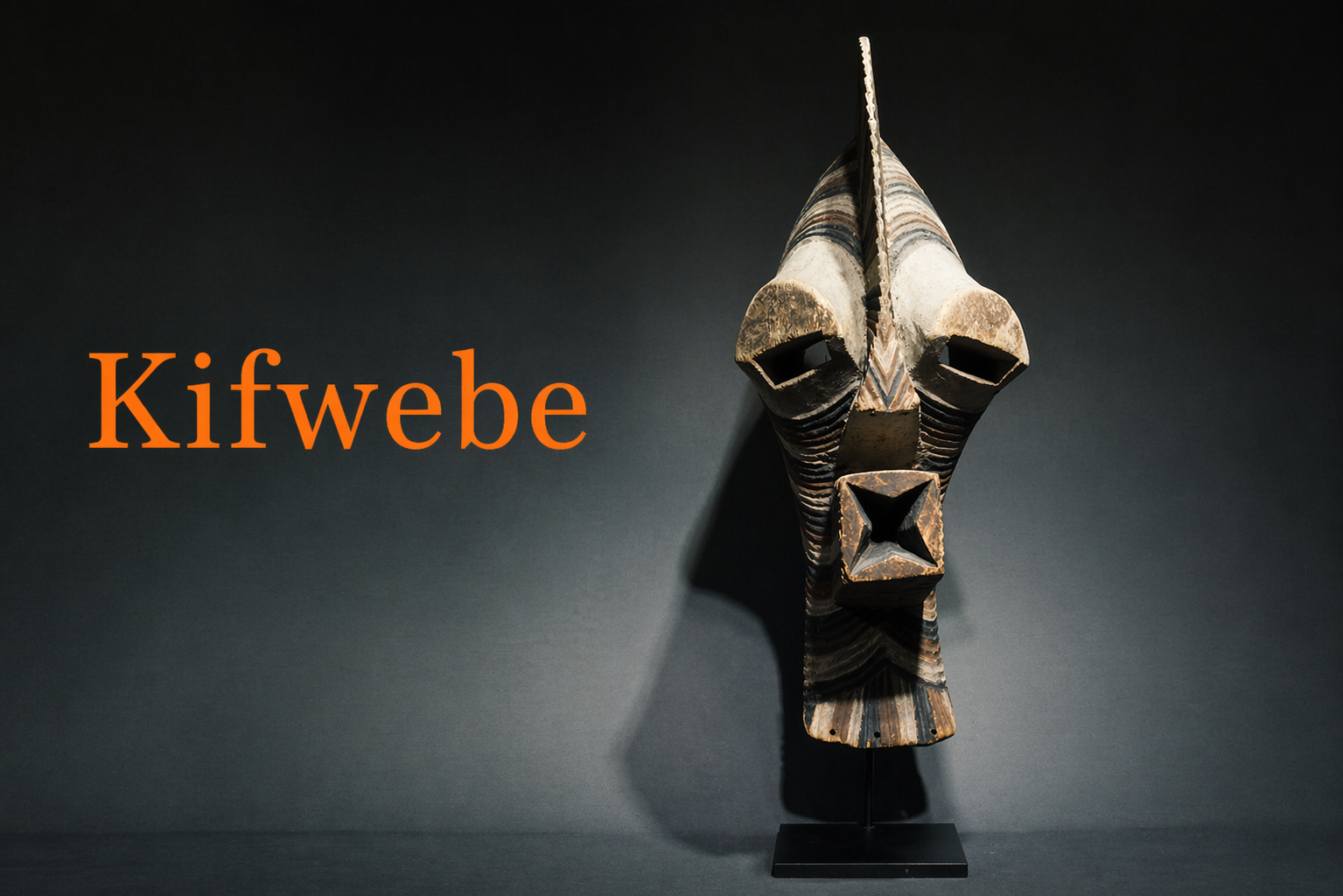
At first glance, it is defined by its structure: a face reduced to essential volumes, covered with rhythmic striations, interrupted by projecting eyes and a mouth that breaks the plane. The geometry is direct, almost abrupt. It is easy to understand why such forms would later resonate with Cubism.
But this clarity is not aesthetic invention. It comes from function.
An Object of Authority
Kifwebe masks were created within the Bwadi Bwa Kifwebe society, a powerful institution among the Songye. These were not decorative objects, but instruments used to regulate social order, enforce authority, and accompany important rituals.
They appeared in moments of tension: initiation, illness, funerals, or the presence of power. Their role was active, not symbolic.
Early observers already noted the dual nature of these masks—at once controlled and unsettling. A balance between order and distortion, beauty and force.
Structure Before Style
What defines a Kifwebe mask is not its decoration, but its construction.
The surface is organized through incised striations, often enhanced with pigments—white, red, or black. These are not ornamental. They structure the face, guiding the eye, creating rhythm and tension across the volume.
The central crest indicates a male mask, associated with authority. White masks, often considered female, form the basis from which other variations developed.
Over time, the style evolved:
- earlier examples show more restrained, curvilinear forms
- later masks become more geometric, more exaggerated
- by the mid-20th century, some forms reach a near abstract intensity
This evolution is not linear, but it shows a constant exploration of structure.
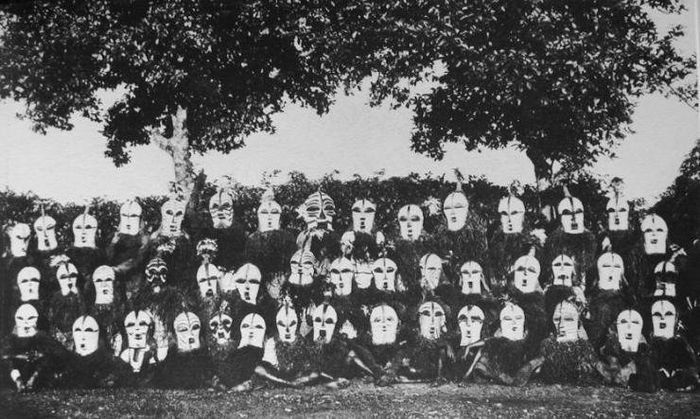
Kifwebe Songye bifwebe masquerade photographed in the Congo in 1934
Early Encounters
The first documented Kifwebe masks entered Western collections at the end of the 19th century.
Explorers, colonial officers, and early ethnographers collected them—often without fully understanding their meaning. The German ethnologist Leo Frobenius, during his expedition of 1905–1906, gathered several examples and recorded fragments of their context.
What emerges from these early accounts is a sense of distance:
- the masks were difficult to obtain
- their meaning was only partially revealed
- and their use remained, in many ways, deliberately obscured
Even at that time, they were already considered powerful objects.
From Ritual to Collection
Today, these masks exist in a different context.
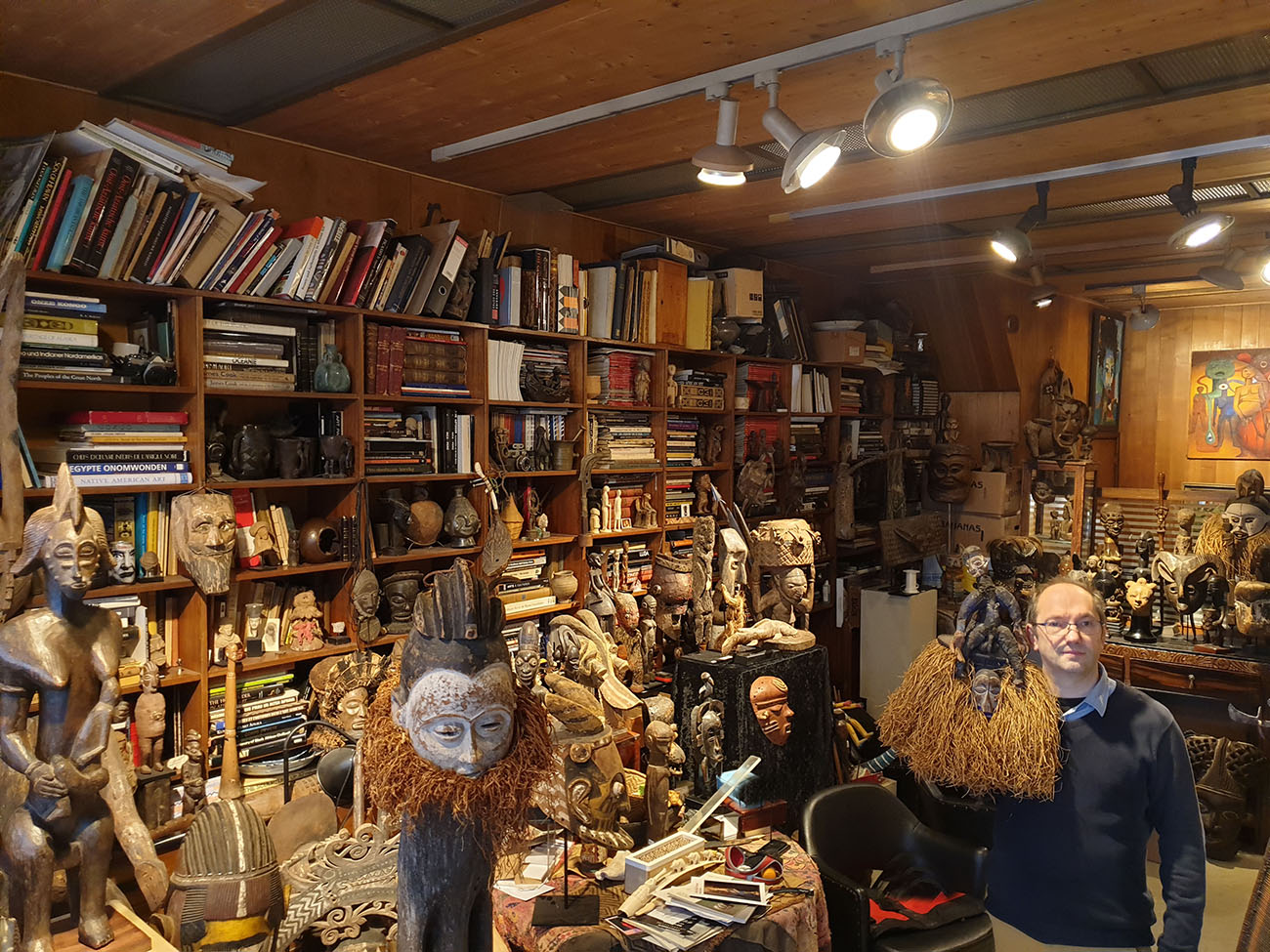
Removed from their original function, they have entered collections—private and institutional. Their role has shifted. No longer active within a social system, they are now observed, studied, and lived with.
And yet, something remains.
The structure still holds. The tension is still present. The object does not collapse into decoration.
This is perhaps why Kifwebe masks have had such a lasting impact. Not only within African art, but also in the way Western artists began to rethink the human face—breaking it down into planes, volumes, and essential forms.
Experienced Eye
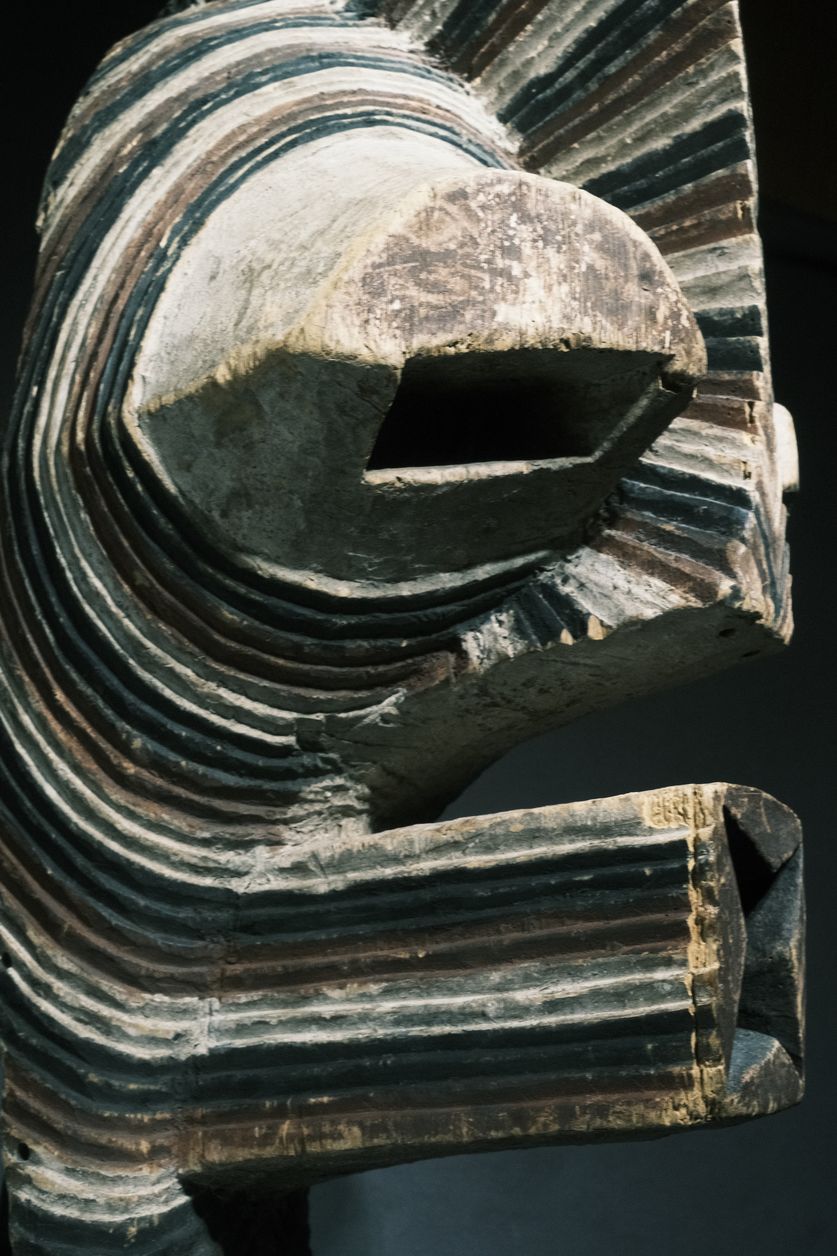
When looking at a Kifwebe mask, it is useful to step away from the idea of “mask” as an object, and to see it instead as a construction of forces.
The lines are not drawn—they are carved to control movement.
The volumes are not shaped—they are positioned to assert presence.
This is what gives certain examples their strength.
And this is also why, once placed within a collection, some of these masks do not simply sit among others—they tend to organise the space around them.
From Kifwebe to Verstockt — a shared language of structure
Not long after acquiring this mask, I discovered an additional layer to its history.
On the reverse, a label identified it as having been part of the collection of Mark Verstockt (1930–2014), the Antwerp-based artist whose work focused on geometry, repetition, and structure.
What interested me was not only the provenance, but the connection.
Verstockt’s work often reduces form to its essential elements—lines, rhythm, and controlled variation. Looking again at the mask, one begins to see a similar logic at play. The striations are not decorative; they organize the surface. The face is not modeled, but constructed.
Two very different worlds, yet a shared way of thinking through form.
I had, in fact, worked with Verstockt years ago, as a photographer, on the book Het teken Mens, centered on Chinese calligraphy. At the time, the connection to African sculpture was not something I considered.
Only later, with this mask in front of me, the parallel became clear.
Closing
The Kifwebe mask is often approached through its striking appearance.
But its true interest lies elsewhere.
Not in what it represents,
but in how it is built.
You can view the Songye Kifwebe mask here →