Month: September 2025

  • The Akuaba Trio- Ashanti Fertility Dolls from Nadya Levi Collection
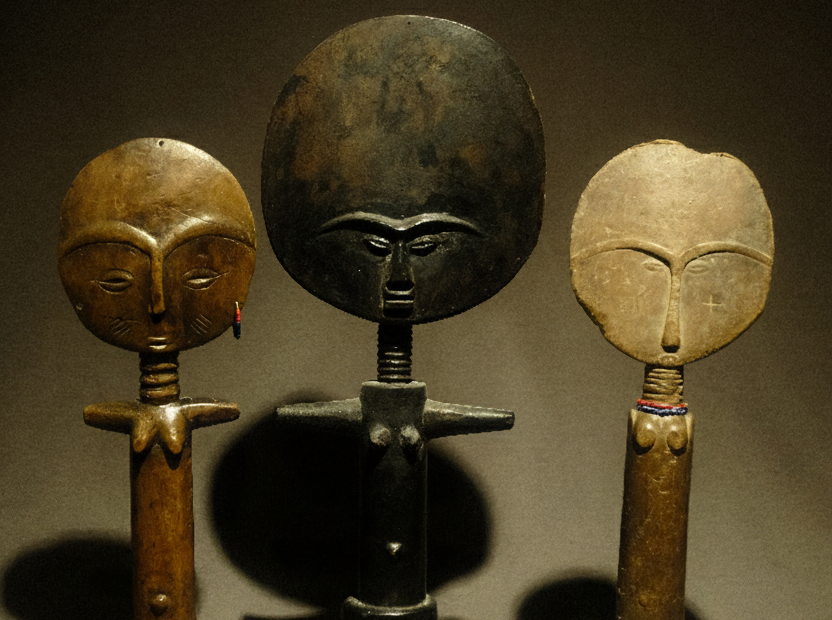
    The Akuaba Trio- Ashanti Fertility Dolls from Nadya Levi Collection
    These three Ashanti Akuaba fertility dolls all come from the respected collection of Nadya Levi. Each one speaks with a different voice — scale, patina, and condition combine to tell a layered story about ritual use, collecting, and family legacy.

    The Legend of Akua

    According to Akan tradition, a woman named Akua was unable to conceive. A priest advised her to have a small wooden figure carved and to care for it as she would a child: carrying it on her back, adorning it, and treating it with devotion. The townspeople mocked her, calling the figure “Akua’s child” (Akua’ba). Soon thereafter she conceived and gave birth to a healthy daughter. The practice spread: women adopted the ritual in hope of fertility, and the carved figures came to be known as Akuaba.

    The form — a flat disc-shaped head, ringed neck, and simplified body — expresses ideals of beauty, health, and prosperity, and is one of the most recognisable typologies in Akan art.

    Form, Meaning & Use

    • Head: The broad, flattened head both accentuates an Akan ideal of beauty and allows the doll to rest comfortably against a woman’s back.
    • Neck rings: Carved rings suggest rolls of fat, a symbol of health and prosperity.
    • Surface & patina: Handling and ritual use produce warm, tactile surfaces — a direct record of devotion.
    • Fate after use: Many figures were returned to shrines as offerings; others became heirlooms and memorials within families.

    The Nadya Levi Akuaba Trio

    African Art collection-Akuaba

    Available individually or together as a mini-collection.

    37 cm — Monumental Akuaba

    Deep black patina. The commanding centerpiece of the group.

    30 cm — Classic Akuaba

    Smooth patina; closely related to museum examples.

    29 cm — Honey-patina Akuaba

    Warm honey patina; arms worn away — a rare and thought-provoking variant.

    Each doll may be purchased individually. For collectors who wish to acquire the full trio, we offer a special arrangement — please contact us to discuss options (private discount, combined shipping, or a surprise extra object included with your purchase).

    Provenance & Notes

    All three dolls originate from the collection of Nadya Levi. Photographs and condition reports are available on each product page. Serious collectors may request additional images or condition details by emailing david.norden@telenet.be.

    © BuyAfricanAntiques — David Norden. All items supplied with written description. Shipping in-house from Antwerp, Belgium. Please note: shipping to the USA is currently expensive due to tariffs.


    Share and Enjoy !

    Shares
  • A Personal Reflection on My Mother’s African Art Collection .

    A Personal Reflection on My Mother’s African Art Collection .

    When I look at the African art my mother, Nadya Levi, gathered over her lifetime, I don’t just see an African Art collection—I see her. Each piece carries a trace of her eye as a sculptor, her curiosity as a traveler, and her passion as a collector. Growing up in her world meant living in the constant presence of forms, textures, and stories that stretched far beyond our own home.

    The Akuaba figures in particular remind me of the balance she saw between simplicity and power. With their large disc-shaped heads and understated bodies, they embody ideals of beauty, fertility, and protection. To me, they also reflect how my mother viewed art: not as decoration, but as living symbols infused with meaning. She would often stop to explain not just what an object was, but why it mattered—who made it, for what purpose, and how its spirit continued to resonate.

    Her own work as a sculptor shaped the way she engaged with these objects. She understood the weight of wood in the hand, the patience required to carve a curve, the silent dialogue between artist and material. In her eyes, the African artists whose works she collected were not anonymous craftspeople but fellow creators, voices speaking across continents and centuries.

    As her son, I now recognize how deeply this shaped me. My brothers and I inherited not just her love of art, but a way of seeing. To be raised among these pieces was to learn early that objects carry memory, that cultures converse with one another, and that collecting is not about possession but about stewardship. The pieces she chose have become part of our family story, threads linking her life to ours.

    When I stand before her collection today, I feel her presence most strongly. I remember the excitement in her voice when she brought home a new find, the way her hands gestured as she explained its origin, and the quiet reverence with which she placed it among the others. These objects are more than art—they are a testament to her journey, her vision, and her enduring gift to us.

    Her collection continues to live, not only in the pieces themselves but in the way they shaped who we are. Each time I look at the Akuaba dolls, I am reminded that legacy is not only something you inherit—it is something you carry forward. Available in Antwerp. More images on private request.

    African Art collection-Akuaba

    L: Akuaba Fertility Doll – Asante, Ghan  | Big doll: Big ancient Ashanti doll  | Akuaba Fertility Doll – Asante, Ghana (29 cm, honey patina)

    About the provenance:

    Nadya Levi , sculptor and And African Art collector


    Share and Enjoy !

    Shares
  • From Lampshade to Pride: A Baule Spirit Spouse Restored

    From Lampshade to Pride: A Baule Spirit Spouse Restored

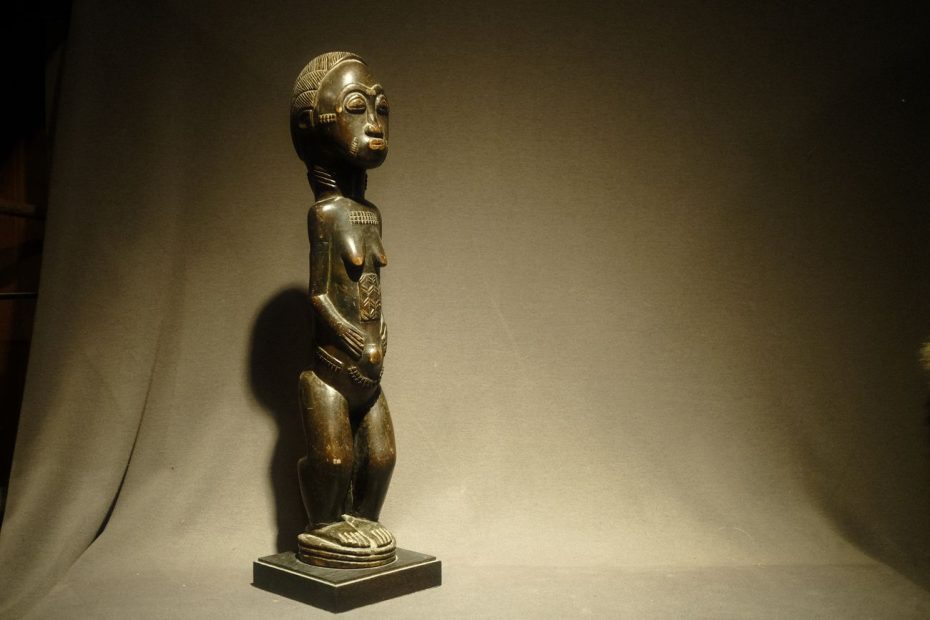
    When I first encountered this 54 cm Baule female spirit spouse at a French auction, she wasn’t standing proudly—she had been transformed into a lampshade. For years, her sacred role had been overlooked, her presence reduced to decoration.

    The Baule believe every person is married not only to an earthly partner but also to a spouse in the spirit world. Figures like this one were created to honor that bond, bringing peace, prosperity, and protection. They stood in the bedroom, where once a week the owner slept alone, joining his spirit wife in dreams. These figures even helped real couples stay together, offering a way to ease tensions and restore harmony.

    I took it upon myself to restore her, giving back the dignity she was meant to carry. Today she stands again as a true Baule spirit spouse—a symbol of beauty, serenity, and balance between the seen and unseen worlds.

    Sometimes, in rescuing an object, you feel as though you are also restoring a piece of its soul.


    More in the shop

    Big Female Baule spouse figure

    Share and Enjoy !

    Shares
  • Picasso’s mask, Modigliani’s freak doll, and the Chanel ghost

    Picasso’s mask, Modigliani’s freak doll, and the Chanel ghost

    A story by David Norden. Any resemblance to actual persons, living or dead, is purely coincidental.

    The night dripped neon and sweat at Club Incognito.
    Pavel sat in the corner booth with the two Russians — Mikhail and Vadim — both in black suits that looked expensive but smelled like they’d been worn three days too long. The table was a battlefield of half-empty vodka bottles, smeared lines of cocaine, and lipstick-stained glasses.

    The music throbbed, bass rattling the ribs. A dancer with a porcelain mask on — eerily blank, like a mannequin’s face — slid by, her movements hypnotic. Pavel noticed her eyes: empty, but watching. Always watching.

    Vadim, slurring:
    “We were supposed to meet… what’s his name, the antiques man… Norden. Buy the three pieces, eh?”

    Mikhail laughed, blowing a cloud of smoke.
    “Picasso’s mask, Modigliani’s freak doll, and the Chanel ghost. I remember. But… look at us now.” He gestured at the powdered table. “Priorities.”

    Pavel’s eyes twitched. Something felt wrong — not just the missed appointment, not just the woman who would now take the objects instead. It was the way the Russians spoke about the masks. Not like collectors, not like art lovers. Like… code.

    The dancer in the mask leaned close to Pavel, whispered in his ear without moving her lips:
    “The lady already has them. You’re too late.”

    Pavel froze. He hadn’t told anyone about the lady.

    Mikhail slammed a glass to the floor.
    “Tomorrow we fix everything. Tomorrow we take them.”

    The word take hung in the air, heavier than the music, heavier than the drugs.

    And just then, the lights flickered. For a moment, the club dissolved into silence, and in the dark Pavel thought he saw the three objects — the Goli Glin Baule mask, the Bozo figure, the Ibibio mask — glowing faintly on the stage, like they were alive, like they were watching him back.

    The lights snapped on.
    The masks were gone. Only the dancer, still moving.

    Pavel rubbed his eyes. Mikhail and Vadim laughed, unaware.

    But Pavel knew: something bigger was moving in Antwerp tonight.

    INT. HOTEL ROOM – EARLY MORNING

    Mikhail and Vadim lie passed out in a tangle of sheets and clothes. The curtains glow with sickly yellow light, like the sun is poisoned. Empty bottles rattle when the tram outside screeches by.

    Pavel is not in the room. But something else is.

    On the dresser sits the Ibibio mask with the Chanel logo. Impossible, since they never bought it. Its glossy surface catches the light, the interlocking C’s pulsing faintly, like a heartbeat.

    Vadim stirs, his eyes bloodshot. He sees it.
    “Misha… Misha, look.”

    Mikhail sits up groggy, rubs his face. Then freezes.
    The mask is no longer on the dresser.
    It’s on his face.

    He claws at it, but his hands pass through. The mask doesn’t weigh him down — it possesses him. His voice distorts, echoing unnaturally:
    “The woman will own you. Unless you own her first.”

    Vadim recoils. His nose bleeds. He blinks, and now all three objects are in the room:

    • The Baule mask hangs on the wall, its long face watching like a silent judge.

    • The Bozo figure slouches in a chair, its head tilted unnaturally, as if listening.

    • The Ibibio mask speaks through Mikhail, its Chanel logo flashing like neon.

    “Art is not art,” the distorted voice continues. “It is power. The same power that made kings, that made revolutions, that made fortunes vanish.”

    Vadim falls to his knees, coked-out panic turning to religious awe.
    “We should have gone yesterday…”

    The masks shimmer, their outlines vibrating, almost alive. The Baule mask whispers now, a woman’s voice, low and seductive:
    “She already knows what you desire. She will pay in flesh what you cannot in rubles.”

    Mikhail jerks violently, collapsing back onto the bed. The mask slips away — vanishes. The room is normal again. Empty bottles. Cigarette smoke. Sunlight.

    Vadim crawls to the dresser. Nothing there. But in the mirror above it, for just a second, all three objects stand behind him, silent, waiting.

    INT. DAVID’S SHOP – LATE MORNING

    Sunlight filters through the old Antwerp windows, catching the dust motes that float in the air. African masks and figures stand silently in rows, their shadows long and watchful.

    David (you) is arranging a display when the bell above the door almost rings — but doesn’t. A gust of cold air moves through the shop, though the door never opened.

    You pause, uneasy.

    Then the phone rings.

    On the other end, a woman’s voice. Calm, precise, with an accent you can’t place:
    “Your Russian buyers… they will not come. They saw too much. The objects already chose their path.”

    You grip the receiver tighter.
    “Who is this?”

    A silence. Then the faintest echo of laughter. Feminine. Familiar. It reminds you of the mysterious lady who had taken the option.

    The line clicks.

    You glance around your shop. Something feels… different. The Baule mask you set aside yesterday — its expression has changed. Subtle, but undeniable. The lips curve, as if smirking.

    A shadow crosses your window. You look — no one there.

    Then, in the quiet, you hear footsteps upstairs. Slow. Deliberate. But you live alone.


    Share and Enjoy !

    Shares
  • Senufo Guardian with a Flying Legend’s Legacy

    Senufo Guardian with a Flying Legend’s Legacy

    Standing 44 cm tall, this Senufo male figure embodies the spiritual guardianship and ancestral presence central to Senufo tradition. Such figures often stood watch in shrines, believed to mediate between the living and the ancestors.

    senufo figure

    But this particular piece carries an extra layer of history. It once belonged to Margaret Füsbahn, one of the first women to fly to Africa in the 1930s. A pioneer of the skies, she journeyed where few dared, and in her travels she formed a collection of objects that spoke to her sense of discovery. Read a French article : cette-pionnière-suisse-de-l-aviation-a-voyagé-tout-autour-du-monde

    or one in German : Pionierin der Lüfte Mit Schnaps im Gepäck bis nach Kamerun

    Margaret Fusbahn

    When you hold this Senufo figure in your hands, you don’t just feel the artistry of the Senufo carver — you also touch the adventurous spirit of a woman who helped open the world.

    Fxe47636 senufo figure

    More images and details:

    Senufo Standing Male Figure – Ex. Margaret Fusbahn Collection

    Share and Enjoy !

    Shares